Kumar Bahukhandi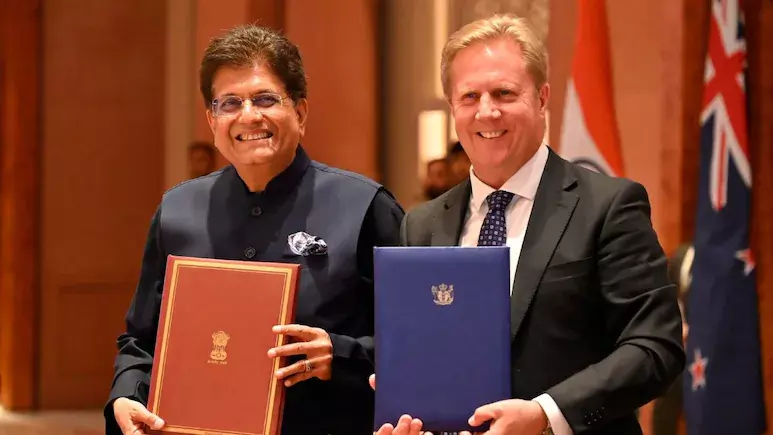
India’s Commerce and Industry Minister Piyush Goyal and New Zealand Trade and Investment Minister Todd McClay display documents following the signing of the India-New Zealand Free Trade Agreement. The pact is now moving towards implementation after clearing New Zealand’s parliamentary process. (File Photo)
Pact moves closer to implementation after clearing New Zealand Parliament; Indian exports set to get zero-duty access from day one
Key Highlights
- India-New Zealand FTA expected to come into force within the next month.
- Both countries working on the exchange of official notes required for implementation.
- Indian goods covered by the agreement to receive zero-duty access to New Zealand from day one.
- New Zealand Parliament’s official record shows the relevant vote as 93 in favour and 29 against.
- Agreement was signed in New Delhi on April 27, 2026.
- FTA expected to open greater opportunities for Indian exporters across several sectors.
- Remaining formalities will determine the agreement’s final date of entry into force.
The India-New Zealand Free Trade Agreement is expected to come into force within the next month, New Zealand Trade and Investment Minister Todd McClay has said, as the two countries move towards completing the remaining formalities for implementing the trade pact.
McClay said the two sides were working on the exchange of official notes required before the agreement can take effect. Once operational, the FTA will give Indian goods zero-tariff access to the New Zealand market from the first day. New Zealand’s implementing legislation specifically provides for Indian goods covered by the agreement to move to a zero tariff rate when the pact enters into force.
“We’re very close now,” McClay said in an interview, adding that the formal exchange with India would start the process leading to the agreement’s entry into force. He indicated that this could happen within the next month.
Parliament Clears Implementing Legislation
The legislative process in New Zealand has now cleared a crucial hurdle. Parliamentary records show that during consideration of the India Free Trade Agreement legislation, the second reading was supported by 93 votes to 29. The legislation subsequently progressed through its remaining stages.
There is an important correction to the material supplied for this story: McClay is reported as saying “93 votes to 26”, but the official New Zealand parliamentary record shows 93–29 for the second-reading vote. Later reporting on the final parliamentary approval also records the vote as 93–29. For publication, I would use the official 93–29 figure rather than repeat 93–26 as fact.
The agreement was signed in New Delhi on April 27, 2026. New Zealand’s implementing legislation makes changes across tariff, customs, investment and export-quota arrangements needed to give effect to the FTA.
Zero-Duty Access for Indian Goods
For India, one of the agreement’s major provisions is tariff-free access to New Zealand. Once the FTA enters into force, Indian goods covered by the agreement will move to a concessionary tariff rate of zero. During the parliamentary debate, McClay himself clarified that the concessionary rate applicable to Indian goods would be zero upon entry into force.
The pact is expected to benefit Indian exports across sectors including textiles and apparel, leather and footwear, engineering goods, processed foods and pharmaceuticals. Earlier reporting on the agreement said more than 8,200 tariff lines would be covered by the duty-free access.
With New Zealand’s parliamentary process substantially completed, attention now turns to the remaining domestic and diplomatic formalities on both sides and the mutually agreed date on which the agreement will formally enter into force.
Photo Caption: India and New Zealand representatives display documents linked to the bilateral trade agreement. The India-New Zealand FTA is moving towards implementation after the required legislation cleared New Zealand’s Parliament. Photo: Supplied
Editorial note: I would remove the sentence “Royal assent was granted on September 17” for the moment. I could verify the parliamentary proceedings and the 93–29 vote from New Zealand’s official records, but I have not found an official source in the material retrieved that independently confirms the September 17 Royal Assent date. Better not to publish that detail until we have the official record.