Kumar Bahukhandi
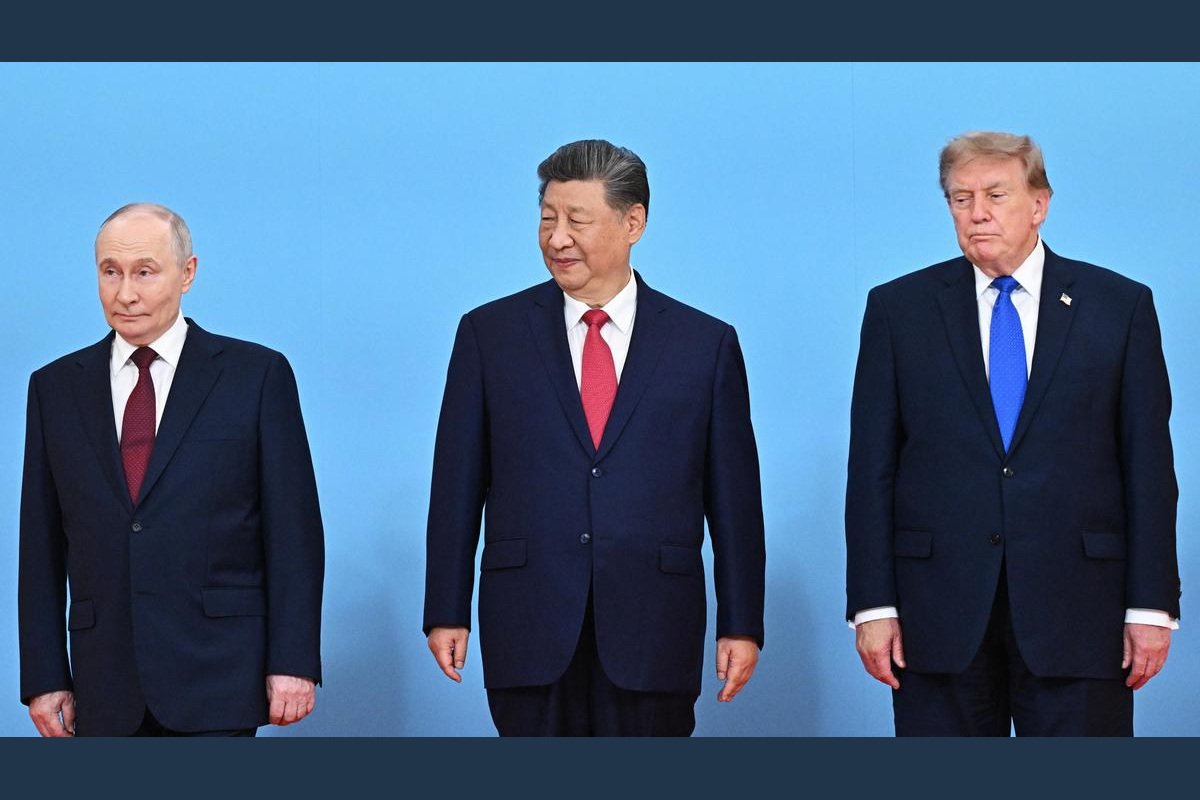
Russian President Vladimir Putin (left), Chinese President Xi Jinping (centre) and US President Donald Trump (right) arrive for their trilateral summit at Kylin Villa in Shenzhen, Guangdong province, China, on Thursday, 19 November 2026. Photo: AP.
The first trilateral summit between the leaders of the United States, China and Russia produced a declaration on strategic stability, energy supplies and UN reform. No breakthrough was announced on Ukraine or Iran.
Key Highlights
- Donald Trump, Xi Jinping and Vladimir Putin met at Kylin Villa in Shenzhen on the sidelines of the Asia-Pacific Economic Cooperation summit.
- The three leaders committed to talks on reducing nuclear risks and preventing the spread of nuclear weapons.
- Their declaration called for UN reform and greater supplies of refined petroleum products, and stressed respect for the immunities of state officials.
- The declaration contained no roadmap for ending the war in Ukraine or resolving the crisis over Iran.
Shenzhen: US President Donald Trump, Chinese President Xi Jinping and Russian President Vladimir Putin held their first trilateral summit on Thursday, 19 November 2026, pledging to maintain strategic stability and open talks on nuclear risks. The leaders met for about 70 minutes behind closed doors at Kylin Villa. Their declaration set out areas for further co-operation, while the talks ended without an announced breakthrough on the war in Ukraine or the crisis over Iran.
“We are really making history,” Trump said before the talks. He argued that the three countries were in a position to discuss reducing the number of nuclear weapons and lowering the risk of their use. He had called for a new arms agreement that would include China after New START, the last nuclear arms treaty between Washington and Moscow, expired in February. The Shenzhen declaration commits the three countries to dialogue on risk reduction and non-proliferation. It gives no date for talks and specifies no limits on arsenals.
Xi set out Beijing’s view of how the three powers should manage their differences. He urged them to “respect one another’s sovereignty and territorial integrity” and cautioned them against challenging each other’s “red lines”. He also called for regular senior-level contact and crisis communication channels to keep misunderstandings from escalating.
Putin said the three countries shared responsibility for upholding the UN Charter and maintaining international peace. He called for dialogue based on sovereign equality and said Russia was prepared to work with the US and China on energy and food security, trade and the governance of artificial intelligence. After the meeting, he described the three-way format as “useful and substantive”.
What the Shenzhen declaration says
The four-point declaration brought together commitments on nuclear risks, energy, the United Nations and the jurisdiction of international courts. As permanent members of the UN Security Council, the three countries said they supported reforms that would make the UN more effective in responding to global challenges. They left the scope of those reforms open, with no proposals on changes to the Security Council’s membership or powers.
On energy, the countries said they planned to increase production and supplies of refined petroleum products and underlined the importance of keeping energy flows stable. Trump separately highlighted the shared interest in keeping oil moving through the Strait of Hormuz, a major route for Middle Eastern oil shipments disrupted by the war involving Iran. The declaration set out no steps for reopening the strait or resolving the wider conflict.
The declaration also stressed the importance of state consent and the immunities of state officials. It called on the International Criminal Court and comparable bodies to avoid what the three governments described as abuse of jurisdiction. On nuclear weapons, the leaders reaffirmed that a nuclear war could never be won and must never be fought, and agreed to continue dialogue on reducing the risks.
China’s account of the meeting said the leaders exchanged views on Ukraine, the Middle East and the Korean Peninsula. Those discussions yielded no announced ceasefire, settlement framework or timetable for further negotiations on Ukraine or Iran. The public declaration did not mention either war by name.
Thursday’s summit followed a series of separate meetings in Shenzhen. Xi met Putin on Wednesday, when he described ties with Russia as contributing to global stability. Trump met Putin and Xi separately before the three-way session on Thursday. Kremlin aide Yuri Ushakov said Ukraine figured prominently in the Trump–Putin discussion, which lasted about 40 minutes.
The immediate result from Shenzhen is a commitment to keep talking about nuclear risks. With no timetable for those talks and no announced plan on Ukraine or Iran, the first test of the summit will be whether the three governments set a date and an agenda for follow-up.