Kumar Bahukhandi
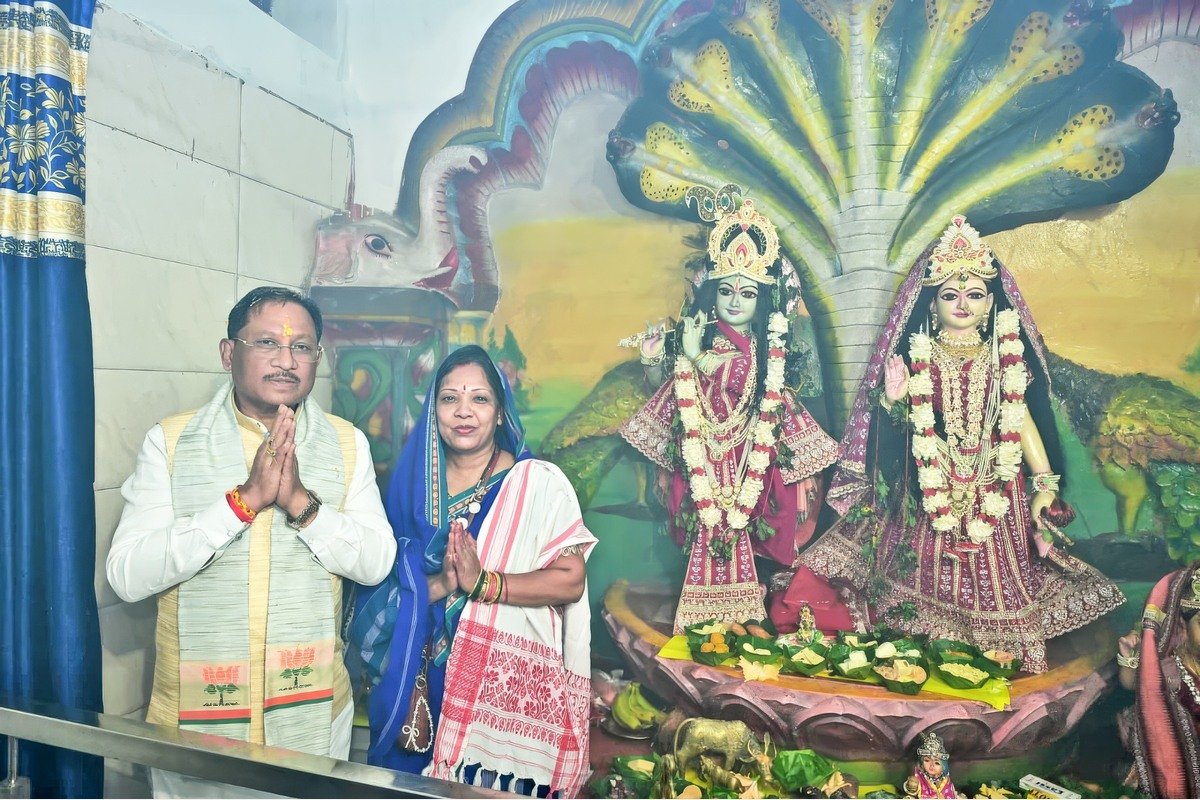
Chief Minister Vishnu Deo Sai and his wife Kaushalya Sai offer prayers with folded hands before the idols of Radha and Krishna at Kanwar Dham in Pamshala, Jashpur district, on 22 November 2026. Photo: cannel24india.com via CG/PR.
Chief Minister Vishnu Deo Sai and his wife Kaushalya Sai join devotees in prayer and play the manjira at Kanwar Dham on the banks of the Ib River. Sai announces financial assistance for all 62 local kirtan groups to buy instruments, costumes and other supplies.
Key Highlights
- Vishnu Deo Sai and Kaushalya Sai, national president of the Kanwar community, offer prayers for the peace and well-being of the people of Chhattisgarh.
- The Chief Minister announces financial assistance for 62 kirtan groups to help them sustain their devotional music traditions.
- The Kartik bhajan and kirtan programme, which began on 27 October, concludes on 24 November. Sessions are held daily at 8 a.m. and 5 p.m.
- Sai remembers Sant Gahira Guru Maharaj’s work for tribal communities and describes the start of medical education in Jashpur as a milestone for the district.
Jashpur: At the Shri Radha-Krishna Temple in Pamshala on Sunday, the sound of the manjira joined the voices of devotees singing on the banks of the Ib River. Chief Minister Vishnu Deo Sai and his wife Kaushalya Sai, national president of the Kanwar community, offered prayers at the shrine and then played the small cymbals alongside devotees and members of the local kirtan groups.
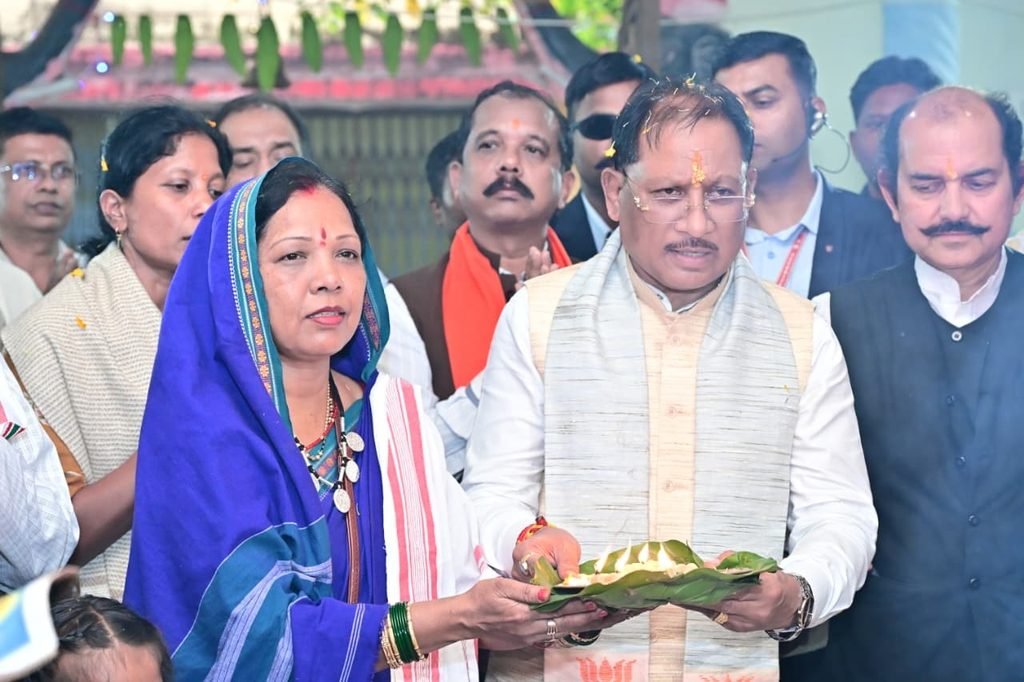
Chief Minister Vishnu Deo Sai and his wife Kaushalya Sai hold a platter of offerings as former Rajya Sabha MP Ranvijay Singh Judev (far right) stands beside them during the Kartik celebrations at Shri Radha-Krishna Temple in Pamshala, Jashpur district, on 22 November 2026. Photo: channel24india.com via CG/PR.
The couple prayed for peace, prosperity and happiness across Chhattisgarh during their visit to Kanwar Dham in Jashpur’s Farsabahar block on 22 November 2026. Addressing the gathering, Sai drew a connection between the devotion expressed in the temple and the responsibility people have towards one another. “To understand another person’s suffering and try to ease it is the highest duty,” he said.
Support for the groups that keep the kirtan going
Sai announced that the state government would provide financial assistance to all 62 local kirtan groups for musical instruments, costumes and other supplies. He thanked their leaders and members for sustaining the month-long programme and giving devotees a place to come together in prayer.
The daily gatherings began on 27 October for the month of Kartik. Devotees attend bhajan and kirtan sessions at 8 a.m. and 5 p.m. at the temple, where the programme will conclude on 24 November. Sai said gatherings like these give younger generations a chance to learn the songs and traditions by taking part alongside their elders.
He also spoke of Karma, Damkach, Jhumar and Mahadev Nacha as part of Chhattisgarh’s folk heritage. He said these traditions carry the values and experience of earlier generations and that keeping them alive is a shared responsibility.
Remembering Sant Gahira Guru Maharaj
Sai recalled the Kanwar community’s role in the freedom struggle, social reform and cultural preservation. He paid tribute to Sant Gahira Guru Maharaj, who devoted his life to spiritual practice, social reform and the welfare of tribal communities. Sai said the saint drew on the teachings of the Ramayana to encourage discipline, ethical conduct and a life free from intoxicants.
The Chief Minister also remembered the late community members who helped establish the central office at Kanwar Dham and build the organisation’s activities. He said their work had given later generations a foundation on which to continue serving the community.
Medical education closer to home
Turning to Jashpur’s development, Sai described the start of medical education in the district as a landmark. He said local students would have an opportunity to study medicine closer to home and that, over time, medical education could help strengthen health services in the district. He linked it to the government’s efforts to improve education, healthcare and employment opportunities for young people in remote and tribal areas.
Welfare measures and services closer to villages
Sai said 18 lakh homes had been approved under the Pradhan Mantri Awas Yojana and that another 3.65 lakh had been allocated under Awaas Plus 2024. He said the state was buying paddy at ₹3,100 per quintal, up to 21 quintals per acre, and spoke of providing financial support to address the gap between the procurement limit and actual production.
He said about 68 lakh women were receiving ₹1,000 a month under the Mahtari Vandan scheme and that more than 55,000 devotees had visited Ayodhya under the Shri Ramlala Darshan scheme. He also cited annual assistance of ₹10,000 for landless agricultural labourers, tendu leaf collection payments of ₹5,500 per standard bag and the revival of the Charan Paduka scheme.
For everyday grievances, Sai pointed to the round-the-clock Chief Minister’s helpline, 1076. He said residents could use it to report problems such as delays in replacing electricity transformers, updating land records after a death, obtaining certificates or registering a police complaint. He also mentioned the Seva Setu portal for mobile applications and the expansion of banking services in Pandarpani and Bandarchua.
Former Rajya Sabha MP Ranvijay Singh Judev, Zila Panchayat President Salik Sai, former MLA Bharat Sai, Jashpur Municipal Council Vice-President Yash Pratap Singh Judev, Zila Panchayat member Ved Prakash Bhagat, former Kanwar community president R. N. Sai and women’s wing president Swadha Sai attended. Senior Superintendent of Police Dr Lal Umed Singh and Zila Panchayat Chief Executive Officer Abhishek Kumar were also present, along with kirtan group members, devotees and villagers.