Kumar Bahukhandi
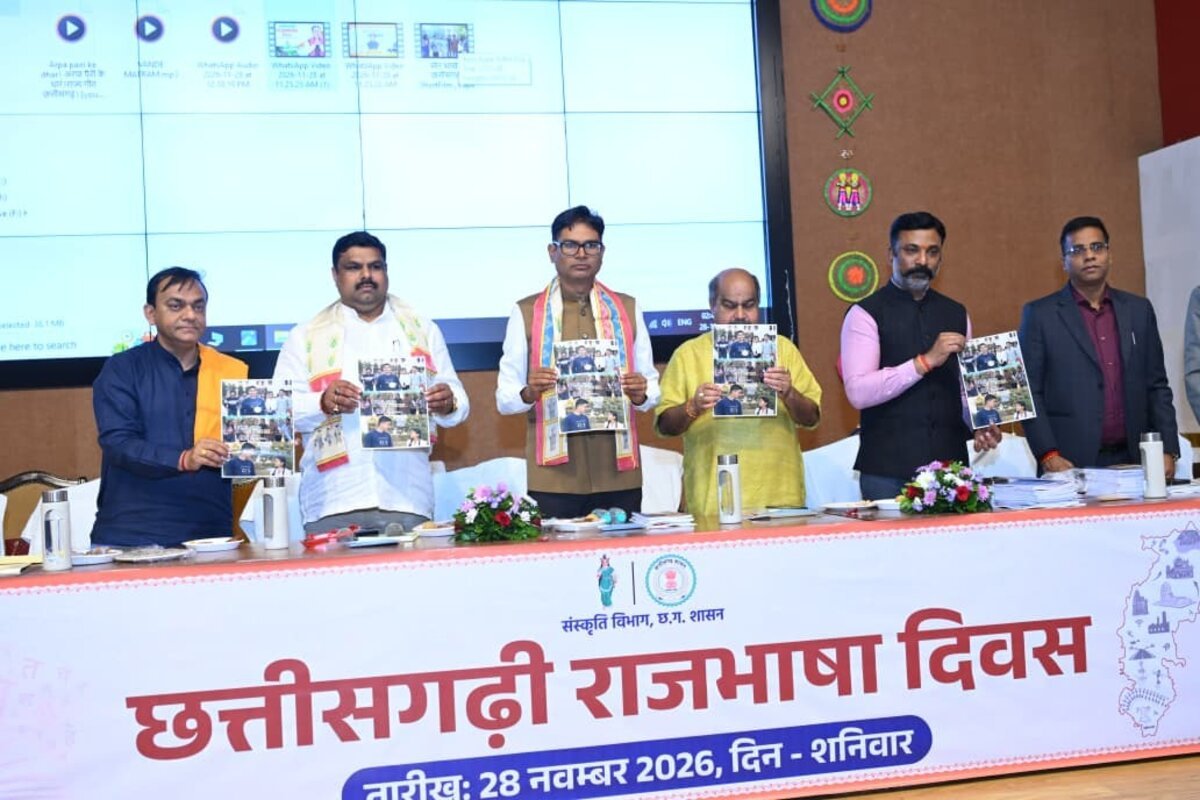
Finance Minister O. P. Choudhary (centre), with School Education Minister Gajendra Yadav to his left and MLA Purandar Mishra to his right, releases Chhattisgarhi literary works at the State-level Rajbhasha Diwas ceremony in Raipur on 28 November 2026. Photo: channel24india.com via CG/PR.
Rajbhasha Diwas brings 14 literary works, a short film and a poets’ gathering to the stage, as five writers are honoured for their service to Chhattisgarhi
Key Highlights
- Finance Minister O. P. Choudhary called for early schooling in familiar local languages, while School Education Minister Gajendra Yadav urged people to speak Chhattisgarhi with pride.
- Chief Minister Vishnu Deo Sai and Culture Minister Rajesh Agrawal addressed the gathering by video, calling for greater use of Chhattisgarhi at home, in education and in creative work.
- The ceremony released the short film Mor Bhakha, honoured five writers and remembered the late poet and scholar Dr Satyabhama Adil.
Raipur: Hearing Chhattisgarhi far from home can bring back the feeling of standing in one’s own village courtyard. Culture Minister Rajesh Agrawal recalled that feeling in a video message on 28 November 2026, as writers, poets and readers gathered in Raipur for Chhattisgarhi Rajbhasha Diwas. At the New Circuit House Convention Hall in Civil Lines, the State-level ceremony gave that sense of belonging a public space, with new books, a short film and poems read aloud in the language of everyday life.
The Chhattisgarh Rajbhasha Commission organised the event under the Culture Department. Finance Minister O. P. Choudhary and School Education Minister Gajendra Yadav attended, while Chief Minister Vishnu Deo Sai and Agrawal sent video messages.
Sai calls for a language children can grow up using
Sai spoke of the warmth Chhattisgarhi carries in folk songs, stories, festivals and family traditions. He said those links endure when younger generations have opportunities to use the language for themselves. He urged families to give it more room in everyday conversation and called for wider use in education, literature and creative work.
Agrawal asked parents to teach children Chhattisgarhi and speak it freely at home and at work. His recollection of hearing the language away from the State gave that appeal a personal meaning. Familiar words can make a distant place feel closer to home, especially for people who have moved away to study or work.
A familiar language can give children confidence in the classroom
Choudhary said children should begin their schooling in a language or dialect they understand. Familiar words, he said, can help them grasp lessons and express themselves with greater confidence. Recalling his own journey from school to the Indian Administrative Service, he encouraged students to learn English and other languages while staying connected to their mother tongue.
Yadav recalled a time before Chhattisgarh became a separate State when some people arriving in towns from villages hesitated to speak Chhattisgarhi. He said the formation of the State and the recognition of Chhattisgarhi as an official language had helped change attitudes. He also cited Hiralal Kavyopadhyay’s 1885 grammar to illustrate the language’s long written and grammatical tradition.
Fourteen works and a film make room for new voices
The ceremony saw the release of 14 literary works spanning subjects such as folk songs, traditional dress, village life and social concerns. Among them were Arvind Mishra’s Nohar-Chhohar Chhattisgarh, Ganeshwar Patel’s Aakhar Au Anjor, Sumitra Sahu’s Chhattisgarh Ke Gehna-Guriya Paridhan and Priya Dewangan’s Maati Ke Sirjay Chhand.
The release of the short film Mor Bhakha brought Chhattisgarhi to the screen as well. For younger audiences, film offers another way to hear the language in stories made for them and to see it as a medium for their own creative work.
Five writers honoured for years of service
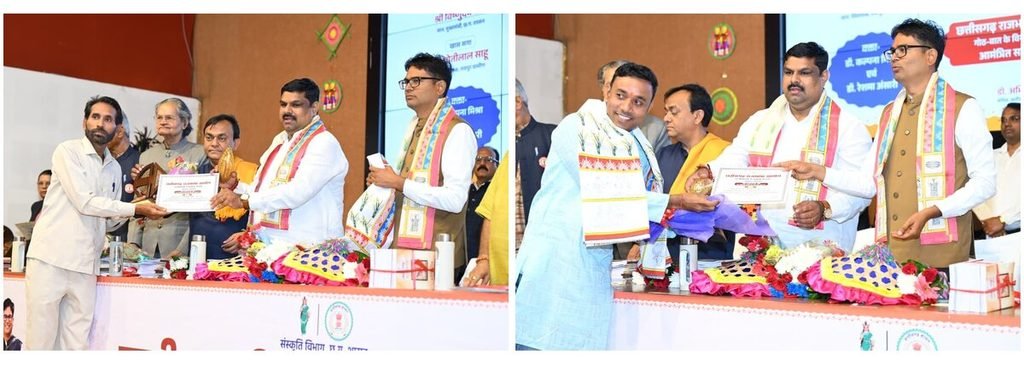
Finance Minister O. P. Choudhary and School Education Minister Gajendra Yadav present certificates and mementos to honourees at the State-level Chhattisgarhi Rajbhasha Diwas ceremony in Raipur on 28 November 2026. Five writers were recognised for their contributions to Chhattisgarhi language and literature. Photos: channel24india.com via CG/PR.
The commission honoured Maksudan Ram Sahu ‘Bariwala’ of Gariaband, Sudha Dewangan of Raigarh, Sudama Ram Gupta of Batauli in Surguja, and Ishwar Sahu ‘Bandhi’ and Govind Dhangar of Raipur district. The awards recognised their contribution to Chhattisgarhi language and literature. Guests also received Maya Chinhari, a traditional token of affection.
A literary discussion titled Purkha Ke Surta remembered the late Dr Satyabhama Adil, a poet, educator and scholar of folk culture. Dr Kalpana Mishra and Dr Reshma Ansari discussed her writing and research on folk songs, ballads and traditions. The session gave younger readers a chance to discover the work of a scholar who spent years documenting what communities had passed down by word of mouth.
Poetry brings the language back to the listening ear
Poets closed the programme with readings about village life, cultural diversity and the feeling of belonging to a place. The kavi sammelan brought the day back to a familiar experience: hearing a story or a verse in the language in which it was first imagined.
The ceremony followed the release, on the eve of Rajbhasha Diwas, of the literary magazine Surhutti and the traditional almanac Bachar by the Chief Minister. Together, the publications, film and readings gave people several ways to take Chhattisgarhi home with them, whether as a book to open, a poem to remember or a conversation to begin with a child.