Kumar Bahukhandi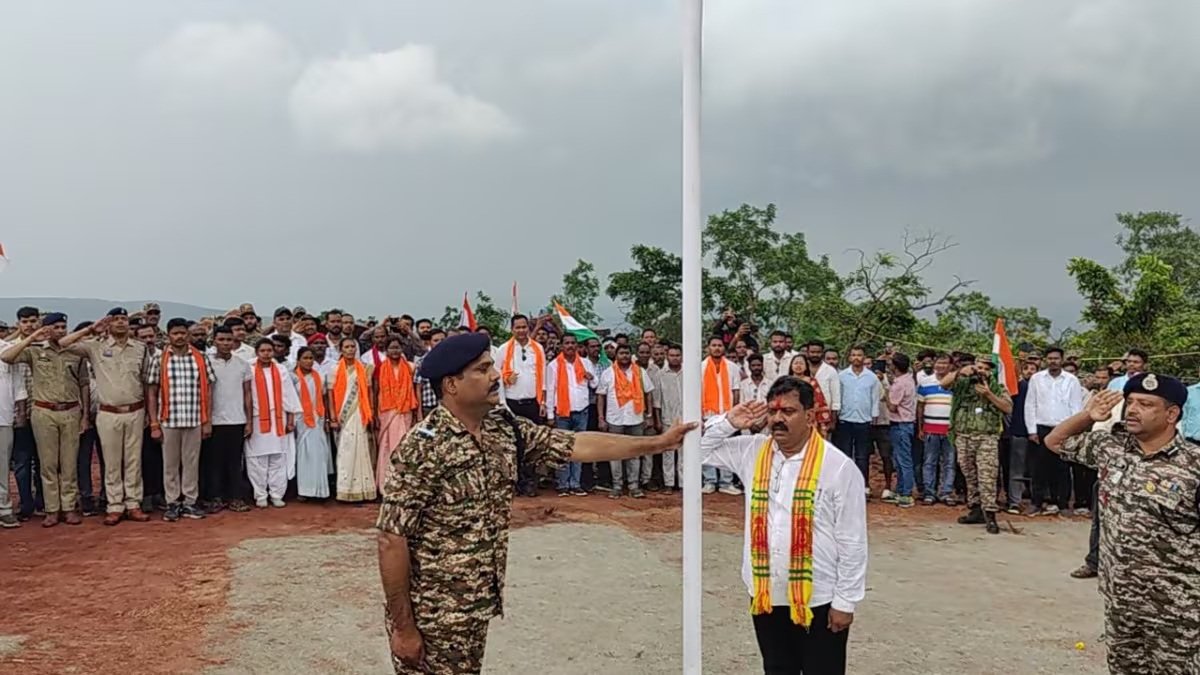
A New Dawn in Bastar: Chhattisgarh Deputy Chief Minister and Home Minister Vijay Sharma stands in salute during a flag-hoisting ceremony in the Karregutta region, as security personnel and local residents join the patriotic gathering during the Bastar Tiranga Yatra. The journey carried the Tricolour through former Maoist strongholds as more than 90 remote villages across Bastar prepared to mark Independence Day with the National Flag for the first time since 1947-Photo Credit:channel24india.com
Deputy CM Vijay Sharma and Forest Minister Kedar Kashyap take Bastar Tiranga Yatra through former Maoist strongholds; national flag reaches remote villages where Independence Day celebrations had remained out of reach for decades
Raipur: As India celebrated its 80th Independence Day on Saturday, August 15, 2026, a very different celebration of freedom unfolded deep inside Bastar — in villages where the shadow of Maoist violence had for decades prevented ordinary expressions of national celebration.
The Tricolour reached more than 90 remote villages across the Bastar division, many of which were set to witness the National Flag being hoisted on Independence Day for the first time since 1947.
The occasion marked more than another Independence Day ceremony. For communities in areas once dominated by Maoists, the sight of the Tricolour represented the changing security situation and the expanding presence of constitutional governance in some of Chhattisgarh’s most difficult terrain.
At the centre of the symbolic journey was Karregutta, the densely forested hill region along the Chhattisgarh-Telangana border that for years was regarded as a major Maoist stronghold.
Chhattisgarh Deputy Chief Minister and Home Minister Vijay Sharma, accompanied by Forest Minister Kedar Kashyap, travelled through the region as part of the Bastar Tiranga Yatra, a motorcycle journey designed to carry the National Flag through areas once synonymous with Maoist influence.
The yatra began from Narayanpur on August 12 with more than 200 motorcycles and travelled through former Maoist-affected areas of Narayanpur, Dantewada, Sukma and Bijapur before reaching the Karregutta region.
For Sharma, the journey was intended to convey a message that went beyond the political or ceremonial.
“From now on, the Tricolour will fly with full pride and honour in every corner of Bastar on every national festival,” he said as the yatra travelled through the region.
Where Black Flags Once Cast a Shadow, the Tricolour Now Flies
The symbolism is particularly powerful because Maoists had historically attempted to enforce boycotts of national celebrations in areas under their influence, sometimes issuing diktats against Independence Day and Republic Day observances.
Sharma recalled that residents in such areas had once faced pressure to display black flags during national festivals.
That history makes the scenes emerging from Bastar this Independence Day especially significant.
Villagers, security personnel and public representatives gathering around the National Flag present an image very different from the one associated with these areas for decades.
“Today, when I visit different villages in Bastar, people tell me that they truly feel free now. There is no longer any force that can reject India’s national flag,” Sharma said.
The Deputy Chief Minister credited the people of Bastar and the courage of security personnel for the transformation taking place across the region.
The Bastar Tiranga Yatra passed through locations that carry painful memories of Maoist violence. Soil was also to be collected from places where security personnel and civilians lost their lives in Maoist attacks, for use in a future memorial.
The journey therefore became both a celebration and an act of remembrance.
Forest Minister Kedar Kashyap said the significance of carrying the Tricolour through areas once regarded as centres of Maoist activity could hardly be overstated.
For security personnel who spent years operating in these forests, and for villagers who lived between Maoist coercion and the risks of conflict, an Independence Day celebration without fear represents a profound change.
Karregutta — From Maoist Stronghold to Symbol of Change
Karregutta occupies a special place in the story of the fight against Maoism.
The difficult hill and forest terrain along the Chhattisgarh-Telangana border had served as a strategically important Maoist base. The region became the focus of a major 21-day joint operation by Central and state security forces in April-May 2025, during which 31 Maoists were killed.
Today, its significance is being recast.
The presence of ministers, security personnel, local residents and the National Flag in a landscape once considered extremely difficult for the state to access provides one of the most striking visual representations of the changes underway in Bastar.
But the transformation of Bastar cannot be measured only by the removal of Maoist camps or the success of security operations.
The more lasting measure will be whether roads reach remote settlements, schools function regularly, healthcare becomes accessible, young people find employment and villagers are able to participate in democratic and national life without fear.
Sharma has said the government’s focus in these areas is now increasingly on roads, education, skill development, processing of minor forest produce and employment.
That transition — from securing territory to ensuring development — may ultimately prove more difficult, and more important, than the security battle itself.
An Independence Day With a Different Meaning
For most Indians, hoisting the Tricolour on August 15 is an ordinary and cherished part of Independence Day.
For some villages of Bastar, it has taken nearly eight decades for that ordinary act to become possible without the shadow of Maoist intimidation.
That is what gives the events of this Independence Day their deeper significance.
A National Flag being raised in a remote village may appear to be a simple ceremony. In an area where armed Maoists once sought to determine whether that flag could be displayed at all, it represents something much larger — the freedom of ordinary citizens to decide for themselves what they celebrate and where their allegiance lies.
The challenge now is to ensure that the change becomes irreversible.
Security can open the road into a village. Development must keep that road open.
Police and security forces can remove an armed Maoist presence. Schools, hospitals, employment, communications and responsive administration must ensure that another generation never finds itself isolated enough for extremism to return.
As the Tricolour appeared across more than 90 remote villages of Bastar during India’s 80th Independence Day, therefore, the celebration was not merely about remembering the freedom India achieved in 1947.
For many communities, it was about experiencing a freedom that had remained incomplete for far too long.
And amid the forests and hills that once echoed with Maoist diktats, the Tricolour now carries a different message — Bastar’s future will be written by its people, not by the gun.