Kumar Bahukhandi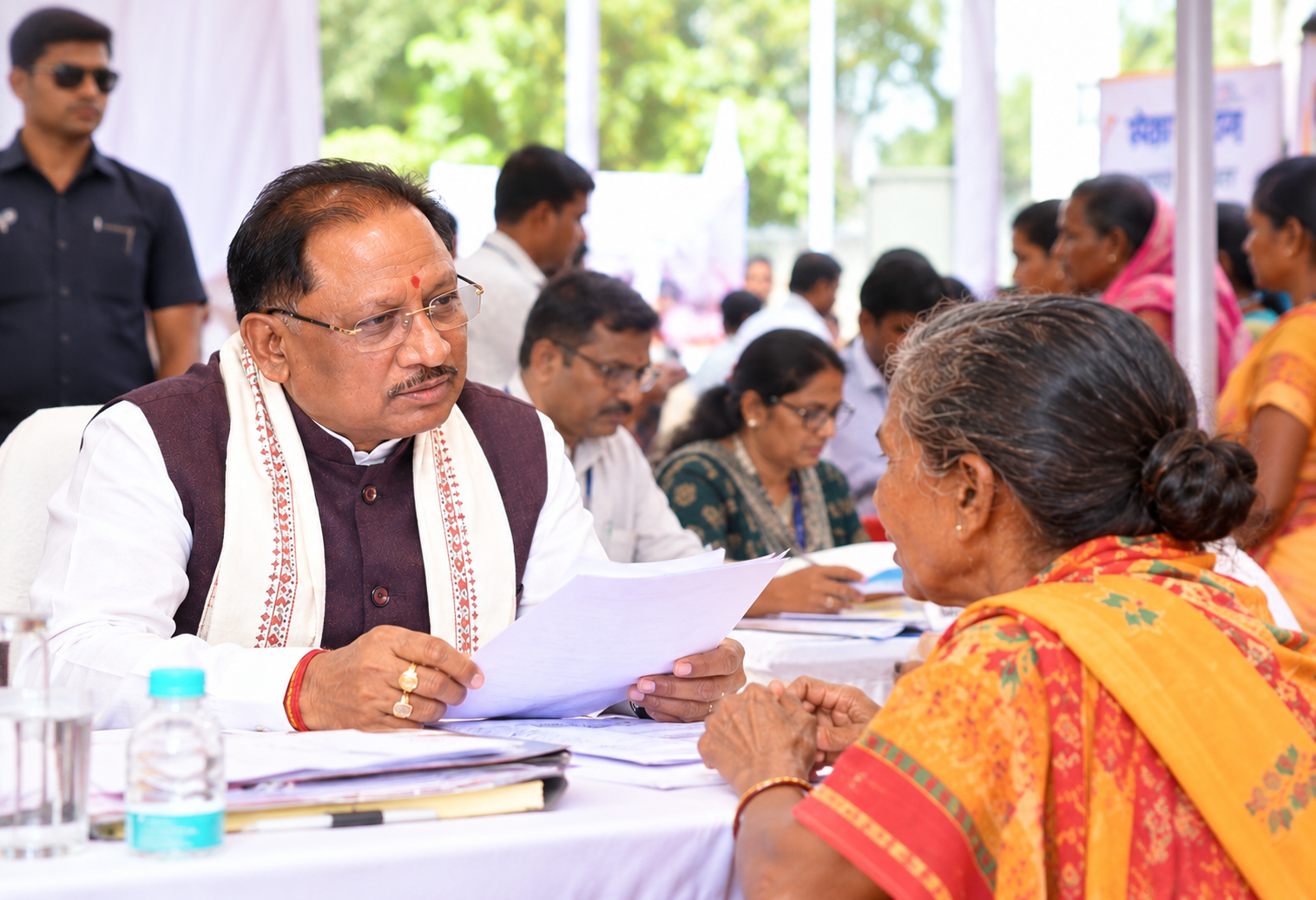
Representational image depicting Chief Minister Vishnu Deo Sai interacting with a woman during a public outreach programme, reflecting the spirit of the Seva Sankalp Abhiyan and the Chhattisgarh government’s emphasis on citizen welfare, responsive administration and inclusive development-Photo: channel24india.com
From welfare delivery and women’s empowerment to tribal development, infrastructure and accountable administration, the Seva Sankalp Abhiyan offers an opportunity to examine how public service can become the foundation of lasting progress.
Governance is not judged merely by the number of policies announced, the funds sanctioned or the promises made from public platforms. Its real strength becomes visible when a farmer receives timely assistance, a woman gains greater financial independence, a village gets reliable drinking water, a child can attend school without difficulty and an ordinary citizen finds the administration responsive rather than inaccessible.
This is the larger significance of the Seva Sankalp Abhiyan, being observed in Chhattisgarh from September 17 to October 17, 2026. Under Chief Minister Vishnu Deo Sai, the campaign seeks to connect public service, cleanliness, social responsibility and citizen participation with the wider objectives of good governance and development.
The campaign also raises an important question: can public service become more than an occasional government activity and develop into a permanent administrative culture?
For a state such as Chhattisgarh, with its considerable geographical, social and economic diversity, the answer will depend upon how effectively government policies reach people living far from administrative centres.
Service as the Foundation of Governance
Public administration has traditionally been associated with authority, regulation and the implementation of government decisions. Modern democratic governance, however, requires something more: accessibility, accountability and an understanding of the everyday difficulties faced by citizens.
A government office should not merely be a place where applications are received. It should be an institution where problems are resolved.
This distinction is particularly relevant to the Seva Sankalp Abhiyan.
The campaign’s emphasis on service and public participation creates an opportunity to strengthen the relationship between the administration and the people. Cleanliness drives, community activities, welfare outreach and public-awareness initiatives acquire lasting significance when they encourage officials and citizens to work together.
Chief Minister Vishnu Deo Sai’s administration has placed considerable emphasis on extending development and welfare programmes to communities that have historically faced geographical and economic disadvantages.
Yet the success of such an approach cannot be measured through public participation alone. It must also be reflected in the quality of services delivered, the time taken to resolve grievances and the extent to which citizens experience improvements in their daily lives.
Good governance begins with intentions, but it earns public confidence through results.
Women’s Empowerment and Financial Independence
One of the most visible dimensions of Chhattisgarh’s welfare approach has been the emphasis on women’s financial security.
The Mahtari Vandan Yojana, which provides eligible women with monthly financial assistance of ₹1,000, has become a significant component of the state government’s social-welfare agenda.
According to figures cited by the Chief Minister, approximately 68 lakh women are covered by the scheme, with cumulative assistance exceeding ₹20,000 crore.
The importance of direct financial assistance should not be understood solely in terms of the amount transferred.
For women managing household expenses, children’s education, healthcare requirements and other family responsibilities, even a modest but predictable source of income can provide greater flexibility in financial decision-making.
However, financial assistance is only one element of empowerment.
Lasting progress requires opportunities for education, skills, employment, entrepreneurship and participation in economic decisions. The challenge for policymakers is to connect welfare support with pathways towards greater financial independence.
A woman who receives assistance today should also have opportunities to build economic security for tomorrow.
Bastar: Development Beyond the Shadow of Conflict
Few regions demonstrate the complexity of development as clearly as Bastar.
For decades, parts of the region have struggled with the consequences of Maoist violence, difficult terrain, inadequate infrastructure and limited access to essential services.
The state government’s efforts to improve security and extend roads, schools, healthcare, communication networks and welfare programmes have brought renewed attention to Bastar’s development prospects.
The administration has credited coordinated security operations and government initiatives with creating conditions for greater economic activity in previously affected areas.
Nevertheless, the long-term transformation of Bastar will depend upon more than improvements in security.
Its young population needs quality education, employment opportunities and access to modern skills. Tribal communities must be able to participate meaningfully in decisions affecting their land, livelihoods, culture and natural resources.
Bastar possesses considerable potential in agriculture, forest produce, tourism, handicrafts and community-based enterprises.
The opportunity lies in ensuring that these resources generate sustainable income for local communities.
The national Sahakar Se Samriddhi conference being held in Jagdalpur on October 8–9 provides an example of how cooperative institutions could become instruments of economic participation in remote and tribal areas.
For Bastar, development should not mean merely catching up with other regions. It should mean building a future that respects its distinct identity while expanding opportunity.
Infrastructure That Changes Everyday Life
Roads, bridges, housing, drinking-water facilities and urban infrastructure are often presented as separate achievements of individual departments.
For citizens, however, they form part of a single experience of development.
A repaired road enables children to reach school, farmers to transport produce and patients to access healthcare. Reliable drinking water reduces hardship, particularly for women and families in rural communities. A completed house provides security and dignity.
The Sai government has emphasised the timely execution of public works, housing schemes and water-supply projects.
Under the Pradhan Mantri Awas Yojana, the objective of expanding access to permanent housing is particularly significant for economically disadvantaged families.
Similarly, the Jal Jeevan Mission and related drinking-water infrastructure projects have the potential to improve both public health and everyday convenience.
But the completion of infrastructure is not the final measure of success.
A road must remain usable after the monsoon. A drinking-water system must continue functioning after installation. A house must be completed to acceptable standards and become genuinely habitable.
This is where regular monitoring, maintenance and administrative accountability become essential.
The Seva Sankalp Abhiyan provides an appropriate occasion to reinforce these responsibilities.
Good Governance Must Also Protect Public Health
Public service includes the responsibility to protect citizens from avoidable risks.
Food safety, sanitation, preventive healthcare and access to essential medicines are as important to good governance as roads and public buildings.
Recent enforcement action in Gaurela-Pendra-Marwahi district illustrates this dimension of administration.
Food-safety authorities have prohibited the sale and distribution of a specified batch of Fortune Maida and initiated action after a paneer sample was declared unsafe following laboratory examination.
The restriction concerns the identified batch, not the product generally.
Such measures demonstrate the importance of inspection and testing, but effective consumer protection also requires consistent enforcement, transparent communication and timely follow-up.
Public health cannot depend upon occasional campaigns or isolated inspections.
It requires institutions that remain vigilant throughout the year.
Youth, Education and the Promise of Opportunity
Chhattisgarh’s future will ultimately be shaped by its young population.
Education, skill development, sporting opportunities and access to employment must therefore occupy a central place in the state’s development strategy.
The government has emphasised investment, industrial expansion and employment generation, while also seeking to encourage sporting activities among children and young people.
The significance of sports extends beyond competition and medals. Participation can encourage discipline, confidence, teamwork and physical well-being.
Equally important is the need to connect education with changing employment requirements.
Industrial investment can generate opportunities, but its benefits will be more widely shared when local young people possess the skills necessary to participate.
This calls for stronger coordination among educational institutions, industries, training organisations and government departments.
Development becomes meaningful when young people are not merely spectators to economic change but active participants in it.
Investment and the Road Towards 2047
The vision of a developed India by 2047 has become an important reference point for national and state-level planning.
For Chhattisgarh, the challenge is to translate that long-term ambition into practical economic opportunities.
The state government has sought investment in emerging sectors, including technology, manufacturing, energy and related industries.
Following engagements in Singapore, the government has highlighted investment commitments and expressions of interest in areas such as data infrastructure, renewable energy and food processing.
These initiatives may help diversify Chhattisgarh’s economy beyond its traditional industrial strengths.
However, investment announcements should be distinguished from completed projects and operational employment.
The real measure of economic progress will be the establishment of functioning enterprises, creation of sustainable jobs, development of local supply chains and the benefits experienced by communities.
The vision for 2047 must therefore be accompanied by measurable milestones, transparent implementation and sustained institutional effort.
The Citizen Is Not Merely a Beneficiary
Perhaps the most important message of the Seva Sankalp Abhiyan is that governance cannot remain the responsibility of government alone.
Citizens also contribute to public life through cleanliness, environmental protection, responsible use of public resources, community participation and respect for civic institutions.
Yet citizen participation should never become a substitute for administrative responsibility.
People can support cleanliness campaigns, but municipal bodies must provide dependable waste-management systems. Communities can help protect water sources, but authorities must ensure reliable water infrastructure. Citizens can report problems, but officials must respond within reasonable timeframes.
A healthy relationship between the government and society requires both participation and accountability.
Public cooperation strengthens governance when institutions are prepared to listen and act.
From a Month-Long Campaign to a Lasting Culture
The Seva Sankalp Abhiyan will conclude on October 17, but the principles associated with it should not end with the campaign.
Its lasting contribution will depend upon whether the emphasis on service, responsiveness and public participation becomes part of routine administration.
Can citizens obtain essential services without unnecessary visits to government offices? Are complaints resolved promptly? Are development works completed on time? Do public schemes reach eligible beneficiaries? Are vulnerable communities able to access the same opportunities as those living in better-connected areas?
These are the questions through which good governance should be evaluated.
Chief Minister Vishnu Deo Sai’s leadership has placed service and development at the centre of the government’s stated priorities. The larger task is to convert those priorities into consistent and measurable improvements across Chhattisgarh.
Service is not simply an administrative obligation; it is the moral foundation of democratic governance.
A government earns trust when it remains accessible, responds to difficulties and recognises the dignity of every citizen.
Chhattisgarh’s journey towards greater prosperity will not be defined by announcements alone, but by the opportunities created for its people and the quality of life they experience.
The true bridge between service and good governance is built when public promises become everyday realities.
And that is the standard by which the Seva Sankalp Abhiyan—and the wider development journey of Chhattisgarh—must ultimately be judged.