Kumar Bahukhandi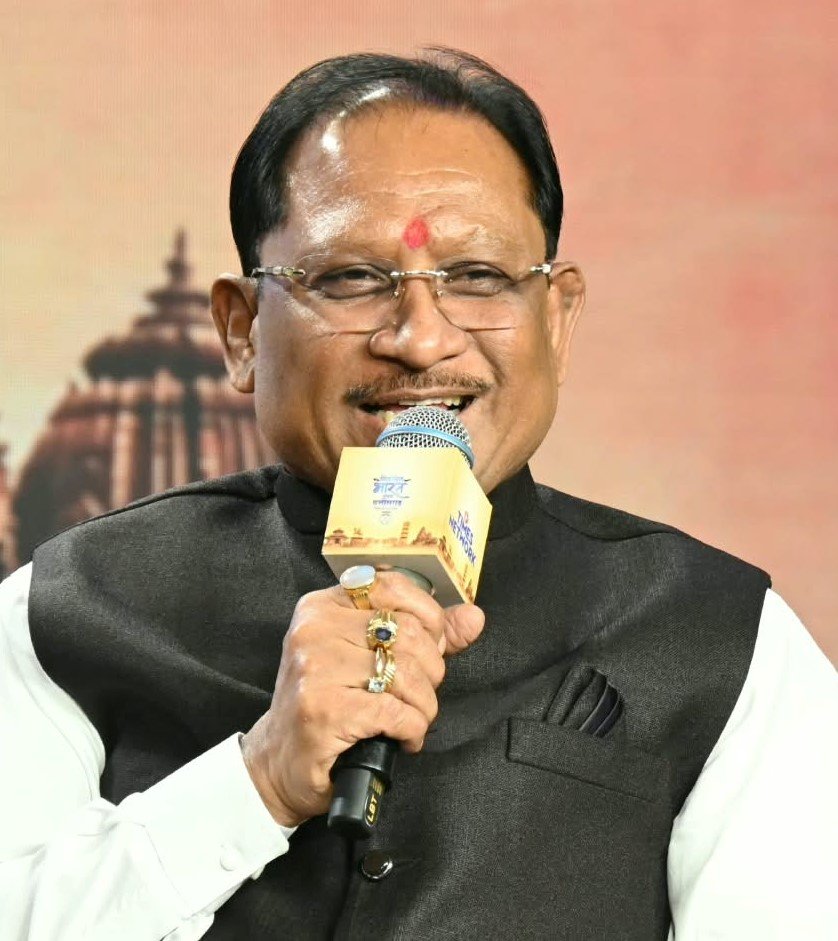
Chhattisgarh Chief Minister Vishnu Deo Sai shares his views on the state’s development journey, highlighting the transformation of Bastar, the decline of Naxal violence and the government’s roadmap for a developed Chhattisgarh. Raipur, Monday, August 31, 2026-Photo Credit:channel24india.com via CMO
Developed Chhattisgarh will play a significant role in Prime Minister Narendra Modi’s vision of Viksit Bharat by 2047, says Chief Minister
Key Highlights
- Sai says the combined strategy of security and development has transformed Bastar
- More than 421 schools opened in remote and sensitive areas under the development approach
- 34 lakh people screened under Mukhyamantri Swasth Bastar Abhiyan; nearly 40,000 received treatment
- State says it has received investment proposals worth around ₹8 lakh crore
- Tourism, livelihoods and employment emerging as key components of Bastar’s post-Naxal development
- 34 Nalanda campuses being developed to provide better study facilities for students and competitive examination aspirants
Raipur: Chhattisgarh Chief Minister Vishnu Deo Sai on Monday August 31, 2026 said the state, after facing the challenge of Naxalism for decades, is entering a new era of peace, confidence and development, with Bastar witnessing some of the most significant changes.
“Chhattisgarh is emerging from the darkness of Naxalism and scripting a new story of development,” Sai said, underlining that progress is now being accelerated across education, healthcare, employment, infrastructure, tourism and livelihoods.
He said Prime Minister Narendra Modi has placed before the country the goal of making India a developed nation by 2047, and Chhattisgarh has prepared its own roadmap to contribute substantially towards that objective. Ten major missions have been identified under the state’s vision document, he said.
Drawing attention to Chhattisgarh’s economic potential, Sai said nearly 44 per cent of the state’s geographical area is covered by forests and it possesses significant mineral resources, including iron ore, bauxite, lithium and gold. Chhattisgarh is also India’s only tin-producing state.
According to the Chief Minister, these natural resources, combined with the state’s workforce, can enable Chhattisgarh to play a much larger role in India’s economic development.
Security and Development Changing Bastar Together
Sai said Naxalism remained one of the biggest obstacles to Chhattisgarh’s development, particularly in Bastar, for several decades.
Following the formation of the state government in 2023, Union Home Minister Amit Shah reviewed the Naxal situation in Chhattisgarh in January 2024. Subsequently, the Centre and the state adopted a coordinated strategy, with greater cooperation among neighbouring states and joint operations by security forces.
Sai credited the leadership of Prime Minister Modi, the determination of Home Minister Shah and the courage of the security forces for what he described as historic progress against armed Naxalism.
“Our approach has not been limited to security operations. Development has been given equal priority because lasting peace is possible only when its benefits reach every village and every family,” Sai said.
He recalled that Bastar’s people had endured nearly four decades of Naxal violence, during which development projects involving schools, hospitals, roads, bridges and communication infrastructure were frequently obstructed, leaving several remote areas disconnected from the mainstream.
The Niyad Nellanar initiative — meaning “Your Good Village” in Gondi — was introduced to address precisely this gap.
Sai said roads, electricity, drinking water, education, healthcare and telecommunications are being extended to remote and sensitive villages through the initiative. More than 421 schools have been opened in the region, while telecommunications coverage is also being expanded. The government has subsequently introduced Niyad Nellanar 2.0 to carry the programme forward.
Sai said the government is working towards the objective articulated by Union Home Minister Amit Shah of transforming Bastar into one of the country’s most beautiful tribal regions.
Healthcare has simultaneously been expanded. Under the Mukhyamantri Swasth Bastar Abhiyan, around 34 lakh health screenings have been conducted and nearly 40,000 people have received treatment, he said. Through the Bastar Munne initiative, government personnel are reaching villages, staying among residents and helping them access schemes and public services.
With security conditions improving, Sai said Bastar is also witnessing new opportunities in tourism and livelihoods.
The state has entered into an agreement with the National Dairy Development Board to encourage animal husbandry, while goat rearing and fisheries are being promoted to increase household incomes.
Sai said Bastar’s natural landscape, tribal culture and distinctive way of life have significant tourism potential. Dhudmaras village has received international recognition as a tourism village, with visitors increasingly using homestays to experience local tribal life and culture.
The government is providing loan and subsidy support for homestays and has included tourism within the ambit of its new industrial policy to link the sector more directly with employment and the local economy.
Sai said around 70 security camps becoming redundant with the decline of Naxalism are also being considered for transformation into ‘Seva Dera’, giving such infrastructure a new developmental purpose.
The Chief Minister stressed that the government’s Naxal strategy also provides a route back into society for those willing to abandon violence. An improved surrender and rehabilitation policy has been introduced to enable former Naxal cadres to return to the mainstream and rebuild their lives with dignity.
“Those who leave violence behind and return to society must have an opportunity to live with dignity,” Sai said.
He maintained that although attempts may continue at the ideological level to create confusion even after armed Naxalism recedes, visible development and improvements in the lives of Bastar’s people would provide the most effective response.
Turning to education, Sai said improving opportunities for young people remains a major government priority. Chhattisgarh had only one medical college when the state was created, compared with 15 medical colleges today. Institutions of national importance, including IIT, IIM and IIIT, are also operating in the state.
The government is developing 34 Nalanda campuses to provide modern study facilities for students and competitive examination aspirants. Support is also being provided to Chhattisgarh students preparing for the UPSC examinations in Delhi.
Sai said the objective is to ensure that a child’s economic circumstances do not become an obstacle to talent or ambition.
On industrial development, the Chief Minister said Chhattisgarh’s new industrial policy is creating a more favourable environment for investment and employment. The state has received investment proposals of around ₹8 lakh crore, he said, adding that the government’s objective is not simply to attract capital but to translate investment into employment opportunities.
Special incentives have consequently been provided for enterprises capable of generating employment for at least 1,000 young people.
Sai also reflected on his own journey from a farming family to public life. He said the death of his father when he was 10 forced him, as the eldest son, to assume responsibilities early, while farming taught him the importance of hard work, patience and responsibility.
He said politics had not originally been part of his plans. His public life began when villagers persuaded him to contest as a ward panch. After five years in that role, villagers elected him sarpanch unopposed. He subsequently became an MLA from Tapkara in 1990, served twice as an MLA in undivided Madhya Pradesh and four times as an MP from Raigarh before serving as a Union Minister of State and later becoming Chief Minister of Chhattisgarh.
“Whatever responsibility I have received in public life, I have tried to discharge it with complete dedication and honesty,” Sai said.
The Chief Minister said Chhattisgarh now stands before a new horizon of opportunity. With the obstacle posed by armed Naxalism receding, he said Bastar and the rest of the state are gaining fresh developmental momentum.
The ultimate objective, he said, is to transform a state already rich in natural resources into one of India’s leading states in human development, education, healthcare, employment, industry and tourism, enabling a Viksit Chhattisgarh to make a strong contribution to Viksit Bharat by 2047.