Kumar Bahukhandi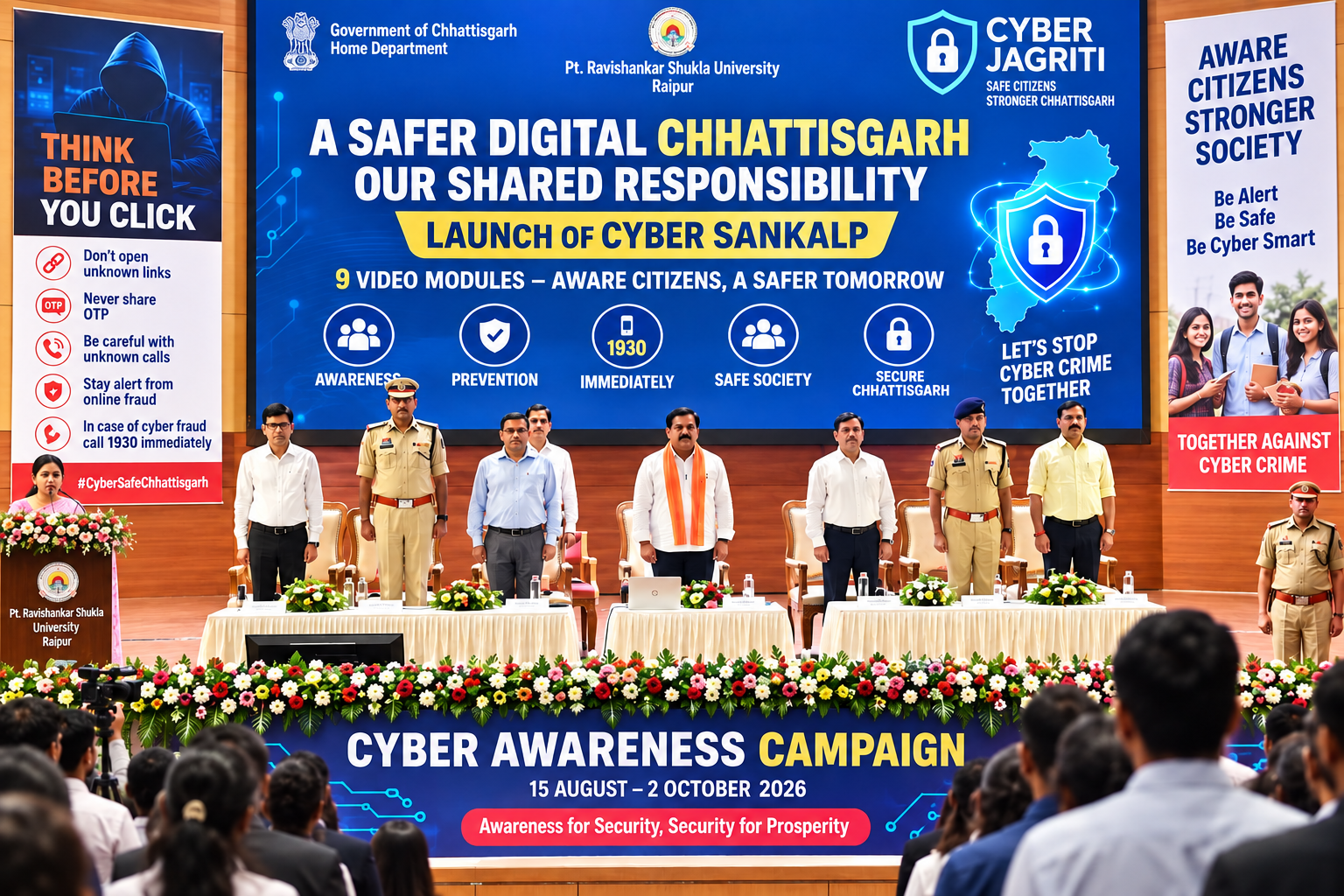
Cyber awareness moves from policing to prevention: officials, police personnel and students participate in the launch of ‘Cyber Sankalp’ at Pt. Ravishankar Shukla University in Raipur, an initiative aimed at equipping citizens with practical knowledge to recognise and prevent cyber fraud ( Representational Illustration )
Deputy CM Vijay Sharma launches nine-part digital safety course, urges students to become cyber-awareness ambassadors; real-life ‘digital arrest’ case shows why calling 1930 without delay can save victims’ money
Key Highlights
- Deputy CM and Home Minister Vijay Sharma launches Cyber Sankalp, a nine-module cyber-safety video course.
- More than 500 students participate in the programme at Pt. Ravishankar Shukla University, Raipur.
- Each video module runs for approximately five to six minutes and explains cyber threats in simple language.
- Citizens urged to call 1930 immediately after cyber financial fraud.
- A victim of a ₹1-crore-plus “digital arrest” fraud recounts how timely police contact helped recover ₹60 lakh.
- Students asked to become cyber-awareness ambassadors for their families and communities.
- Chhattisgarh Police’s Cyber Jagruti campaign runs from August 15 to October 2, 2026.
Cybercrime often begins with something seemingly harmless — a phone call, an unfamiliar link, an urgent message or a convincing voice claiming to represent a bank, police agency or government department.
By the time suspicion arises, money may already have moved.
Chhattisgarh is now attempting to confront that vulnerability at its most effective point: before a citizen becomes a victim.
The State’s ongoing Cyber Jagruti campaign received a significant push at Pt. Ravishankar Shukla University in Raipur with the launch of ‘Cyber Sankalp’, a nine-module video course designed to take practical cyber-safety education beyond police stations and cyber cells and into homes, colleges and communities.

Deputy Chief Minister and Home Minister Vijay Sharma addresses students during the ‘Cyber Sankalp’ programme at Pt. Ravishankar Shukla University in Raipur, urging young people to become cyber-awareness ambassadors and take the message of digital safety from campuses to homes and villages-Photo Credit:channel24india.com via CG/DPR .
Deputy Chief Minister and Home Minister Vijay Sharma launched the initiative while directly interacting with more than 500 students from the university and different colleges in Raipur.
His message was straightforward: technology may have transformed everyday life, but digital convenience cannot remain separated from digital caution.
“As rapidly as digital facilities are expanding, awareness about digital security must also increase,” Sharma said.
Cyber Safety Before Cyber Investigation
What makes Cyber Sankalp significant is its emphasis on prevention rather than merely investigation after a crime has occurred.
The programme consists of nine short video modules, each approximately five to six minutes long. They have been designed in simple language to explain emerging forms of cyber fraud, common digital traps and practical precautions citizens can take.
That approach matters because cybercriminals increasingly exploit human behaviour rather than simply breaking technological security.
A victim may voluntarily reveal an OTP after being frightened by a caller. Someone may click a fraudulent banking link because it appears genuine. An elderly person may believe a caller claiming that a relative is in trouble. Others can be intimidated through the increasingly reported phenomenon of a so-called “digital arrest”.
In such cases, awareness itself becomes a first line of defence.
Sharma consequently asked students not to keep what they learn within the university campus. He urged them to explain cyber threats to their parents, grandparents, friends and neighbours and to carry cyber-awareness messages into villages.
The idea effectively places young people at the centre of a much larger public-safety network.
One Number Every Citizen Should Remember: 1930
Among all the messages delivered at the programme, one deserves particular public attention:
If cyber fraud occurs, call the national cybercrime helpline 1930 immediately.
Sharma stressed that victims should neither panic nor waste crucial time after discovering a fraudulent transaction.
The first period following a cyber financial crime can become a “golden hour” during which rapid reporting may enable authorities and financial institutions to trace or stop the movement of money before it disappears through multiple accounts.
The importance of that window was demonstrated not through a theoretical presentation, but through the experience of a victim present at the programme.
A doctor identified as Dr Sen recounted how cybercriminals allegedly trapped him through a “digital arrest” fraud involving more than ₹1 crore.
He contacted the police in time.
According to the account shared at the programme, intervention during the crucial early period helped in the recovery of ₹60 lakh.
The episode offered the students perhaps the strongest lesson of the day: after cyber fraud, every minute can matter.
Students as Cyber-Awareness Ambassadors
Sharma’s interaction with more than 500 students also reflected an important shift in the way cybercrime prevention can be approached.
Young people are among the country’s most intensive users of smartphones, digital payments, social media and online services. That exposure can make them vulnerable, but it also places them in a uniquely powerful position to protect others.
A digitally aware student can warn a parent against sharing an OTP. A granddaughter can tell an elderly family member never to transfer money merely because an unknown caller claims to be a police officer. A young person in a village can explain why suspicious links should never be opened.
One informed individual can therefore protect an entire family.
Sharma urged students to become “ambassadors of cyber awareness” and spread knowledge about fraudulent calls, fake links, OTP scams, banking fraud, social-media deception and digital-arrest tactics.
Students were also informed about the Cyber Crime Volunteer initiative being promoted by the Union Home Ministry and the Indian Cyber Crime Coordination Centre (I4C), aimed at encouraging wider public participation in cybercrime prevention.
A Safer Digital Chhattisgarh Needs Public Participation
Senior police officials used the programme to explain how cybercrime itself is changing.
Additional Director General of Police (Intelligence) Amit Kumar advised students to remain alert to evolving methods of cybercrime and follow essential online-safety practices. Additional Deputy Commissioner of Police Gaurav Mandal explained different forms of cybercrime and preventive measures.
Raipur Police Commissioner Dr Sanjeev Shukla, Inspector General of Police (Technical Services) Prashant Agrawal, Additional Police Commissioner Amit Tukaram Kamble, Pt. Ravishankar Shukla University Vice-Chancellor Prof. Sachchidanand Shukla and Registrar Shailendra Patel were among the officials present.
The university programme forms part of the Chhattisgarh Police’s Cyber Jagruti campaign running from August 15 to October 2, through which citizens are being educated about different forms of cybercrime, preventive measures and the immediate steps required after becoming a victim.
But the larger value of Cyber Sankalp may emerge after the formal campaign concludes.
Police can investigate cybercrime. Banks can attempt to freeze fraudulent transactions. Technology can identify suspicious activity.
Yet none of these measures can completely replace an alert citizen who recognises the trap before clicking the link, sharing the OTP or transferring the money.
That is why Cyber Sankalp represents more than another awareness event.
If its nine short lessons travel from universities to homes, from students to parents and grandparents, and from cities to villages, Chhattisgarh could create something cybercriminals find considerably harder to exploit:
a population that knows their methods before they strike.