Kumar Bahukhandi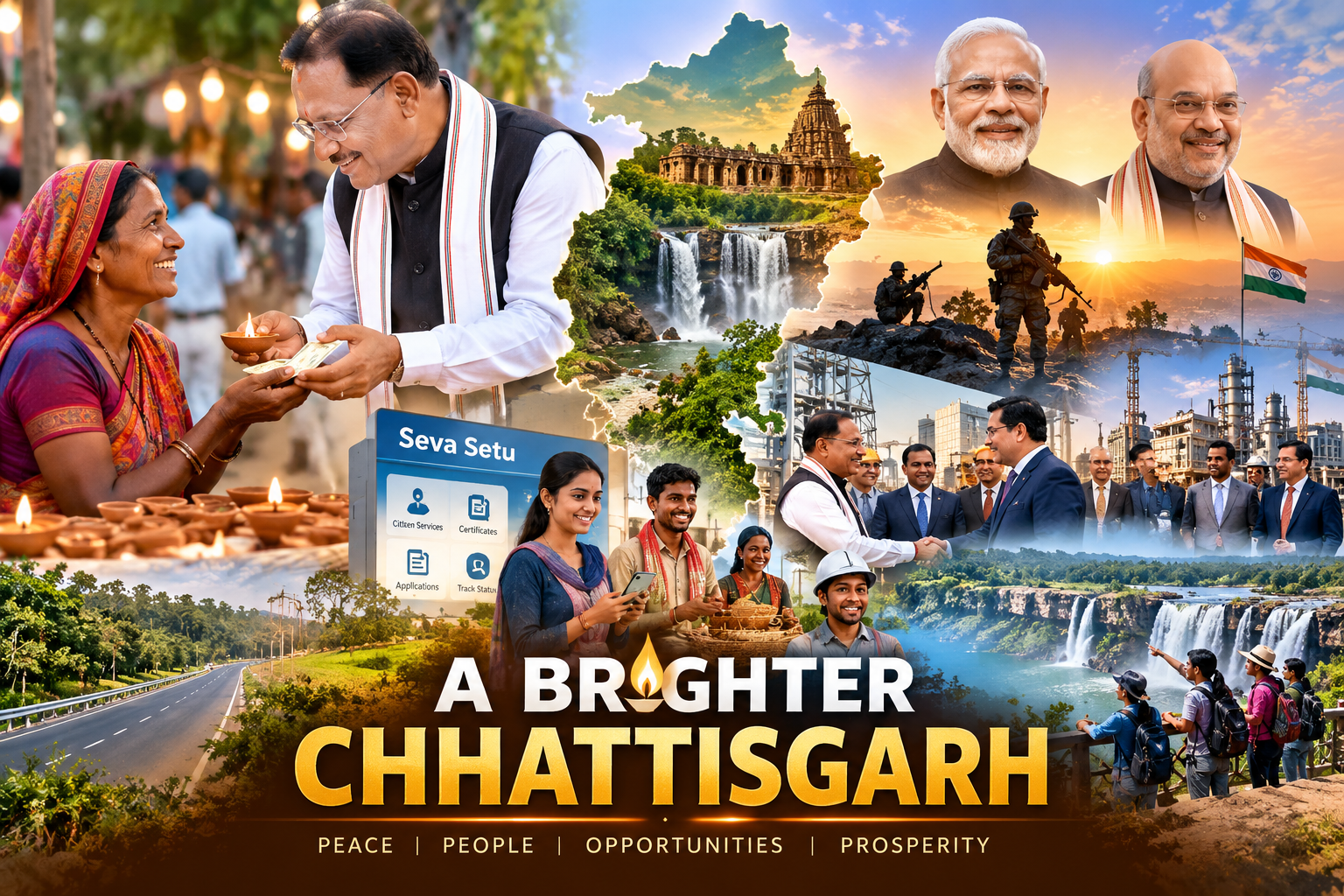
From a roadside diya to a new development narrative — Chief Minister Vishnu Deo Sai’s governance approach brings together citizen-centric services, peace in Bastar, investment, employment and tourism as Chhattisgarh seeks to turn security gains into wider economic opportunity. Illustration: AI-generated/channel24india.com
Sometimes the character of governance is revealed not inside a conference hall, behind a podium or through the language of an official document, but in an apparently insignificant moment on the roadside.
When Chhattisgarh Chief Minister Vishnu Deo Sai stopped at Telibandha Marine Drive in Raipur and approached the modest stall of Meera, a woman selling earthen lamps, there was nothing extraordinary about the commodity he purchased. It was a simple diya. Yet the encounter carried a larger message.
Sai bought the diya and gave the woman ₹1,000. More importantly, he spoke to her.
He asked about her livelihood, her family and whether government welfare schemes were actually reaching her. Meera told him that she had a bank account under the Pradhan Mantri Jan Dhan Yojana and was receiving ₹1,000 every month under the Mahtari Vandan Yojana.
That conversation deserves attention because governance ultimately has to pass this test: Does the person sitting beside the road experience the government whose policies are announced from the Secretariat?
A Chief Minister buying a diya cannot, by itself, transform a state. Nor should symbolism ever be mistaken for administration. But political symbolism acquires meaning when it connects with policy.
That is where the roadside encounter becomes relevant to the larger story unfolding in Chhattisgarh.
Governance must reach the last person
Vishnu Deo Sai’s public persona has remained noticeably understated. His political communication generally avoids the theatrical aggression that increasingly dominates public life. His manner is easy-going, his public interactions relatively unhurried, and his political vocabulary frequently revolves around service, welfare and development.
But accessibility has value only when administration becomes accessible as well.
The upgraded Seva Setu provides one important example. Launched in April 2026 as an expansion of Chhattisgarh’s digital citizen-service architecture, the platform brought hundreds of government services onto a common digital system. The official portal provides facilities including online applications and tracking, digitally signed certificates, WhatsApp integration, multilingual access, electronic payments and real-time notifications.
This may appear less dramatic than a major infrastructure inauguration, but for an ordinary citizen governance is often experienced through certificates, applications, permissions, records and benefits.
If technology can save a villager a repeated journey to a government office, reduce dependence on intermediaries, allow an applicant to track a file and make the system more transparent, digital governance ceases to be a fashionable phrase. It becomes public service.
The real success of Seva Setu, therefore, will not be measured by the sophistication of its portal but by the number of unnecessary doors a citizen no longer has to knock upon.
The principle is important: government should increasingly travel towards the citizen instead of requiring the citizen perpetually to travel towards government.
The transformation of Bastar changes the conversation
Yet the most consequential change confronting Chhattisgarh goes far beyond digital services.
For decades, the name Bastar was introduced to much of India through the vocabulary of Maoist violence—ambushes, landmines, encounters, inaccessible villages and the deaths of security personnel and civilians.
That association extracted an enormous human and economic price.
In May 2026, Union Home Minister Amit Shah declared that the national objective of eliminating Naxalism had been achieved ahead of the March 31, 2026 deadline. Significantly, while making that declaration in Jagdalpur, Shah specifically credited personnel of the District Reserve Guard and CoBRA commandos for their contribution.
Any account of this transformation must therefore remember something that political narratives can sometimes overlook.
Peace was not obtained without sacrifice.
Soldiers and personnel of the security forces operated for years in extraordinarily difficult terrain. Many never returned home. Families lost sons, husbands, fathers and brothers. Civilians and tribal communities also suffered through decades of violence.
Their sacrifice cannot become a footnote to the development story that follows.
The political and administrative coordination between the Chhattisgarh government headed by Vishnu Deo Sai and the Union government, particularly the Ministry of Home Affairs under Amit Shah, formed part of the strategy against Left-Wing Extremism. Sai himself has credited the Centre under Prime Minister Narendra Modi and the strategy pursued by the Union Home Ministry for the change.
But defeating violence can only be the first chapter.
The more difficult test begins when the gun falls silent: can the space vacated by extremism be occupied quickly enough by schools, hospitals, roads, employment, markets, tourism, communications and hope?
That is now Chhattisgarh’s challenge.
From the security map to the investment map
There is another reason why the decline of Maoist violence matters.
Capital is cautious. Industry studies infrastructure, logistics, policy stability and security before committing money. For decades, perceptions surrounding Naxalism affected the image of Chhattisgarh, particularly Bastar.
The Sai government is now attempting to replace that old perception with another proposition: Chhattisgarh as an investment destination.
The scale of the ambition is considerable.
Since the Industrial Development Policy was introduced in November 2024, Chhattisgarh has reported investment proposals exceeding ₹8 lakh crore across roughly 290 projects, with potential employment estimated at about 1.9 lakh jobs. By September 2026, 175 projects representing approximately ₹2.95 lakh crore had reportedly moved off the drawing board. Significantly, many proposals are no longer confined to the state’s traditional strengths in mining and heavy industry; electronics, pharmaceuticals, textiles, food processing, technology and tourism are increasingly part of the investment conversation.
Sai has personally participated in this investor outreach.
After engagements within India and missions to countries including Japan and South Korea, the Chief Minister is now scheduled to take Chhattisgarh’s investment pitch to Singapore, where his October visit includes participation in the Singapore-India Network for Growth forum and interactions with business leaders and investors.
There is an interesting contrast here.
The same political leader who can stop beside a small roadside diya seller is also attempting to sit across the table from international investors.
The two worlds should not be regarded as contradictory.
The ultimate purpose of attracting investment is not the size of an announcement; it is the opportunity that investment creates for the person who needs a job, the family that needs an income and the young graduate who should not have to leave Chhattisgarh merely because opportunity lives elsewhere.
Investment proposals are therefore only the beginning. Their real worth will be established when proposals become factories, enterprises, hotels, technology centres and service businesses; when construction begins; when local supply chains develop; and, above all, when Chhattisgarh’s young people find meaningful employment.
Tourism can become Bastar’s second identity
Perhaps nowhere is the opportunity greater than in tourism.
For too long, Bastar’s extraordinary natural and cultural inheritance remained overshadowed by the image of conflict.
Yet this is the land of Chitrakote and Tirathgarh waterfalls, Kanger Valley, caves, forests, tribal art, handicrafts, indigenous traditions and Bastar Dussehra. The Chhattisgarh Tourism Board itself presents Bastar as a region distinguished by forests, waterfalls, caves and tribal culture.
The Sai government’s attempt to position Bastar as a major tourism destination is therefore not merely about attracting visitors.
Tourism possesses an unusual economic advantage: its benefits can travel far beyond large companies.
A tourist needs transport. A tourist eats at a restaurant. A tourist buys handicrafts. A tourist may stay in a hotel, resort or homestay. Guides are required. Drivers earn. Local food finds customers. Artisans gain markets. Women-led self-help groups can supply products. Young people can become hospitality professionals, naturalists, photographers, adventure-tourism operators and entrepreneurs.
Sai has publicly linked the expansion of tourism with employment and self-employment opportunities for local youth as Bastar moves away from its old association with Naxalism.
That approach deserves to be understood in its wider economic context.
If peace brings tourists, tourists bring enterprise, and enterprise brings sustainable local income, the defeat of extremism acquires a meaning much deeper than a security statistic.
A young person holding a tour guide’s identity card instead of being vulnerable to recruitment by an extremist organisation would represent a transformation no government advertisement could adequately capture.
Development must become the permanent answer to extremism
The post-Naxal phase carries responsibilities of its own.
Security forces can clear territory, but development must secure confidence.
A road must remain more powerful than an extremist route. A school must offer a stronger future than indoctrination. A mobile tower must connect a village with opportunities beyond the forest. A health centre must establish the visible presence of the State. Employment must give a young person something tangible to protect.
This is why the next stage of the Sai government’s work in Bastar may ultimately prove as important as the security achievement itself.
The government has spoken of rehabilitation, infrastructure, agriculture, tourism, industry and employment as components of the post-Naxal roadmap.
The emphasis now must be relentless implementation.
Because peace is not simply the absence of gunfire.
Peace is the presence of opportunity.
The politics of the ordinary
And that brings us back to Meera and her diya.
There is something revealing about that little episode.
India’s political culture often associates leadership with scale—larger stages, longer convoys, bigger announcements and increasingly elaborate public spectacles.
But citizens frequently remember something else.
They remember whether a leader listened.
They remember whether he could speak to an ordinary vendor without making the encounter appear distant or ceremonial. They remember whether the administration behind him made their lives easier.
Sai’s understated style has consequently become part of his political identity. The larger question is whether this accessibility can remain connected to measurable governance as Chhattisgarh’s ambitions grow.
The challenge ahead is enormous.
Investment proposals have to become investment on the ground. Digital services have to work for citizens who are not digitally sophisticated. Tourism development must protect Bastar’s ecology and indigenous culture rather than overwhelm them. Industrialisation must generate local employment. The benefits of peace must reach the villages that endured the greatest cost of conflict.
And the sacrifices of the soldiers and civilians who made today’s changed security environment possible must never disappear beneath the celebration of development.
Prime Minister Narendra Modi’s government at the Centre, Amit Shah’s Home Ministry, the Sai government in Chhattisgarh, the police, Central Armed Police Forces, District Reserve Guard personnel and countless people living in the affected districts have all been participants in a difficult transition whose consequences will unfold over many years.
For Vishnu Deo Sai, this moment therefore presents both an opportunity and a test.
He leads Chhattisgarh at a time when the state has the possibility of changing an old national narrative—from a mineral-rich state constrained by conflict to a state seeking investment, technology, tourism, employment and broader participation in India’s growth story.
His government’s record will eventually be judged not merely by the number of investment proposals signed, portals launched or campaigns organised, but by what these initiatives do to everyday lives.
That is precisely why the roadside diya remains such a compelling image.
A small earthen lamp costs almost nothing.
But the woman selling it represents an economy.
Her bank account represents financial inclusion.
Her monthly welfare payment represents the reach of government.
Her roadside business represents self-reliance.
The road beside her represents connectivity.
The investor being invited to Chhattisgarh represents the possibility of tomorrow’s employment.
And a Bastar in which visitors can travel without the shadow of Maoist violence represents something that generations of people in the region waited decades to see.
Leadership in Chhattisgarh’s new phase will ultimately be measured by whether these apparently separate stories—the roadside vendor, the digital citizen, the soldier’s sacrifice, the tribal village, the tourist, the entrepreneur and the global investor—can be joined into one coherent story of opportunity.
The diya purchased from Meera illuminated only a small space.
The task before Vishnu Deo Sai’s government is considerably larger:
to ensure that the peace secured at enormous human cost becomes development, that development becomes employment, that investment becomes prosperity, and that the light of opportunity reaches those corners of Chhattisgarh that remained in the shadow for far too long.