Kumar Bahukhandi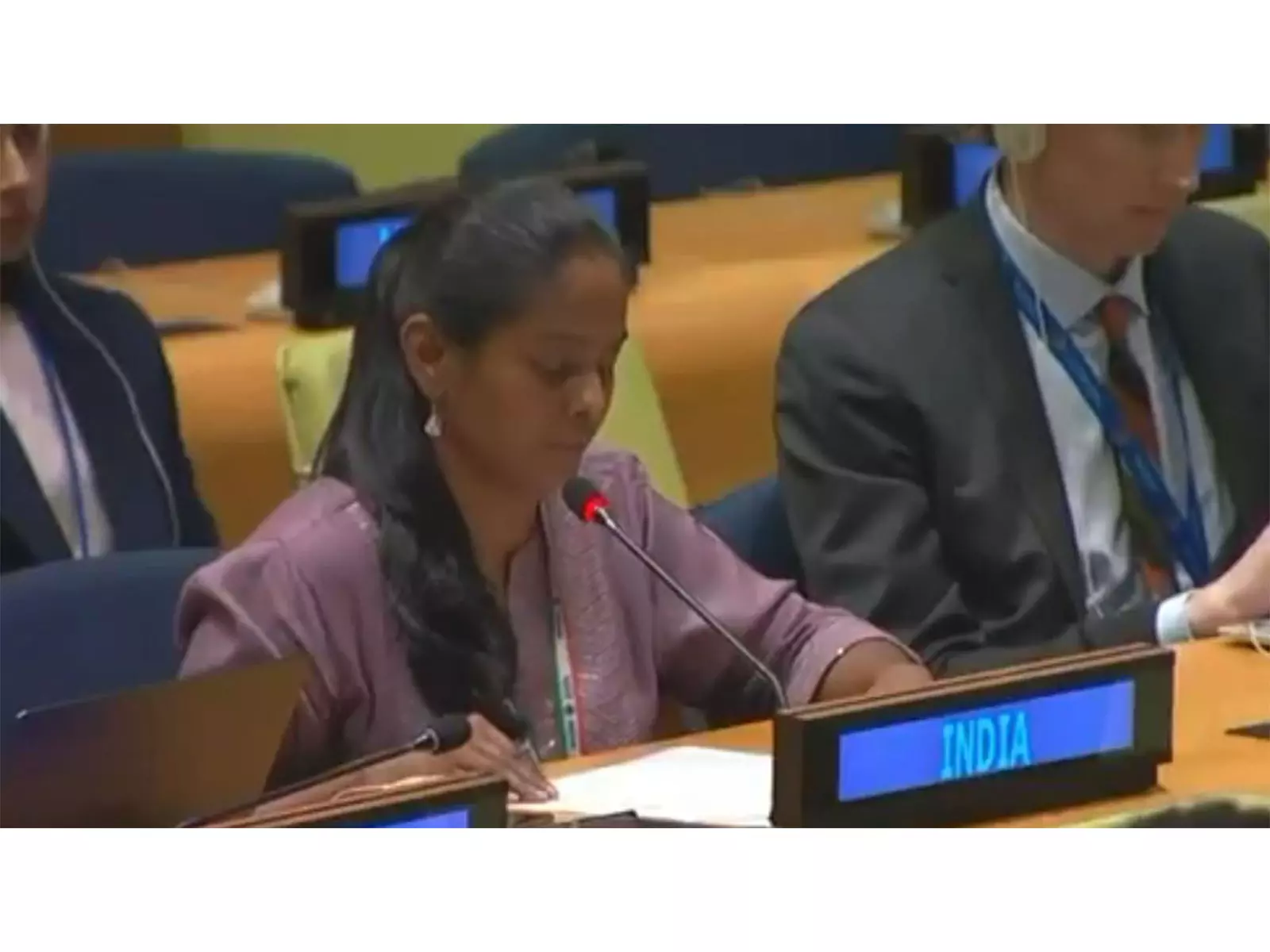
R. Mythili, Counsellor and Legal Adviser at India’s Permanent Mission to the United Nations, addresses the UN General Assembly’s Sixth Committee in New York on Monday, October 12, 2026, as India calls for terrorist acts meeting the necessary legal threshold to be appropriately recognised within the framework of crimes against humanity. India also emphasised the responsibility of states to prevent, investigate and prosecute such offences. Photo: X / India’s Permanent Mission to the United Nations
At the United Nations, India Urges Stronger Legal Accountability for Grave Acts of Terrorism While Emphasising the Primary Responsibility of States to Prevent, Investigate and Prosecute Such Crimes
Key Highlights
- India calls for terrorist acts meeting the necessary legal threshold to be appropriately recognised within the international framework governing crimes against humanity.
- R. Mythili, Counsellor and Legal Adviser at India’s Permanent Mission to the United Nations, presents India’s position.
- The statement is delivered during deliberations of the UN General Assembly’s Sixth Committee.
- India emphasises that states bear primary responsibility for preventing, investigating and prosecuting crimes against humanity.
- The intervention comes amid international discussions on a proposed convention concerning the prevention and punishment of crimes against humanity.
New York: India has called upon the international community to ensure that terrorist acts meeting the established legal threshold are appropriately addressed within the framework of crimes against humanity, arguing for an effective system of accountability while reaffirming the primary responsibility of individual states to prevent, investigate and prosecute such offences. The position was presented on Monday, October 12, 2026, during deliberations of the United Nations General Assembly’s Sixth Committee.
India Places Terrorism Within the International Legal Debate
Representing India at the United Nations, R. Mythili, Counsellor and Legal Adviser at India’s Permanent Mission, addressed the Sixth Committee during discussions concerning the proposed United Nations Conference of Plenipotentiaries on Prevention and Punishment of Crimes against Humanity.
India’s intervention drew attention to the need for international legal arrangements to respond adequately to acts of terrorism that satisfy the requirements for classification as crimes against humanity.
The statement did not suggest that every terrorist act should automatically fall within that category. Rather, it emphasised recognition where the necessary legal conditions are met.
This distinction is important because international criminal law applies specific criteria to crimes against humanity, and those criteria cannot be replaced merely by the gravity or political character of an allegation.
Why the Legal Threshold Matters
Under the framework reflected in the Rome Statute of the International Criminal Court, crimes against humanity involve specified acts committed as part of a widespread or systematic attack directed against a civilian population, with knowledge of the attack.
A terrorist act may be exceptionally serious without necessarily satisfying every element required for classification as a crime against humanity.
However, where terrorist violence forms part of conduct meeting those legal requirements, the underlying acts may fall within the established international criminal law framework.
India’s intervention focused on ensuring that such conduct is not overlooked when international legal instruments dealing with crimes against humanity are considered.
National Responsibility Remains Central
A significant aspect of India’s position was its emphasis on the responsibility of states themselves.
The statement highlighted the importance of national legal and judicial mechanisms in preventing, investigating and prosecuting crimes against humanity.
This approach places domestic institutions at the centre of enforcement, recognising that effective accountability depends not only on international agreements but also on the capacity and willingness of states to act.
Police investigations, prosecutorial processes, judicial scrutiny and appropriate national legislation are essential components of that responsibility.
International cooperation can support these mechanisms, particularly where offences involve multiple jurisdictions or cross-border elements.
Sixth Committee Examines a Major International Legal Question
The Sixth Committee is the principal forum for legal questions within the United Nations General Assembly.
Its discussions on the prevention and punishment of crimes against humanity form part of a wider effort to consider an international convention addressing these grave offences.
Unlike genocide and certain war crimes, crimes against humanity have not historically been governed by a single comprehensive global convention dedicated specifically to their prevention and punishment.
The proposed treaty process therefore carries significance for the development of international criminal law, cooperation between states and accountability for serious violations.
India’s contribution introduces the question of how qualifying acts of terrorism should be reflected in that framework.
Accountability Must Rest on Evidence and Established Law
The legal classification of serious violence carries consequences for investigations, prosecutions and international cooperation.
For that reason, any determination that an act constitutes a crime against humanity must be based on the relevant legal elements and evidence.
India’s emphasis on the requisite threshold reflects the importance of preserving that distinction while seeking effective accountability for grave terrorist violence.
It also raises a broader question for international legal discussions: how to ensure that evolving forms of organised violence are adequately addressed without weakening established legal safeguards.
India’s Message: Stronger Accountability Through Law
India’s statement at the United Nations places the prevention and punishment of serious terrorist violence within a wider conversation about international criminal accountability.
By calling for the appropriate recognition of terrorist acts that meet the legal requirements of crimes against humanity, New Delhi has advocated an approach grounded in legal definitions, state responsibility and effective prosecution.
The outcome of the ongoing international discussions will depend on negotiations among UN member states.
For India, the central message is that grave offences must be addressed through credible legal mechanisms, with national responsibility and international cooperation working together to prevent impunity.