Kumar Bahukhandi
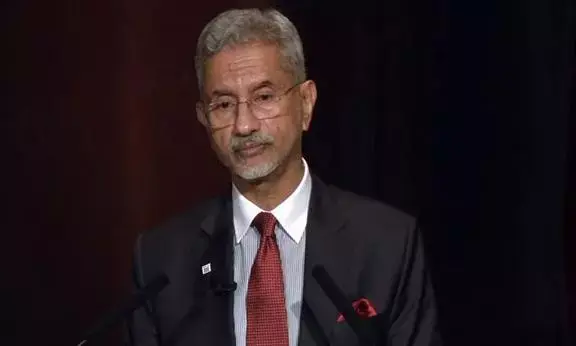
New York: External Affairs Minister S Jaishankar enunciated that in a “multipolar” world where change has been stretching the fabric of the global order, the key to the future of Asia as well as the world lies in the relationship between India and China.
During his opening address at the Asia Society at the Asia Society Policy Institute in New York on Tuesday September 24 Jaishankar said Asia is at the “cutting edge of change” and that India is the part leading that change.
“Asia is very much at the cutting edge of that change. Within Asia, India is part of leading that change. But that change is today stretching the fabric of the global order…I think the India-China relationship is key to the future of Asia. In a way, you can say if the world is to be multipolar, Asia has to be multipolar. And therefore, this relationship will influence not just the future of Asia but, in that way, perhaps the future of the world as well,” he said.
He further said that India has to prepare to rise amid volatility and unpredictability.
“India which is rising, has to prepare to rise amidst volatility and unpredictability. Typically, when countries rise, when big powers rise, they hope for congenial circumstances,” he added.
In his address, Jaishankar picked three words to describe the changing world.
He said that to describe the world, the word “rebalancing” was an obvious choice and said that Asia played a key role in that process.
“Now when I speak about rebalancing, I think Asia has been very much key to that rebalancing when we talk. If one looks, for example, at the last top 20 economies of the world, there are many more Asian economies in that than there were a few decades ago. And even if one looks among the 20, the Asian ones have really risen much more strongly and impactfully. And among them, is India, which was a decade ago the 10th largest economy in the world, currently the 5th, likely to be the third by the end of the decade,” he stated.
Jaishankar said that the other word was “multipolar,” as it was the consequence of the rebalancing as it overlaps and convergences the international politics impacting the global architecture that was there during the initial years of the United Nations.
“The word that would occur to me when I again tried to describe the world would be multipolar and this is a consequence of rebalancing in the sense that there are many more independent centres of decision-making in the world and what it does is it really shifts international politics more in the direction of finding convergences and overlaps, and that actually has an impact on the global architecture that from what was in the initial years of the UN, a very much more bipolar world briefly went into unipolarity,” he explained.
The third word that Jaishanakar used to describe the world was plurilateralism. He said it was an ugly word, but it describes a world beyond the bilateral relations.
“A third word that would occur to me is plurilateralism. It’s a very ugly word, but it in a sense describes a world beyond bilateral relations, but in short, a multilateral one where countries form combinations based on these convergences and overlaps that I’ve talked about,” he said.
I think this is the latest step in the growth of that platform now rebalancing multipolar plurilateralism,” he added.
( Source : ANI )