Kumar Bahukhandi
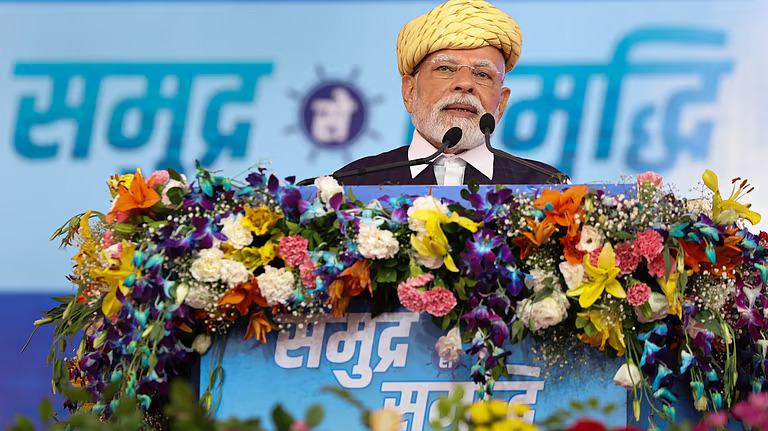
Prime Minister Narendra Modi addresses the gathering during the ‘Samudra se Samruddhi’ event at Gandhi Maidan, in Bhavnagar, Gujarat.PTI
Bhavangar : Prime Minister Narendra Modi on Saturday September 20 , 2025 said India’s main adversary is its dependence on other nations as he made a strong pitch for “aatmanirbharta” and called for indigenous production of everything from semiconductor chips to ships.
Speaking at the ‘Samudra se Samruddhi’ event, where he inaugurated and laid foundation stones of projects worth Rs 34,200 crore, Modi said all the problems of India have only one solution, and that is self-reliance.
“India is moving forward with the spirit of global brotherhood and India has no major enemy in the world today, but in true terms, India’s biggest adversary is dependence on other nations,” stated the Prime Minister, emphasising that this dependence must be collectively defeated.
He said greater foreign dependence leads to greater national failure. “For global peace, stability, and prosperity, the world’s most populous country must become self-reliant,” Modi said, and cautioned that reliance on others compromises national self-respect.
“The future of 140 crore Indians cannot be left to external forces, nor can the resolve for national development be based on foreign dependence. The future of the coming generations cannot be left to others. If the country with a population of 140 crore is dependent on others, it compromises national self-respect,” he added.
As per a popular saying, pain of 100 kinds has only one remedy; similarly, all problems of India have one solution, and that is aatmanirbharta (self-reliance), Modi stated.
Targeting Congress, Modi said the talent of young people was suppressed after Independence by the then ruling party which brought in a “license Raj”.
“As a result of consistently ignoring inherent strengths of India, the country couldn’t achieve the success it truly deserved even after six to seven decades of freedom,” Modi said and blamed “prolonged entanglement in the license-quota regime and isolation from global markets” as the main factors.
When the globalisation era began, the then governments focused solely on imports, which led to scams of thousands of crores of rupees, Modi said.
Citing India’s shipping sector as a major example of the damage caused by flawed policies, Modi said that India once had a very vibrant ship-building industry.
“Ships built in India’s coastal states once powered domestic and global trade. Even fifty years ago, India used domestically built ships, with over 40 percent of its import-export conducted through them.
“Till 50 years ago, our trade was carried out by 40 per cent ships made in India, but this has now come down to just 5 per cent,” the PM pointed out.
He said India pays a staggering USD 75 billion or Rs 6 lakh crore every year to foreign shipping companies for their services.
“Can people imagine how much money has been paid in freight to other countries over the past seven decades? This outflow of funds has created millions of jobs abroad. If even a small portion of this expenditure had been invested by earlier governments in the domestic shipping industry, the world would have been using Indian ships today, and India would have been earning lakh of crores in shipping services,” the PM added.
“Chips (semiconductor chips) or ships, we must make them in India,” Modi said, adding that domestic ports are the backbone of India’s rise as a global maritime powerhouse.
India’s maritime sector is now moving towards next-generation reforms, he said, and announced that from today, all major ports in the country will be freed from multiple documents and fragmented processes.
“The implementation of ‘One Nation, One Document’ and ‘One Nation, One Port’ Process will simplify trade and commerce,” he said.
He said a series of reforms have been initiated in the maritime sector, and five maritime laws have been introduced in a new form.
The PM said a historic decision has been taken to strengthen the maritime sector, with large ships now accorded the infrastructure status.
“Ship-building companies will now find it easier to secure loans from banks and will benefit from reduced interest rates. All benefits associated with infrastructure financing will now be extended to these ship-building enterprises,” Modi added.
He said the government is working on three major schemes to make India a major maritime power.
“These initiatives will ease financial support for the shipbuilding sector, help shipyards adopt modern technology, and improve design and quality standards. Over Rs 70,000 crore will be invested in the coming years,” he said.
He inaugurated and laid the foundation stone for development projects related to the maritime sector worth more than Rs 7,870 crore. He also unveiled and laid the foundation stone of multiple projects of the Central and state governments, worth more than Rs 26,354 crore, catering to various sectors in Gujarat.
The PM also conducted an aerial survey of Dholera Special Investment Region, a greenfield industrial hub located around 100 km south of Ahmedabad. Later, he reviewed the progress of the under-construction National Maritime Heritage Complex at Lothal in Ahmedabad district which seeks to showcase India’s maritime heritage.
Upon arrival in Bhavnagar earlier in the morning, he participated in a roadshow.
(Source-PTI)