Kumar Bahukhandi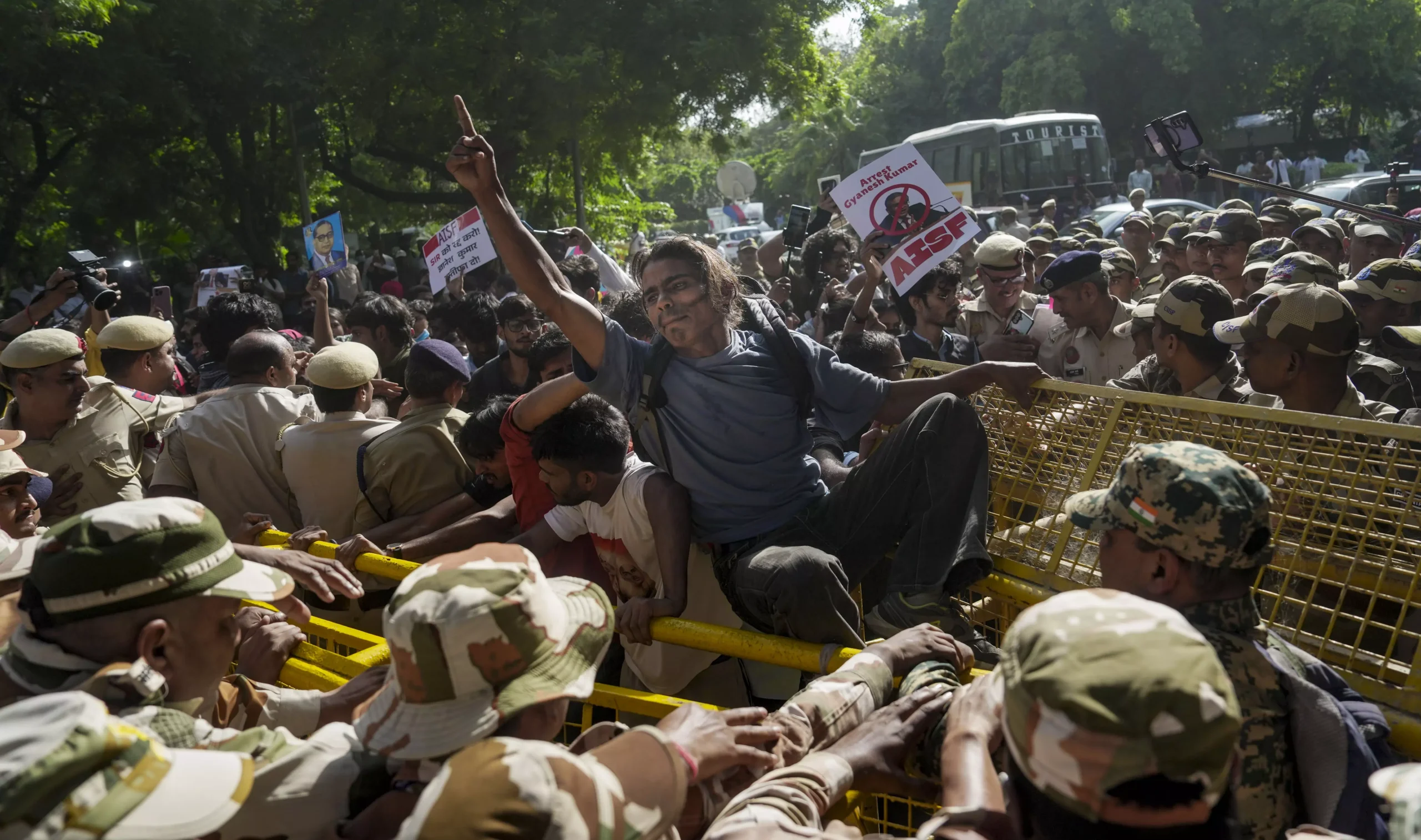
Demonstrators confront police barricades during a protest demanding the resignation of Chief Election Commissioner Gyanesh Kumar over alleged irregularities in the Special Intensive Revision (SIR) of electoral rolls and claims of large-scale voter deletions, at Jantar Mantar in New Delhi on Saturday, October 3, 2026. The demonstration highlights the historic protest site’s continuing role as a symbol of democratic dissent and public accountability.(File Photo)
From Historic Anti-Corruption Movements to Contemporary Electoral Protests, New Delhi’s Iconic Demonstration Site Reflects the Continuing Struggle to Balance Citizens’ Right to Protest with Public Order
Key Highlights
- Jantar Mantar remains one of India’s most recognisable locations for democratic demonstrations and public dissent.
- Protesters gathered on October 3, 2026, demanding the resignation of Chief Election Commissioner Gyanesh Kumar over alleged irregularities in electoral roll revisions.
- The demonstration reflected concerns surrounding the Special Intensive Revision (SIR) of electoral rolls and allegations of voter deletions.
- From Anna Hazare’s anti-corruption movement to protests demanding justice for women and fairness in examinations, the area has witnessed several important public campaigns.
- The constitutional right to peaceful assembly remains central to India’s democratic traditions, subject to lawful restrictions.
- The continuing significance of Jantar Mantar raises questions about public accountability, institutional trust and the relationship between citizens and the state.
New Delhi: Jantar Mantar is more than a historic observatory or a familiar address in the national capital. Over the decades, it has become one of India’s most enduring symbols of democratic expression, where citizens, activists, students and political organisations have gathered to question authority, demand accountability and draw national attention to issues affecting public life. The latest demonstration near the landmark on Saturday, October 3, 2026, when protesters confronted police barricades while demanding the resignation of Chief Election Commissioner Gyanesh Kumar, once again highlighted the continuing importance of public dissent in a constitutional democracy.
The protesters raised allegations concerning the Special Intensive Revision (SIR) of electoral rolls, including claims of irregularities and large-scale deletion of voters’ names.
The allegations formed part of a wider political controversy surrounding electoral administration. However, the claims raised by demonstrators must be distinguished from independently established findings.
The scene of protesters facing police personnel behind yellow barricades illustrated a familiar feature of political life in the capital: citizens attempting to make their grievances heard while authorities sought to maintain security and public order.
An Observatory That Became a Measure of Democracy
Built in the eighteenth century under Maharaja Sawai Jai Singh II, Jantar Mantar was originally designed for astronomical observation and the measurement of celestial movements.
Its historic instruments reflect an era when scientific observation sought to understand time, planetary positions and the movement of heavenly bodies.
Over time, the surrounding area acquired an entirely different significance.
It became a place where the public could draw attention to political decisions, administrative failures, social inequalities and demands for reform.
The transformation carries a striking symbolism. A monument created to measure the movement of celestial bodies now stands near a public space where political movements and changing social attitudes can be observed.
While the astronomical structures preserve India’s scientific heritage, the demonstrations associated with Jantar Mantar reflect the continuing evolution of its democratic life.
From Anti-Corruption Campaigns to Demands for Justice
Jantar Mantar’s association with public protest has been strengthened by movements that attracted national attention.
Anna Hazare’s anti-corruption campaign became one of the defining public mobilisations of its time, bringing questions of political accountability and institutional reform into everyday conversations.
Demonstrations following the 2012 Delhi gang rape, widely remembered through the Nirbhaya movement, reflected public anger over violence against women and demands for stronger legal protections.
Student-led protests and campaigns concerning competitive examinations, including controversies over the National Eligibility-cum-Entrance Test (NEET), have also demonstrated how young people use public mobilisation to seek transparency and accountability.
These movements differed in their objectives, leadership and political circumstances.
What connected them was the belief that public participation should not end with voting or remain confined to formal political institutions.
Electoral Roll Controversy Brings Fresh Demonstrations
The October 3 demonstration against Chief Election Commissioner Gyanesh Kumar brought electoral administration into focus.
Protesters demanded his resignation while raising allegations concerning the Special Intensive Revision of electoral rolls and the deletion of voters’ names.
Electoral rolls are fundamental to the functioning of representative democracy because inclusion on the voter list determines whether an eligible citizen can exercise the right to vote.
Questions concerning the accuracy of these records therefore carry considerable public significance.
At the same time, allegations of irregularities require examination through evidence, established procedures and appropriate institutional scrutiny.
Political disagreement over electoral administration is legitimate in a democracy, but claims of wrongdoing cannot be treated as proven solely because they are raised during a demonstration.
The Right to Protest and the Responsibility to Maintain Order
The Constitution of India protects freedom of speech and expression under Article 19(1)(a) and the right to assemble peaceably and without arms under Article 19(1)(b).
These freedoms provide an important constitutional foundation for peaceful demonstrations.
However, they are not unlimited. The Constitution permits reasonable restrictions under specified circumstances, including those concerning public order.
Authorities have a responsibility to maintain security, regulate public spaces and prevent violence. Citizens, meanwhile, retain the right to express disagreement through lawful and peaceful means.
The challenge lies in ensuring that restrictions on demonstrations remain lawful, proportionate and consistent with constitutional protections.
Police barricades and crowd-control arrangements may serve legitimate security purposes, but their use also invites scrutiny when citizens believe their opportunity to protest has been unnecessarily restricted.
Dissent Is Not the Opposite of Democracy
Democracy requires more than periodic elections and the functioning of legislatures.
It also depends on public discussion, independent institutions, access to information and the ability of citizens to question decisions that affect their lives.
Peaceful dissent can draw attention to grievances that might otherwise remain unheard.
It may also encourage institutions to explain decisions, correct mistakes and improve public confidence.
This does not mean that every protest demand is justified or that every allegation deserves acceptance without examination.
Rather, a democratic society must provide space for disagreement while maintaining standards of evidence, fairness and constitutional responsibility.
The right to question authority and the responsibility to establish facts must operate together.
Public Protest in the Age of Social Media
The character of public mobilisation has changed considerably with the expansion of digital communication.
Demonstrations that once depended primarily on physical participation can now reach wider audiences through photographs, videos, live broadcasts and social media platforms.
A protest involving a relatively limited number of participants may attract national attention within hours.
This wider visibility can help public grievances reach institutions and communities beyond the immediate demonstration site.
However, rapid online circulation also creates challenges involving misinformation, selective presentation and politically motivated interpretations.
For journalists, the responsibility is to report both the demands of protesters and the responses of authorities accurately, without confusing allegations with established facts.
Why Jantar Mantar Continues to Matter
Jantar Mantar’s importance lies not merely in the number of demonstrations held there but in what the location represents.
It has become a familiar meeting point between public expectations and institutional authority.
The causes change, political leadership changes and public concerns evolve, yet the underlying demand often remains the same: citizens want their voices to be heard.
The October 3 protest over electoral roll revisions was another example of that continuing relationship between democratic participation and public accountability.
Whether a demonstration ultimately changes government policy or institutional decisions is a separate question.
Its broader significance lies in the ability of citizens to participate in public debate and seek answers from those exercising authority.
A Living Reminder of Constitutional Democracy
Jantar Mantar’s enduring legacy is therefore both historical and contemporary.
Its astronomical instruments remind visitors of an earlier effort to understand the universe through observation and measurement.
The demonstrations associated with its surroundings reveal another continuing effort: society’s attempt to measure the responsiveness, fairness and accountability of democratic institutions.
The strength of a democracy is not determined by the absence of disagreement. It is reflected in the manner in which disagreement is expressed, heard and addressed.
As India continues to confront questions concerning elections, governance, social justice and public accountability, Jantar Mantar remains a powerful reminder that peaceful dissent is not merely a political event. It is an essential part of democratic participation.