Kumar Bahukhandi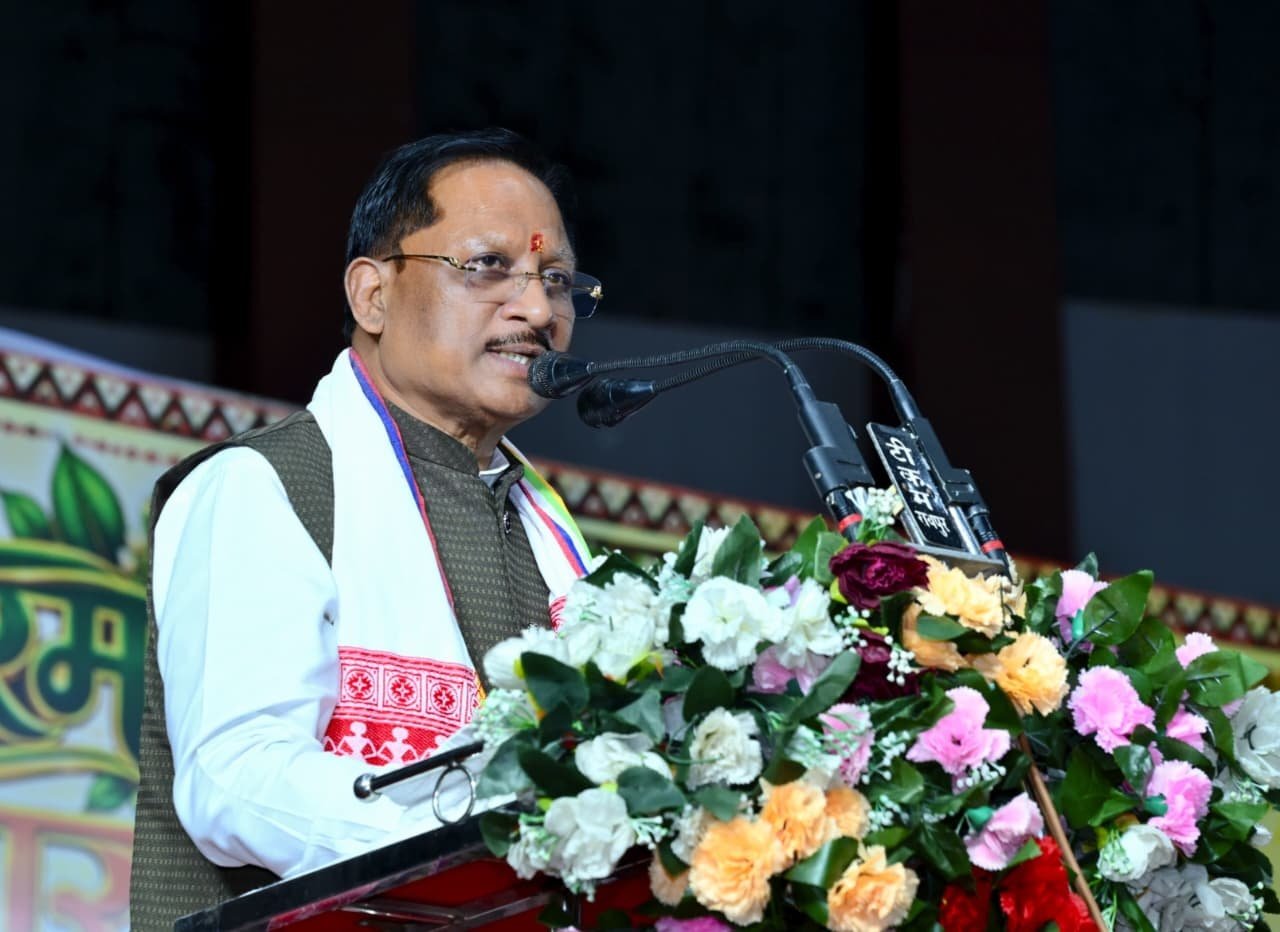
Chief Minister Vishnu Deo Sai addresses the Karma Parab Mahotsav organised by the Youth Wing of Chhattisgarh Pradesh Kanwar Samaj at Balbir Singh Juneja Indoor Stadium in Raipur on Friday, October 9, 2026, highlighting the importance of tribal traditions, nature conservation and youth empowerment. Photo: channel24india.com via CG/DPR
Chief Minister Announces ₹1 Crore for Community Infrastructure and Annual Celebrations; Urges Tribal Youth to Embrace Education, Technology and Employment While Preserving Their Cultural Identity
Key Highlights
- Chief Minister Vishnu Deo Sai describes Karma Tihar as a living symbol of Chhattisgarh’s tribal traditions, cultural identity and reverence for nature.
- Sai announces ₹90 lakh for community buildings and a cultural stage, besides ₹10 lakh for organising the annual Karma Mahotsav in Raipur.
- Chief Minister praises the Kanwar community for preserving its ancestral traditions and promoting social unity.
- Government prioritises tribal education, healthcare, employment, entrepreneurship and economic empowerment through PM-JANMAN and Dharti Aaba initiatives.
- Tribal Youth Hostel in Delhi expands its capacity to 200 seats to support students preparing for competitive examinations.
- Sai encourages young people to pursue modern education, reject addiction and contribute to building a developed Chhattisgarh.
Raipur : Chief Minister Vishnu Deo Sai has described Karma Tihar as an enduring expression of Chhattisgarh’s rich tribal heritage, cultural traditions and deep-rooted relationship with nature, emphasising that preserving ancestral values while embracing education and modern opportunities is essential for the progress of tribal communities.
Addressing the Karma Parab Mahotsav organised by the Raipur Mahanagar Unit of the Youth Wing of Chhattisgarh Pradesh Kanwar Samaj at Balbir Singh Juneja Indoor Stadium on Friday, October 9, 2026 Sai said traditional festivals were not merely occasions for celebration but also powerful reminders of society’s responsibility towards nature, cultural continuity and collective harmony.
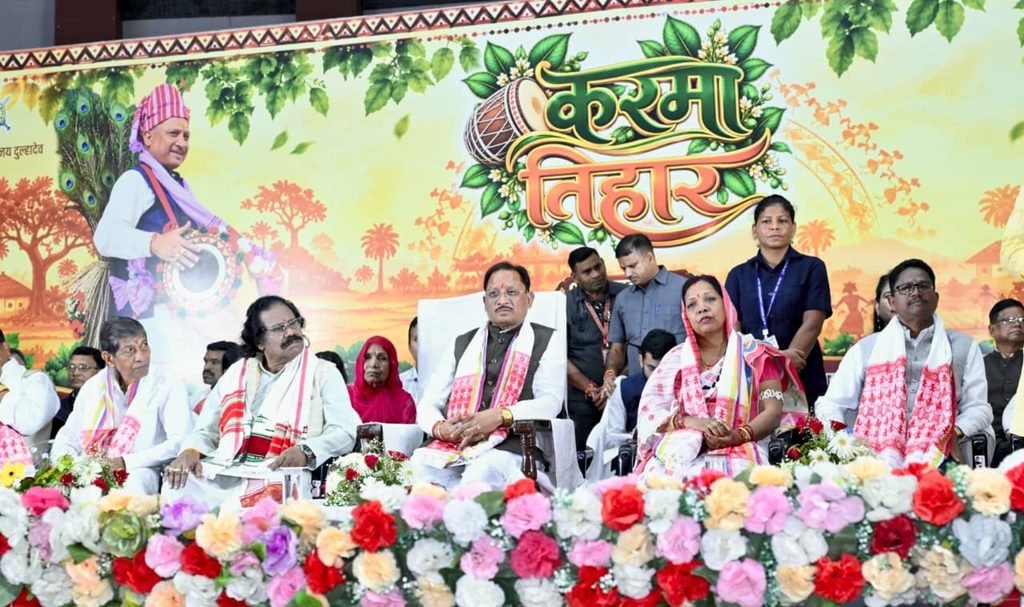
Chief Minister Vishnu Deo Sai, accompanied by his wife, Kaushalya Sai, attends the Karma Parab Mahotsav organised by the Kanwar community at Balbir Singh Juneja Indoor Stadium, Raipur, on Friday, October 9, 2026. Community leaders and other dignitaries are also present on the dais. Photo: channel24india.com via CG/DPR
“Karma Tihar is a unique symbol of our rich tribal culture, traditions, faith and gratitude towards nature. Such festivals remind us to remain connected to our roots while strengthening social unity and our commitment to environmental conservation,” the Chief Minister said.
Sai inaugurated the programme by performing traditional rituals and offering prayers. He extended greetings to members of the Kanwar community and the people of Chhattisgarh on the occasion of Bhado Ekadashi Vrat and Karma Tihar.
The Chief Minister praised the Kanwar community for preserving its customs and traditions despite changing social circumstances, describing its commitment to cultural heritage as an example for younger generations.
He said cultural identity was not an obstacle to progress but a source of strength that helped communities maintain unity and self-confidence while adapting to modern developments.
Recognising the community’s social and cultural requirements, Sai announced financial assistance totalling ₹1 crore for infrastructure development and the continuation of traditional celebrations.
The announcements included ₹50 lakh for constructing a community building at Madwarani in Korba district, ₹25 lakh for another community building at Tatibandh in Raipur and ₹15 lakh for developing a cultural stage at Jefra village in Kanker district.
An additional ₹10 lakh was announced for organising Karma Mahotsav annually in Raipur.
The Chief Minister congratulated the Kanwar Samaj Youth Wing and community representatives for organising the celebration and encouraging wider participation in cultural activities.
Explaining the spiritual and environmental significance of Karma Tihar, Sai said the festival represented the inseparable relationship between human life and the natural world.
During the celebrations, community members worship the Karam Daar, observe traditional fasts and perform rituals expressing gratitude towards nature.
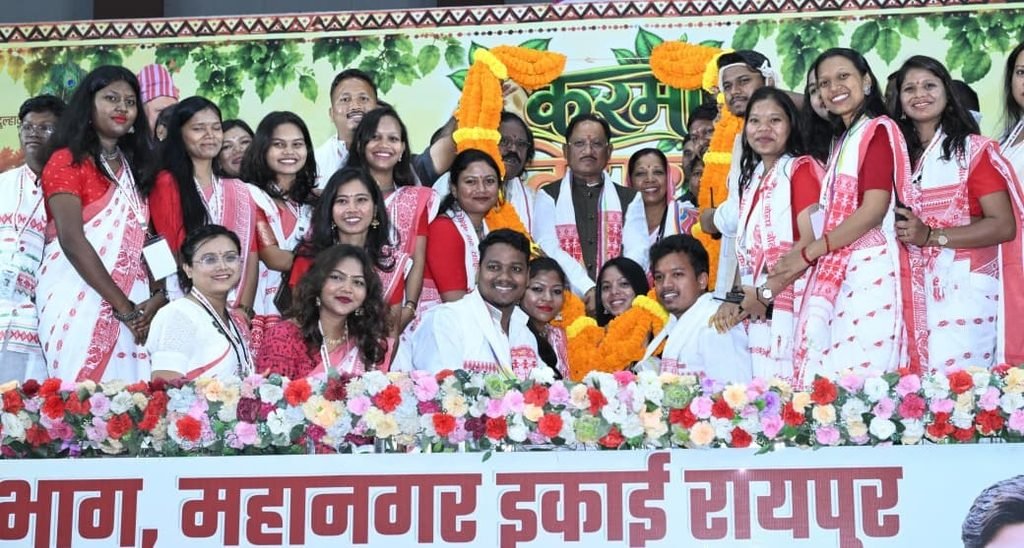
Chief Minister Vishnu Deo Sai and his wife, Kaushalya Sai, National President of All India Kanwar Samaj, join enthusiastic young members and women of the Kanwar community during the Karma Parab Mahotsav at Balbir Singh Juneja Indoor Stadium, Raipur, on Friday, October 9, 2026. Photo: channel24india.com via CG/DPR
Traditional Karma songs and dances form an integral part of the festivities, bringing families and communities together in an atmosphere of devotion and celebration.
The following day, devotees conclude their fast after the ceremonial immersion of the Karam Daar.
Sai said these customs, preserved across generations, reflected the understanding that human well-being depended on maintaining harmony with the environment.
“Our ancestors never considered nature merely a resource. They regarded it as the foundation of life and an inseparable part of our culture. Our relationship with water, forests and land is based not only on necessity but also on faith and a deep sense of belonging,” he observed.
The Chief Minister linked the festival’s environmental message with Prime Minister Narendra Modi’s Ek Ped Maa Ke Naam initiative, which encourages citizens to plant trees in honour of their mothers.
He said the campaign had transformed environmental conservation into a wider public movement and encouraged citizens to accept personal responsibility for protecting natural resources.
In Chhattisgarh, plantation activities were also being promoted through the Seva Sankalp Abhiyan.
Sai stressed that protecting the environment was not solely the government’s responsibility but a collective obligation towards future generations.
The Chief Minister also appreciated the Kanwar community’s increasing emphasis on education, social reform and freedom from addiction.
He said communities that successfully combined cultural preservation with educational advancement were better positioned to overcome social and economic challenges.
“Education, values, organisation and awareness are essential for the progress of any community. Our young people must acquire modern knowledge, embrace science and technology, and explore new opportunities without losing their cultural identity,” Sai said.
He urged young people to stay away from addiction, educate others about its harmful consequences and strengthen social harmony.
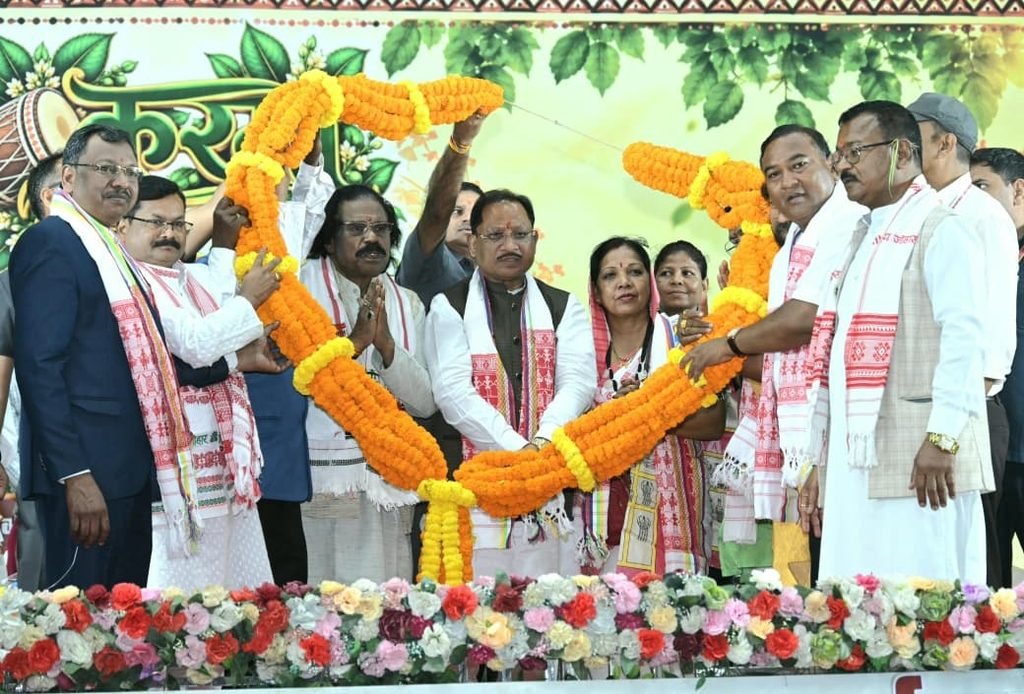
Kanwar Samaj representatives honour Chief Minister Vishnu Deo Sai and Kausalya Sai with a traditional marigold garland in the presence of his wife, Mrs Kaushalya Sai, during the Karma Parab Mahotsav at Balbir Singh Juneja Indoor Stadium, Raipur, on Friday, October 9, 2026. Photo: channel24india.com via CMO
The Chief Minister expressed particular satisfaction that the Karma Parab Mahotsav had been organised by the community’s youth wing, describing it as evidence of the younger generation’s willingness to preserve ancestral traditions.
He said cultural programmes organised by young people could strengthen intergenerational relationships and ensure that traditional knowledge continued to remain relevant.
Turning to the development of tribal communities, Sai said the Central and state governments were working together to expand access to education, healthcare, housing, employment and essential infrastructure.
He described the election of President Droupadi Murmu, who belongs to a tribal community, to the country’s highest constitutional office as a source of pride and inspiration.
The Chief Minister said the government was determined to ensure that tribal families living in remote and underserved regions received equal opportunities for social and economic advancement.
Under the Pradhan Mantri Janjati Adivasi Nyaya Maha Abhiyan (PM-JANMAN), efforts were being made to provide permanent housing, roads, drinking water, healthcare, education and other essential facilities to Particularly Vulnerable Tribal Groups.
Similarly, the Dharti Aaba Janjatiya Gram Utkarsh Abhiyan was accelerating development in tribal-majority villages.
Sai emphasised that the success of welfare programmes depended not merely on their announcement but on ensuring that their benefits reached the intended beneficiaries.
“Our priority is not simply to formulate development schemes but to ensure that their benefits reach the last person in tribal society and bring meaningful improvements to people’s lives,” he said.
The Chief Minister highlighted the government’s initiatives to improve educational opportunities for tribal youth, particularly those living in remote areas.
He said schools that had remained closed for years in parts of Bastar had reopened, enabling children to resume their education in areas previously affected by Naxalism.
The reopening of educational institutions, he said, was an important step towards creating a more secure and promising future for children in the region.
Sai also announced that the Tribal Youth Hostel in Delhi had expanded its capacity to 200 seats, providing additional accommodation and support for young people from Chhattisgarh preparing for competitive examinations.
He said access to educational facilities in major cities could help talented students overcome geographical and economic barriers.
The Chief Minister referred to the recently organised State-Level Employment Fair in Raipur, where thousands of young people were offered employment opportunities.
He said the state’s new Industrial Policy contained special provisions for Scheduled Tribes to encourage entrepreneurship and self-employment.
The government’s objective, he explained, was to enable young people not only to secure employment but also to establish enterprises capable of generating jobs for others.
Sports infrastructure and training facilities were also being expanded to help talented athletes from tribal regions compete at national and international levels.
“There is no shortage of talent in our tribal regions. What our young people need are opportunities, proper training and the resources to demonstrate their abilities. Our government is committed to providing them with these facilities,” Sai said.
Agricultural development and the economic security of rural families also featured prominently in the Chief Minister’s address.
Sai reiterated that the government had fulfilled its commitment to paying two years of pending paddy bonuses to farmers.
He said ₹3,716 crore had been transferred directly into farmers’ bank accounts on Good Governance Day, observed on the birth anniversary of former Prime Minister Atal Bihari Vajpayee.
The government was also procuring up to 21 quintals of paddy per acre at ₹3,100 per quintal, he said.
According to the Chief Minister, strengthening agricultural incomes and making farming more profitable remained essential to Chhattisgarh’s long-term economic development.
He also highlighted measures undertaken to improve the livelihoods of forest-dependent families.
The remuneration for tendupatta collection had been increased from ₹4,000 to ₹5,500 per standard bag, benefiting lakhs of families associated with the forest-based economy.
The Charan Paduka Yojana had also been revived to provide additional support and convenience to tendupatta collectors.
Sai said forest-dwelling communities played an important role in the state’s social and economic life and deserved greater access to development opportunities.
Women’s economic empowerment was another priority highlighted during the programme.
The Chief Minister said the Mahtari Vandan Yojana was providing ₹1,000 every month directly into the bank accounts of eligible women across Chhattisgarh.
He said the assistance was helping women meet household requirements, build savings and undertake small income-generating activities.
“When women become economically empowered, the entire family and society become stronger. Mahtari Vandan Yojana has helped increase women’s confidence, dignity and ability to make independent decisions,” Sai said.
The Chief Minister also reiterated the government’s commitment to providing permanent housing to economically disadvantaged families.
He recalled that the state government had approved 18 lakh houses under the Pradhan Mantri Awas Yojana during its first Cabinet meeting.
Approximately 1,600 houses were now being constructed daily across the state, he said.
Under the Deendayal Upadhyay Bhumiheen Krishi Majdoor Kalyan Yojana, eligible landless agricultural labourer families were also receiving ₹10,000 annually in financial assistance.
Sai said these measures reflected the government’s commitment to improving living standards and extending social security to vulnerable sections of society.
He urged members of the Kanwar community, particularly young people, to remain actively involved in education, social reform, environmental protection, employment and entrepreneurship.
The Chief Minister said cultural preservation and modern development should progress together rather than be viewed as competing priorities.
“Our traditions give us identity and strength. While preserving this heritage, we must move forward through education, awareness, social unity and economic progress. Every young person has a role in building a developed Chhattisgarh,” Sai emphasised.
Addressing the gathering, All India Kanwar Samaj National President Kaushalya Sai also highlighted the importance of protecting cultural traditions and the natural environment.
She said unnecessary interference with nature disturbed ecological balance and called upon community members to recognise environmental conservation as a shared responsibility.
Former National Commission for Scheduled Tribes Chairman Dr Nand Kumar Sai, Chhattisgarh Scheduled Tribes Commission Chairman Roop Singh Mandavi, Chhattisgarh State Forest Development Corporation Chairman Ramsevak Paikra, MLA Anuj Sharma, Chhattisgarh Housing Board Chairman Anurag Singh Deo, former Cabinet Minister Nanki Ram Kanwar, Pradesh Kanwar Samaj President Harvansh Singh Miri and Raipur Mahanagar Kanwar Samaj President Manohar Singh Paikra were among the dignitaries present.
The celebration brought together community leaders, youth representatives, women and families in a colourful display of Chhattisgarh’s tribal traditions.
The Chief Minister’s participation and financial announcements reinforced the government’s stated commitment to preserving cultural heritage while expanding education, infrastructure and economic opportunities for tribal communities.
The occasion also conveyed a wider message: that cultural traditions rooted in respect for nature, social responsibility and collective participation can remain relevant in a rapidly changing society.