Kumar Bahukhandi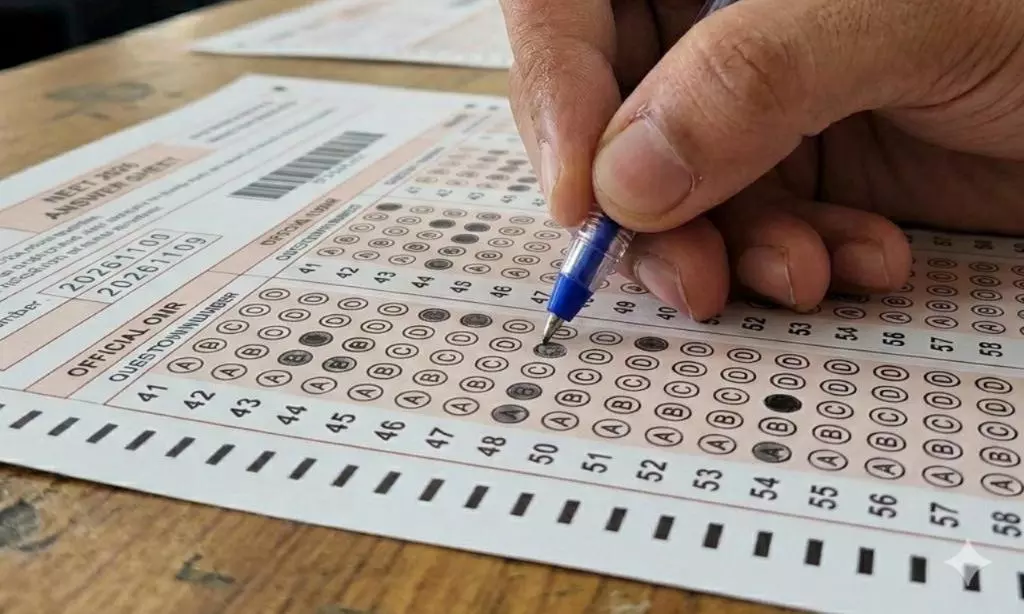
An aspirant marks answers on an OMR sheet. The CBI charge sheet in the NEET-UG 2026 paper leak case relies on digital records, phone-location data, coaching notebooks and forensic comparison of allegedly leaked questions to reconstruct the suspected chain of disclosure. Representational AI-generated Image
Society access records, phone locations, coaching notebooks and forensic comparison of leaked questions form key pieces of evidence; 13 accused named in the case
New Delhi: The investigation into the NEET-UG 2026 paper leak has moved beyond allegations of a conventional question-paper theft. The CBI charge sheet presents what investigators describe as a trail of digital records, reconstructed questions and alleged misuse of access by subject experts associated with the National Testing Agency (NTA).
Filed before a special CBI court on July 28 against 13 accused, the charge sheet relies substantially on digital and circumstantial evidence to establish how confidential examination material was allegedly reconstructed and passed to aspirants before the May 3 examination.
A residential society app becomes evidence
One unusual element in the investigation is the access-control application used at the Pune residential society where NTA chemistry expert P.V. Kulkarni lived.
According to officials familiar with the charge sheet, records from the application were used to establish visits by students and parents to the society during April. Investigators reportedly matched these records with call-detail records and mobile-phone location data to corroborate their presence.
The significance of the evidence is not the application itself, but the digital trail it allegedly preserved—turning routine visitor records into material capable of independently supporting other evidence collected during the investigation.
Three subject experts under the scanner
The CBI case centres on three Pune-based subject experts associated with the NTA examination process—Kulkarni in chemistry, Manisha Gurunath Mandhare in zoology and botany, and Manisha Sanjay Havaldar in physics.
The agency alleges that procedural weaknesses surrounding the confidential question-setting, translation and back-translation exercise were exploited to reconstruct questions after the experts had left the secured NTA environment.
Investigators allege that Kulkarni used a combination of memory and brief notes to reconstruct questions, while other material was allegedly reproduced after the experts returned to their hotel rooms. These remain prosecution allegations and will have to withstand judicial scrutiny during trial.
Coaching notebooks provide another link
The investigation also focuses on special coaching sessions allegedly conducted in Pune before the examination.
The CBI claims that students attending some of these sessions wrote down questions dictated during classes, with certain questions reportedly marked as “important” or “very important.” Investigators subsequently obtained notebooks and compared their contents with material appearing in the examination.
Beautician Manisha Sanjay Waghmare is alleged to have played an important intermediary role by obtaining and circulating material through a network extending to aspirants in Rajasthan and Haryana.
The agency has also alleged that Havaldar supplied 16 pages containing 68 physics questions to the mother of an aspirant at Mandhare’s instance.
Expert comparison finds substantial matches
To scientifically assess the alleged leak, material recovered from aspirants and intermediaries was sent to an expert panel constituted by Delhi University.
According to the investigation, comparison with four NEET-UG 2026 sets—Kailash, Shivalik, Set 2 and Set 3—produced varying levels of similarity. The CBI claims that the sets to which particular experts had access produced substantially higher matches, in some instances reaching about 85 per cent, while sets outside their access showed fewer similarities.
A coaching-centre owner, Shivraj Raghunath Mutgaonkar, has also been named as an accused. Investigators allege that he obtained questions through an intermediary and provided them to students for monetary consideration.
The larger issue: protecting examination integrity
Beyond individual criminal liability, the charge sheet raises an institutional question for India’s examination system: whether restricting physical access to a question paper is sufficient when people involved in preparing it may be capable of reconstructing substantial portions from memory, notes or repeated exposure.
The case therefore places the spotlight on safeguards surrounding question-setting teams, post-session monitoring, conflicts involving private coaching and the digital audit trail associated with personnel handling confidential examination material.
At the same time, a charge sheet represents the investigating agency’s case and does not establish guilt. The allegations against each accused will ultimately be tested through evidence and arguments before the competent court.
For millions of students competing through examinations such as NEET, the wider significance is clear. Examination security is not merely about guarding a sealed paper; it also depends on protecting the entire chain through which questions are conceived, reviewed, translated and handled before they reach an examination centre.