Kumar Bahukhandi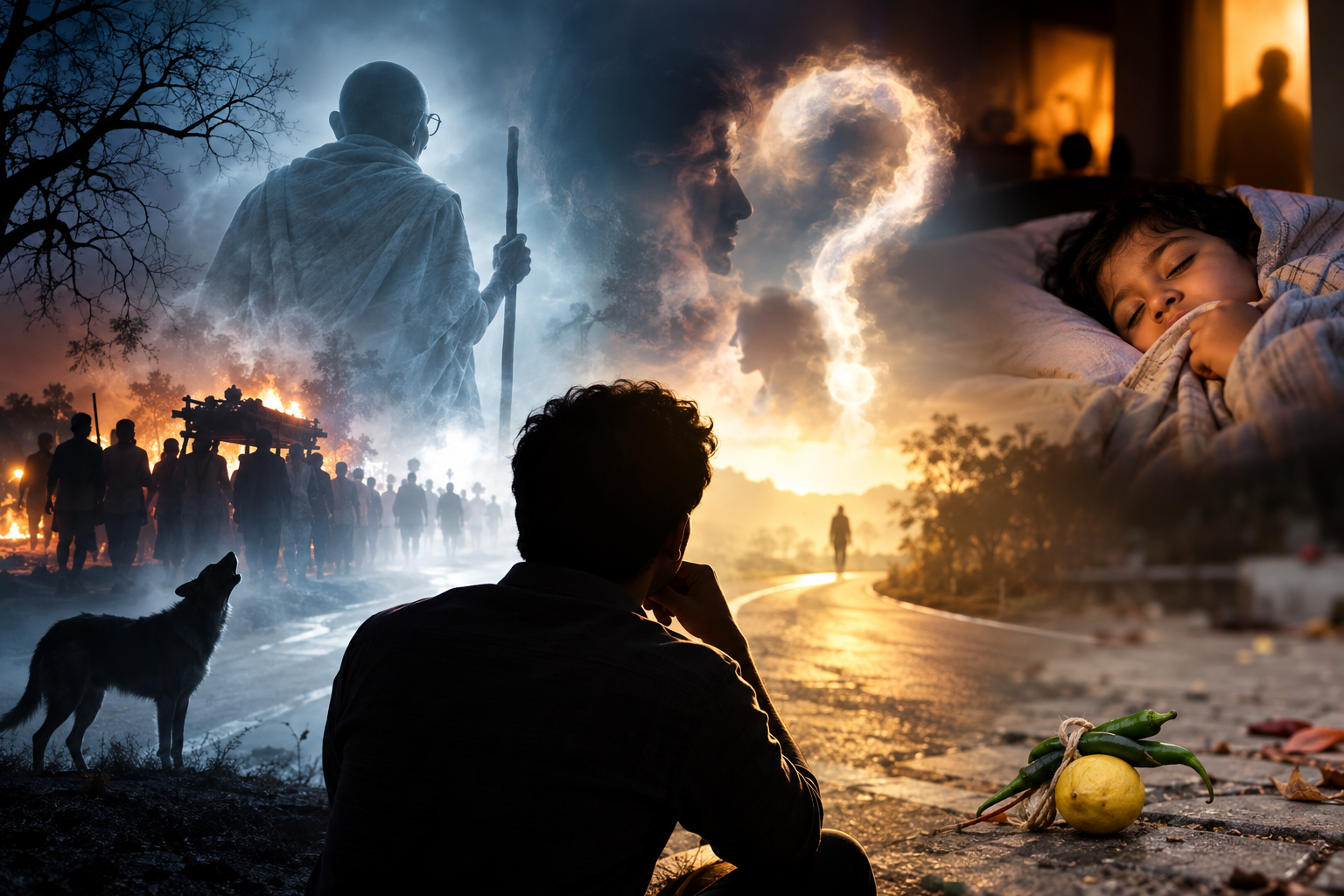
Since time immemorial, human beings have wondered whether there is something beyond what the eye can see and reason can comfortably explain. The supernatural has survived centuries of scientific progress, not necessarily because it has been proved, but because the questions surrounding it have never completely disappeared.
Some believe. Some dismiss. Many of us probably stand somewhere in between.
There are moments when an unusual sound, an unexpected shadow or an inexplicable experience makes even a sceptical mind hesitate. Was it real? Was it imagination? Was it fear playing tricks on the mind? Or was it simply a coincidence that acquired meaning because we were already prepared to see something mysterious in it?
We often disregard such experiences almost immediately. Yet the same mind that rejects them during daylight may interpret them very differently on a lonely road at midnight.
Think of the associations we inherit almost unconsciously: a cremation ground after dark, a funeral procession passing by, the prolonged howl of a dog at night, or a knotted lemon-and-chillies lying abandoned on the road. None of these proves anything supernatural. Yet each can awaken memories, warnings and superstitions absorbed over years from family, folklore, films and society.
Perhaps the supernatural sometimes begins not outside us, but within us.
Popular cinema has repeatedly played with this uncertainty. In Lage Raho Munna Bhai, Munna begins seeing and conversing with Mahatma Gandhi. Within the narrative, the experience becomes a device through which Gandhian ideas enter his everyday life. A rational observer, however, might naturally ask whether such an experience should be understood as vision, imagination or hallucination.
Films dealing with loss and spirituality have similarly portrayed characters who continue to see, hear or communicate with people who are no longer alive. Cinema has the freedom to turn such encounters into romance, philosophy, spirituality or psychological conflict. Real life is considerably more complicated.
When Memory Begins to Feel Like Presence
Most of us have heard somebody say that they felt the presence of a person they deeply loved after that person’s death. Some speak of dreams. Others describe conversations, signs or an overwhelming feeling that the deceased person was somehow nearby.
Should every such experience be dismissed as superstition? Equally, should every such experience be accepted as evidence of spirits?
Neither conclusion comes easily.
Grief, memory, affection and longing can be extraordinarily powerful. A person we have loved for decades does not simply disappear from our inner world when that person dies. Their voice may remain in memory. We may know what advice they would have given us. At a difficult moment, we may even find ourselves silently asking them what to do.
That emotional experience is real to the person experiencing it. But the sincerity of an experience and proof of a supernatural explanation are two different things.
There are also practices intended deliberately to establish communication with the dead. The planchette, séances and various spiritual practices have long attracted people who believe communication with spirits is possible. Others regard the same practices as products of suggestion, expectation and unconscious human behaviour.
The disagreement itself tells us something fascinating about the human mind: we do not merely experience the world; we also interpret it.
What one person calls a spirit, another may call a hallucination. What one calls divine intervention, another calls coincidence. What appears to one person as a message from beyond may appear to another as the mind searching for meaning.
And sometimes neither side can conclusively demonstrate what happened.
This is where I find the idea of an ontological mirage interesting: something appears to possess an independent existence, yet we remain uncertain whether what we are seeing belongs to external reality or has been constructed by perception, expectation and belief.
There is an amusing contradiction here too.
If somebody sees a beloved person who has died and derives comfort or guidance from the experience, we may be tempted to describe it as spiritual. If the same person sees a frightening stranger who does not exist, we may immediately call it hallucination.
Why should affection change our vocabulary?
Perhaps the more meaningful question is not simply, “Did you see something?” but “What exactly did you experience, and why did your mind understand it in that particular way?”
Children demonstrate this power of belief beautifully.
A child refusing to sleep may suddenly become obedient when warned, “Baba will come.”
Where is this Baba?
Under the bed? Behind the curtain? Outside the window?
Probably nowhere.
Yet, for the frightened child, Baba can become astonishingly real. The child pulls up the blanket, closes the eyes and finally goes to sleep. An imaginary presence has produced a very real response.
Adults may smile at the child, but are we always so different?
We too carry our own Babas—fear, memory, superstition, expectation, inherited beliefs and unexplained experiences. We simply give them more sophisticated names.
Science rightly asks for evidence before accepting extraordinary claims. At the same time, human experience includes emotions and perceptions that cannot always be neatly packaged into immediate explanations. The sensible position, therefore, need not be blind belief or arrogant dismissal. Sometimes the most intellectually honest answer is simply: I do not know.
And perhaps there is nothing embarrassing about those three words.
Buddhist literature contains a striking metaphor comparing worldly appearances to dreams and mirages, reminding us that what appears unquestionably real may not possess the permanence or independent reality we attribute to it. The wording of this teaching appears in Buddha’s Teachings and has circulated widely in collections of Buddhist sayings.
Reality, after all, is not always identical to our perception of it. A mirage does not contain water, but the traveller genuinely sees something shimmering in the distance. Fear may create no ghost, yet the heartbeat it produces is real. Memory may not bring back the dead, yet it can make someone’s presence almost tangible.
So, do spirits exist?
I will leave that question where it has remained for centuries.
The next time something inexplicable makes you stop, look back and wonder whether you really saw what you think you saw, you may choose science, spirituality, psychology, coincidence—or simply smile and continue walking.
As for me, I am quite comfortable leaving a little room for the unknown X-factor.