Kumar Bahukhandi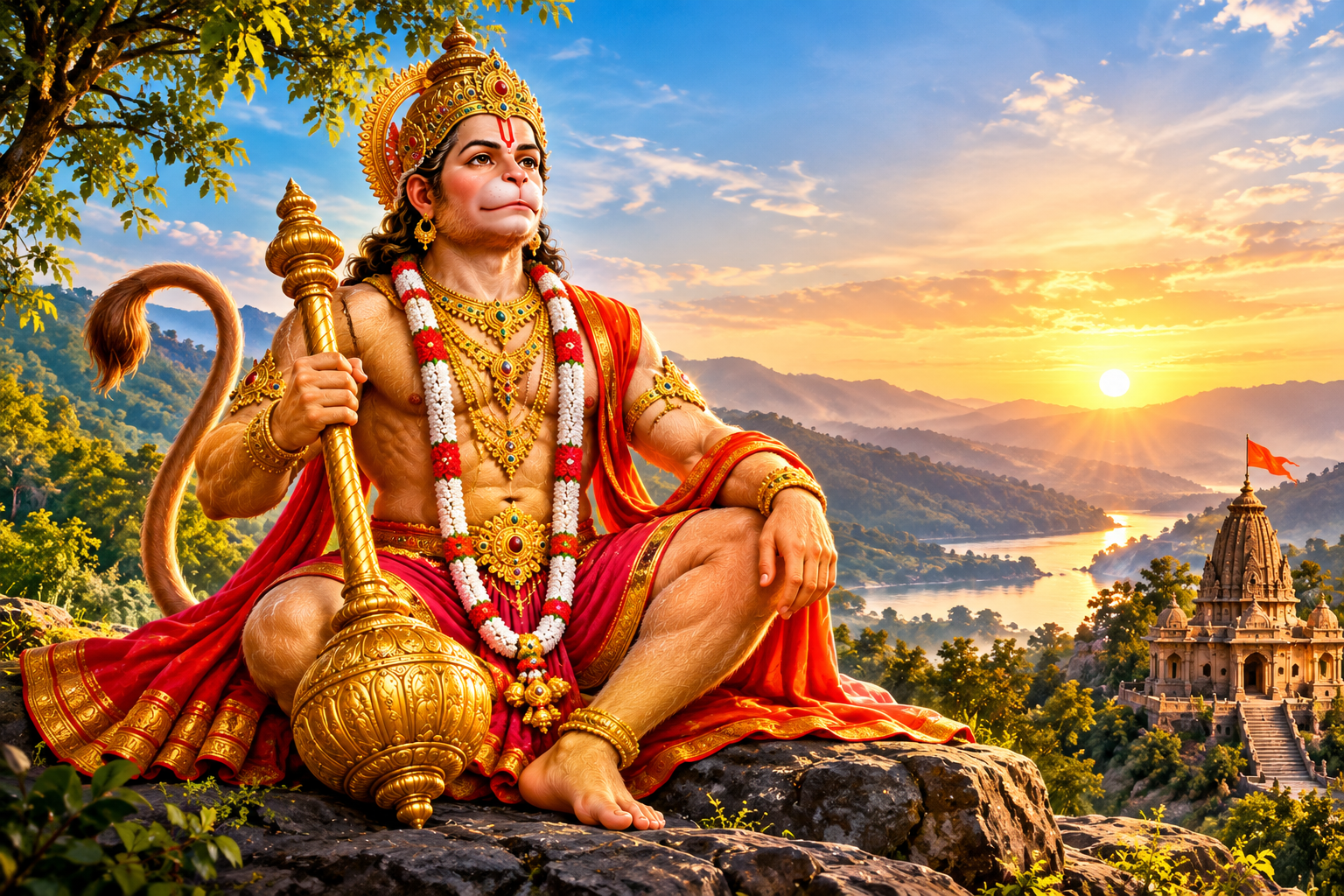
Lord Hanuman, revered as a symbol of strength, courage, devotion and selfless service. The Shri Hanuman Chalisa continues to inspire devotees to seek inner strength and faith during moments of sankat. Illustration: AI-generated for channel24india.com
From a pilot fighting for his life to a young industrialist facing overwhelming responsibility, different experiences show how remembrance of Lord Hanuman can become courage, endurance and inspiration
There are moments in life when knowledge tells us what to do and experience tells us how to act, yet something within us still searches for strength. For millions of devotees, that search leads naturally towards prayer, and among the most familiar and deeply cherished prayers in Indian devotional life is the Shri Hanuman Chalisa.
Its forty verses have travelled through generations. They are recited in temples and homes, before journeys and difficult decisions, during illness and uncertainty, and sometimes in circumstances where fear becomes immediate and intensely personal.
The Shri Hanuman Chalisa repeatedly speaks of courage, protection, service and deliverance from sankat. Yet sankat does not always arrive in the same form. It can be a threat to life, the death of someone loved, an overwhelming responsibility, uncertainty about the future, or simply a moment when one’s inner strength appears inadequate to the situation ahead.
This is what makes three very different contemporary experiences — those of Captain Smit Machchhar, industrialist Kumar Mangalam Birla and former US President Barack Obama — particularly interesting. Their circumstances cannot and should not be equated, but each illustrates, in a different way, how remembrance associated with Lord Hanuman can enter human experience at a moment of vulnerability.
When a Pilot Fighting for His Life Remembered the Shri Hanuman Chalisa
Captain Smit Machchhar’s experience represents perhaps the most dramatic of the three.
During the violent cockpit attack aboard a Flydubai aircraft in 2026, Machchhar was not sitting peacefully in a temple or reciting a prayer as part of his daily routine. He was injured and confronting an immediate threat to his own life as well as the safety of those aboard the aircraft.
Amid the violence and physical pain, his mind returned to the Shri Hanuman Chalisa.
Machchhar later spoke publicly about continuing to recite it during the ordeal. He also recounted his experience while speaking with Prime Minister Narendra Modi from his hospital bed.
There is no reason to separate his professional ability from his faith in order to understand what happened. He was a trained pilot. His experience, judgement, physical effort and decisions were critical. Yet his own account adds another dimension to those facts — while fighting for his life, he turned towards Lord Hanuman for courage and strength.
For Machchhar, therefore, the Shri Hanuman Chalisa was not an interpretation added after the danger had passed. According to his testimony, it accompanied him while the crisis itself was unfolding.
The familiar verse assumes an especially powerful meaning in that context:
संकट तें हनुमान छुड़ावै।
मन क्रम बचन ध्यान जो लावै।।
His was sankat in its most immediate form — survival.
At 27, Kumar Mangalam Birla Faced a Very Different Sankat
Kumar Mangalam Birla’s experience could hardly have been more different.
He was only 27 when his father, industrialist Aditya Vikram Birla, died in 1995. It was first a son’s personal loss, but grief was accompanied almost immediately by another formidable reality. A young man suddenly had to shoulder responsibility for a vast business legacy.
Birla has recalled the uncertainty of that period and the difficulty of imagining how he would manage everything that had unexpectedly come before him. During that phase, he has said, he began reciting the Shri Hanuman Chalisa four times a day.
Nothing about the situation disappeared simply because he prayed.
His father’s death remained irreversible. The businesses still had to be managed. Decisions still had to be taken. Responsibility still had to be carried and the future still had to be confronted.
That is precisely why his experience deserves attention.
Captain Machchhar turned towards the Shri Hanuman Chalisa while fighting for his life. Kumar Mangalam Birla turned towards it while seeking the strength to shoulder an overwhelming responsibility.
One crisis unfolded within terrifying moments. The other demanded endurance over years.
The difference helps us understand sankat more deeply.
Deliverance from sankat need not always mean that the difficulty itself disappears. Sometimes it may mean discovering the strength to walk through it.
Lord Hanuman in the Pocket of an American President
Barack Obama’s experience introduces an entirely different dimension.
During a White House interview in 2016, the then US President displayed several small personal objects that he carried with him. Among them was a small figurine of Lord Hanuman.
Obama explained that these keepsakes reminded him of people he had encountered and their stories. When he became tired or discouraged, the objects could help him regain perspective, remember the people whose lives were affected by his decisions and renew his determination to continue.
His experience must be represented accurately. There is no reason to claim that Obama recited the Shri Hanuman Chalisa, nor did he present the figurine as evidence of supernatural intervention.
Its significance lies somewhere else.
A representation of Lord Hanuman had crossed geographical, cultural and religious boundaries to become one of the personally meaningful objects carried by a President of the United States.
Machchhar’s experience was about survival. Birla’s was about strength amid grief and responsibility. Obama’s was about remembrance and inspiration.
Survival. Strength. Inspiration.
Three very different experiences, but each touches a point where ordinary human strength encounters its perceived limits.
Why Lord Hanuman Represents More Than Escape from Difficulty
The enduring appeal of the Shri Hanuman Chalisa also lies in the character of Lord Hanuman himself.
Lord Hanuman is not remembered as a passive observer of adversity.
He crosses the ocean. He searches for Sita. He enters Lanka. He confronts danger. He brings the Sanjeevani when Lakshman lies unconscious. He serves Lord Ram with complete devotion.
His strength is accompanied by humility. His intelligence is directed towards purpose. His courage leads to action. His extraordinary abilities remain inseparable from service.
The Shri Hanuman Chalisa therefore contains not merely a promise of protection but a devotional model of active courage.
दुर्गम काज जगत के जेते।
सुगम अनुग्रह तुम्हरे तेते।।
The verse does not tell the devotee that life will contain no difficult tasks. It places the difficult beside the possibility of overcoming it through grace.
Another line speaks even more directly to fear:
तुम रक्षक काहू को डरना।।
To someone frightened or vulnerable, such words are not merely literary expressions. Within devotion, they carry the assurance that the individual does not confront difficulty alone.
Devotion Does Not Need a Certificate from Science
Discussions about ancient devotional practices sometimes fall into an unnecessary argument. One side tries to declare everything scientifically proved, while another assumes that whatever cannot be scientifically demonstrated has little meaning.
The Shri Hanuman Chalisa does not require either approach.
Science and devotion need not be placed in a hierarchy.
Science seeks knowledge through observation, investigation, evidence and reason. Devotion grows through shraddha, remembrance, surrender and the relationship between the devotee and the divine.
To place devotion above science as a scientific proposition would misunderstand science. But to place devotion beneath science merely because devotion cannot always be measured would misunderstand devotion.
The Shri Hanuman Chalisa does not become meaningful because science approves it, nor does it become less meaningful where science remains silent.
Its primary realm is devotion.
A devotee reciting
संकट कटै मिटै सब पीरा।
जो सुमिरै हनुमत बलबीरा।।
is not conducting an experiment.
The devotee is remembering Lord Hanuman.
Knowledge Has Its Place, and So Does Shraddha
Indian philosophical thought itself offers a wider understanding of knowledge and spiritual experience.
The Bhagavad Gita says:
तपस्विभ्योऽधिको योगी ज्ञानिभ्योऽपि मतोऽधिकः।
कर्मिभ्यश्चाधिको योगी तस्माद्योगी भवार्जुन।।
The verse does not ask us to reject knowledge. Rather, it reminds us that intellectual knowledge does not exhaust the possibilities of human experience.
Knowledge has its place. Action has its place. Discipline has its place. And shraddha has its place.
A trained pilot can rely upon his professional knowledge while also praying.
An industrialist can exercise judgement and leadership while seeking strength from Lord Hanuman.
A President operating within the intensely rational world of government can still carry a sacred symbol that possesses deeply personal meaning.
Human experience is large enough to contain all of these dimensions.
The Miracle May Also Be the Strength to Continue
The word miracle often makes us look for something spectacular. Perhaps that understanding is too narrow.
A person survives circumstances that appeared almost impossible.
Someone grieving finds the courage to shoulder a responsibility that initially appeared unbearable.
Someone exhausted finds enough inner strength to rise again and continue.
The external circumstances may not always change.
Sometimes the person confronting them does.
This is where the meaning of sankat and shraddha meet.
The Shri Hanuman Chalisa lives not only in books or temples but also in memory. That means it can accompany the devotee wherever life leads — into a home, a hospital, an office, an aircraft or a moment when nobody else can fully understand the fear within.
And therein may lie one of its most profound meanings.
The perceived power of the Shri Hanuman Chalisa may lie not only in the hope that Lord Hanuman will remove sankat, but also in the faith that the devotee will not face sankat alone.
The miracle, within lived faith, may sometimes be survival.
At other times, it may be courage.
And sometimes, it may simply be the strength to continue.
— Kumar Bahukhandi
Assistant Professor, Journalism & Mass Communication
Working Journalist & Editor