Kumar Bahukhandi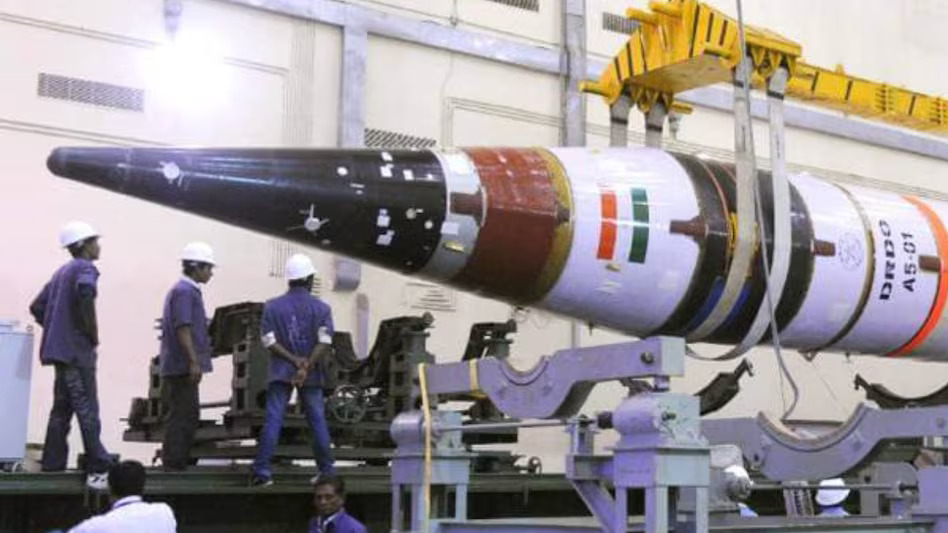
India’s Agni-5 ‘bunker buster’ missile will be capable of carrying an 8-tonne warhead-Photo: X/@DRDO
Compared to the original version of Agni-V, both the new versions will have a range of 2500 kilometers, but their destructive power and accuracy will make them a formidable weapon available in India’s strategic arsenal.
On 22 June, America dropped bunker-buster (GBU-57/A Massive Ordnance Penetrators) bombs from its B-2 bomber planes on Iran’s Fordo nuclear plant. Iran’s major nuclear plant suffered a lot of damage in this air strike. Actually, Iran had built the Fordo nuclear plant 100 meters below the ground amidst the mountains, which cannot be damaged by a normal explosion. That is why America decided to drop bunker-buster bombs on this nuclear plant. These bombs first enter the ground by making a hole of 60 to 70 meters and then explode. That is, these bombs are used to target the enemy’s underground facilities.
India has also accelerated its efforts to develop advanced bunker-buster bombs. Learning from recent global conflicts, the country is preparing for future wars by developing a new and powerful missile system that will be capable of penetrating enemy nuclear bases and other strategic infrastructure built deep below the ground. The Defense Research and Development Organization (DRDO) is developing a modified version of the Agni-V intercontinental ballistic missile. The original version of the Agni-V has a range of over 5000 kilometers and this missile usually carries a nuclear warhead. Its modified version will be a conventional weapon capable of carrying a massive 7500 kg bunker-buster warhead.
Enemy bases built 100 meters below the ground will also be destroyed
Designed to attack enemy military and strategic bases built under strong layers of concrete, this missile will drill down to 80 to 100 meters into the ground before exploding. India’s development of the missile reflects its intent to match the capabilities of the US, which recently used the world’s largest conventional bunker-buster GBU-57/A to attack Iran’s Fordo nuclear plant. The US dropped a total of 14 GBU-57/A bombs on the Iranian nuclear plant. The GBU-57 and its predecessor GBU-43 (known as the Mother of All Bombs) have set standards in the field of deep-penetration weapons.
Indian bunker-buster bombs will cost less to launch
Indian bunker-buster bombs will cost less to launch
The indigenous version of the GBU-57/A being developed by India aims to have greater penetration. To drop the US GBU-57/A bombs, expensive bombers are required. In contrast, India is designing its bunker-buster bombs to be delivered to the target by missiles. That is, the Indian bunker-buster bombs will cost less to launch and will not require expensive bombers. This will give India a big strength in the global weapon market. Two new versions of Agni-V are being developed. One will feature an airburst warhead for above-ground targets, while the other will be a deep-penetrating missile designed to penetrate hardened underground structures. In concept, it will be a bomb similar to the GBU-57, but with a potentially much larger payload.
Indian bunker-buster will be able to carry 8 tonne warhead
Both versions of the Agni-V being developed can have the ability to carry warheads weighing around 8 tonnes, making them one of the most powerful conventional weapons globally. Both the new versions will have a range of 2500 km compared to the original version of Agni-V, but their destructive power and accuracy will make them a formidable weapon available in India’s strategic arsenal. Both these weapons will be especially important for targeting command and control centres, missile sites and other critical military infrastructure of adversary countries like Pakistan and China.
The speed of these missiles is expected to be between Mach 8 to Mach 20 (8 to 20 times the speed of sound), which puts them in the category of hypersonic weapons. They will be equal to the speed of US bunker-buster weapon systems, but their payload carrying capacity will be much higher. India’s effort to indigenously develop and deploy such weapon systems reflects its growing military capabilities and its commitment to becoming self-reliant in defense technology.