Kumar Bahukhandi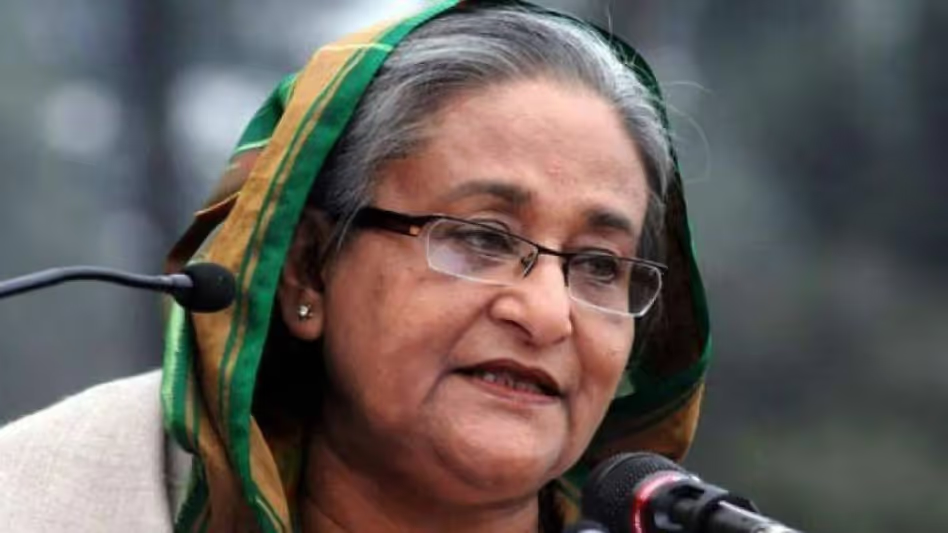
Bangladesh was simmering ever since the country’s high court had in June reinstated a 30 per cent reservation in government jobs for the descendants of freedom fighters who fought in the 1971 liberation war, that was subsequently cut down by the Bangladesh Supreme Court to five per cent on July 21. (This quota, first introduced by Sheikh Mujibur Rahman in 1972, was cancelled by Sheikh Hasina’s government in 2018 after widespread protests.) The underlying idea underscores a schism between those who fought for separation from Pakistan and those who collaborated to continue as East Pakistan.
Bangladesh Prime Minister Sheikh Hasina’s sudden escape to India by helicopter on August 5 took all, especially India, by surprise. She had ruled for the last 15 years, as head of the Awami League party, founded by her father, Sheikh Mujibur Rahman, the nation’s first Prime Minister. His assassination in 1975, followed by political uncertainty, led to two military rulers. First, Lt. Gen. Zia-ur Rahman became President in 1977. Though not named in the conspiracy to assassinate Sheikh Mujib, by mid-level military officers, suspicion always lingered, especially after he rehabilitated them and posted them abroad as diplomats.
These deep fissures persisted in Bangladesh as the Bangladesh Nationalist Party (BNP), led by Begum Khaleda Zia after her husband’s assassination in 1981, aligned with Jamaat-e-Islami, which stood tainted by collaborating with Pakistan prior to 971. President Zia-ur Rahman reoriented Bangladesh’s foreign policy towards the West, Muslim nations like Saudi Arabia and China.
Bangladesh’s Army retained power till Lt. Gen. Hussain Muhammad Ershad was ousted in 1990. His exit coincidentally followed the same path as Sheikh Hasina’s. Popular protests, supported by the Awami League, BNP and Jamaat, forced the Army to abandon the President. With democracy restored, the old political divisions resumed.
However, the problem is not political confrontation but the gradual abandonment of the rules and institutions basic to a functioning democracy. Sheikh Mujibur Rahman too lost popularity by bringing in de facto one-party rule, eventually leading to his assassination. His daughter ignored this lesson over the last 15 years. She defanged the media, the courts and the Opposition parties. Finally, she even abandoned the agreed principle of elections under a neutral interim government. Thus, unsurprisingly the Opposition boycotted the January 2024 national election. This is an old tradition in Bangladesh as even elections held when President Ershad was in power saw similar boycotts.
Prime Minister Sheikh Hasina did bring Bangladesh remarkable economic and social advancement. The country became a major garment export hub, utilising the shift of low-cost manufacturing from China. However, the Covid-19 pandemic dealt this model a serious blow. Bangladesh’s exports fell from $45.99 billion in 2019 to $39.05 billion in 2020. They then rose to $44.38 billion, still below the 2019 mark. The figures were $54.7 billion and $55.79 billion in 2022 and 2023. According to the World Bank, although Bangladesh made a strong post-pandemic economic turnaround, it has been hampered by a balance of payments deficit, financial sector vulnerabilities and global economic uncertainty. Also, despite improved social indicators economic fragility persisted. The sanctions imposed by the United States, loss of preferential tariffs as the country’s economy grew and cronyism constricted the economy. This forced Bangladesh to seek an IMF bailout of $4.7 billion.
On January 9, after her election victory, my article in this newspaper was titled “Hasina’s victory: Time for caution, not complacency”. The Indian government was, however, then completely preoccupied with the upcoming Lok Sabha election. The time for a serious private chat with India’s authoritarian friend in Dhaka slipped by. Generally, repressive politics go poorly with a testy economy.
Like its other South Asian neighbours, Bangladesh too played India against China. Hence the reluctance to advise Sheikh Hasina to moderate her authoritarian instincts. Perhaps the BJP’s own doubtful credentials about preserving Indian democratic conventions and institutions inhibited preaching abroad. A long rope was given as Sheikh Hasina was seen as a bulwark against Islamist forces in India’s politically sensitive Northeast.
The 30 per cent job reservation for descendants of the freedom fighters of 1971 sparked protests by youth. The Supreme Court overturned the reservations on July 21. A narrow window for reconciliation existed before the Opposition parties seized the opportunity to make it a mass movement. As protests swelled, the violent repression took a mounting human toll. Over 10,000 activists, protesters and opposition figures were detained. Remittances from abroad fell and the garment industry took an estimated hit of $10 billion. The Opposition announced a “March to Dhaka”. The BNP student wing “Shibir” was banned under terrorism laws.
The numbers dead on August 4 touched 100. The game passed out of Sheikh Hasina’s hands.
Bangladesh Army chief Lt. Gen. Waker Uz Zaman, who had assumed charge on June 23, arranged for Sheikh Hasina and her sister Sheikh Rehana to be evacuated to India. The Army chief said he will “make sure justice will be served against every death and crime”. At an all-party meeting he announced an interim government, to be soon named. Without a court order, the sudden release of BNP supremo Khaleda Zia is an attempt to calm public sentiments as indeed a sign of change.
India faces the classic dilemma of big powers when their close ally is ousted by a popular upsurge. The US faced it in Iran after the Shah’s ouster in 1979, the consequences of which still persist. The US, by its consistent critique of democratic aberrations in Bangladesh, has a window available for engaging the new order. India’s muteness is now a handicap. Hopefully, the popular anger and retaliation against Hindus and Awami League cadres would subside. Any free election may see the BNP-Jamaat alliance restored and probably victorious. That presents foreign policy challenges for New Delhi as the China-Pakistan alliance may get preferential treatment. The BJP’s anti-Muslim image will hamper its handling of this new orientation.
If law and order collapses, another dose of military rule may be inevitable. India would prefer it to a BNP-Jamaat government. With Nepal and Maldives already in China’s embrace and Sri Lanka tottering, the exit of a friendly government in Bangladesh raises questions about India’s ability to shape politics in its neighbourhood. Could India have strengthened Sheikh Hasina’s hands by not persisting with the Citizenship Amendment Act and coaxing West Bengal chief minister Mamata Banerjee to relent on sharing Teesta waters?
If law and order collapses, another dose of military rule may be inevitable. India would prefer it to a BNP-Jamaat government. With Nepal and Maldives already in China’s embrace and Sri Lanka tottering, the exit of a friendly government in Bangladesh raises questions about India’s ability to shape politics in its neighbourhood. Could India have strengthened Sheikh Hasina’s hands by not persisting with the Citizenship Amendment Act and coaxing West Bengal chief minister Mamata Banerjee to relent on sharing Teesta waters?
All that is speculation. The reality is of a more destabilising order threatening to take power in Bangladesh. India is learning an old lesson. Authoritarian allies take you down when they fall, unless you control them in time or prepare for a soft landing.
The writer is a former secretary in the external affairs ministry