Kumar Bahukhandi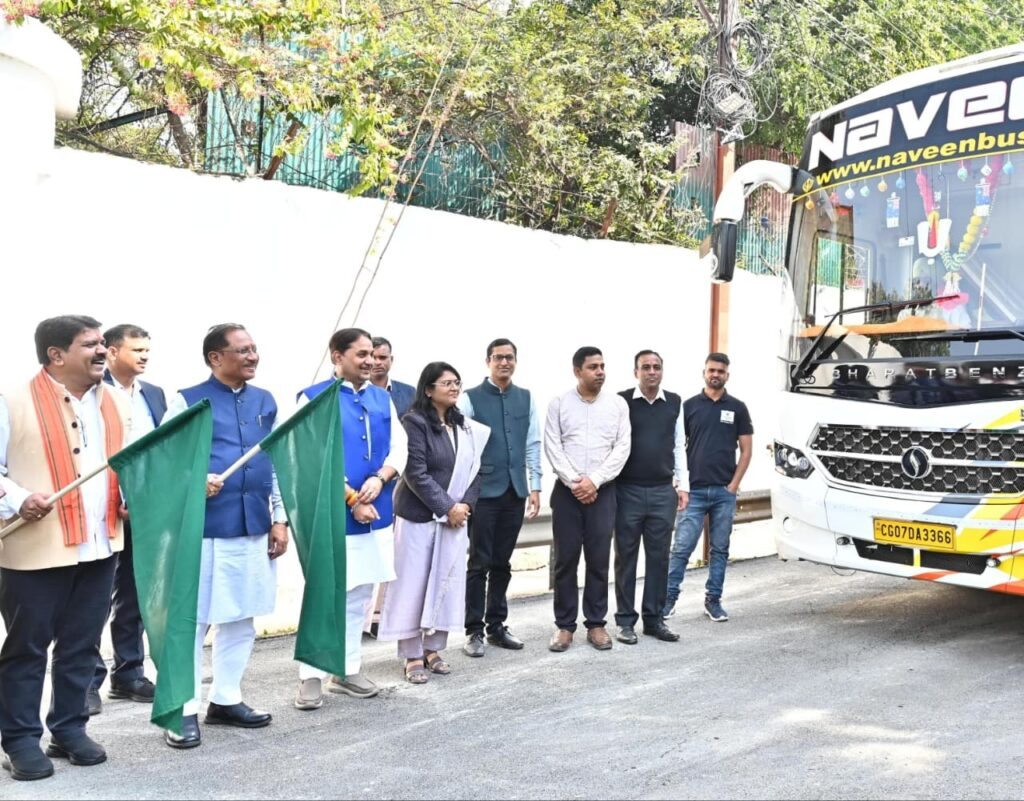
Chief Minister Vishnu Deo Sai and Deputy Chief Minister Vijay Sharma flagging off two buses from the Chief Minister’s residence -Symbolic Image (File Photo )
Chief Minister Rural Bus Scheme 2025: Bringing Accessible Transportation to Remote Villages
In Chhattisgarh, the state government is effectively implementing the Chief Minister Rural Bus Scheme 2025 with the objective of strengthening transportation facilities in rural areas. This scheme is a decisive initiative to extend public transport to villages where passenger bus services were previously unavailable.
The first phase of the scheme includes districts of the Bastar and Surguja divisions.
So far, under the Chief Minister Rural Bus Scheme, bus operations have commenced on a total of 57 selected routes with 57 buses. Through these buses, passenger bus services have reached 330 new villages for the first time, bringing about positive changes in rural life.
The main objective of the scheme is to connect rural areas to block headquarters, urban areas, tehsil headquarters, and district headquarters, where public transport facilities were previously absent. This ensures easy access to education, healthcare, employment, and administrative services for rural citizens.
Under the Chief Minister Rural Bus Scheme, bus operators are being provided financial assistance by the state government on a per-kilometer basis. Assistance is being provided at the rate of ₹26 per kilometer in the first year, ₹24 per kilometer in the second year, and ₹22 per kilometer in the third year.
In addition, a complete exemption from road tax is being provided under the scheme for a maximum period of three years, making bus operations on rural routes economically viable.
The route selection process has been kept completely transparent. Under this scheme, routes are selected by a state-level committee based on the recommendations of a district-level committee, ensuring that areas with genuine need receive priority.
A tender process is followed for bus operations on the selected routes. Through the tender, the eligible applicant proposing the lowest financial rate is selected, minimising the financial burden on the government and ensuring the sustainability of the service. After receiving duly completed permit applications from the successful bidders in the tender process, permits are issued for bus operations following a hearing process. This ensures complete adherence to regulatory procedures.
Currently, the process for operating buses on 12 new rural routes has been completed. In addition, 15 new rural routes have been selected, and tenders have been invited for bus operations on these routes.
District-wise, 8 buses are operating in Sukma, 4 in Narayanpur, 2 in Jagdalpur, 4 in Kondagaon, 6 in Kanker, 7 in Dantewada, 2 in Manendragarh-Chirmiri-Bharatpur, 6 in Surajpur, 5 in Koriya, 7 in Jashpur, 4 in Balrampur, and 2 in Ambikapur. Thus, a total of 57 buses are operating on 57 routes.
Under the future action plan, the target is to operate 200 buses under the Chief Minister’s Rural Bus Scheme in the financial year 2026-27.
This initiative by the state government will enhance connectivity in rural areas, thereby giving a new impetus to inclusive development, social empowerment, and economic activities .