Kumar Bahukhandi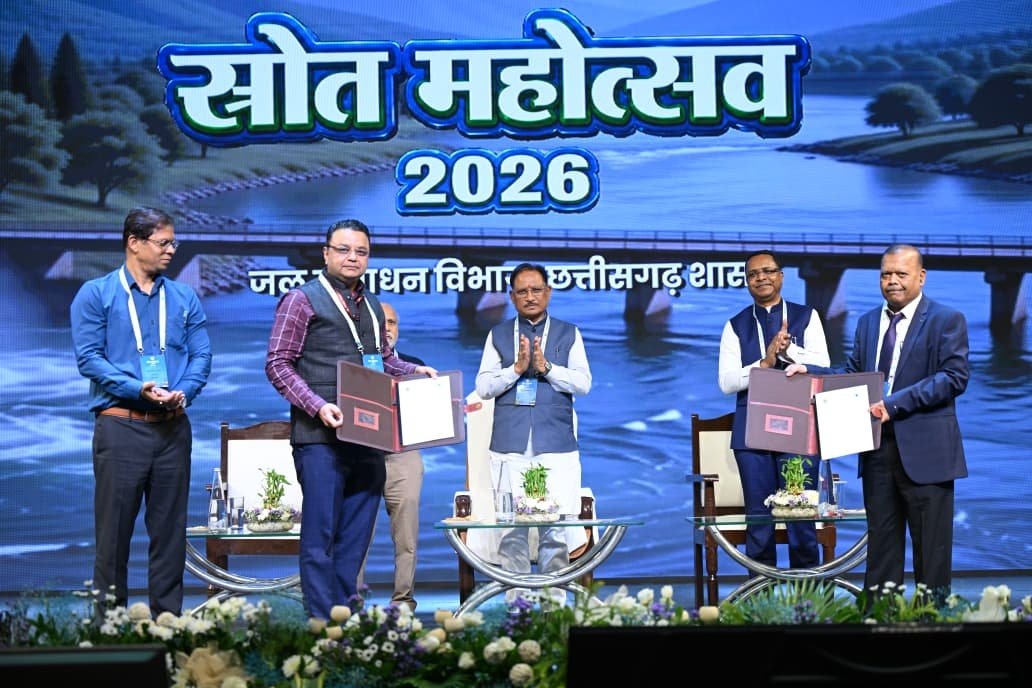
Representatives exchange Memoranda of Understanding with the Chhattisgarh Water Resources Department in the presence of Chief Minister Vishnu Deo Sai during Srot Mahotsav 2026 at Omaya Garden in Raipur on Wednesday, August 19, 2026. The agreements with the National Water Academy, Pune, and Antrix Corporation Limited, Bengaluru, will strengthen training and the use of geospatial technology in water-resource management-Photo Credit:channel24india.com via CMO
Chief Minister inaugurates Srot Mahotsav 2026 in Raipur, calling for a scientific, time-bound strategy to protect river origins, catchment areas and groundwater reserves
Key Factors
- River conservation campaign to rest on five pillars: mapping, protection, recharge, public participation and action planning
- State and district-level committees to prepare time-bound plans for restoring river sources
- MoU with National Water Academy, Pune, to strengthen training and technical capabilities
- Antrix Corporation to support scientific monitoring through advanced geospatial technology
- Around 1,540 square kilometres of Kunkuri tehsil to be covered in the initial phase
- Nine river groups to develop science-based and site-specific restoration solutions
- Chief Minister releases Neer-Nari-Nidhi, a book documenting water-conservation initiatives
Raipur : Rivers must be protected because their survival is inseparably linked to water security and human life, Chhattisgarh Chief Minister Vishnu Deo Sai said while inaugurating Srot Mahotsav 2026 and a state-level workshop at Omaya Garden in Raipur on Wednesday, August 19, 2026.
“Rivers are not merely sources of water; they are the lifelines of our civilisation, culture, agriculture and prosperity. If rivers survive, water will survive—and if water survives, life will survive,” Sai said.
The Chief Minister inaugurated the workshop by lighting the ceremonial lamp. The programme brought together water and river-management experts, members of state and district-level committees, district representatives and officials to formulate a scientific and time-bound strategy for protecting the origins and catchment areas of Chhattisgarh’s rivers.
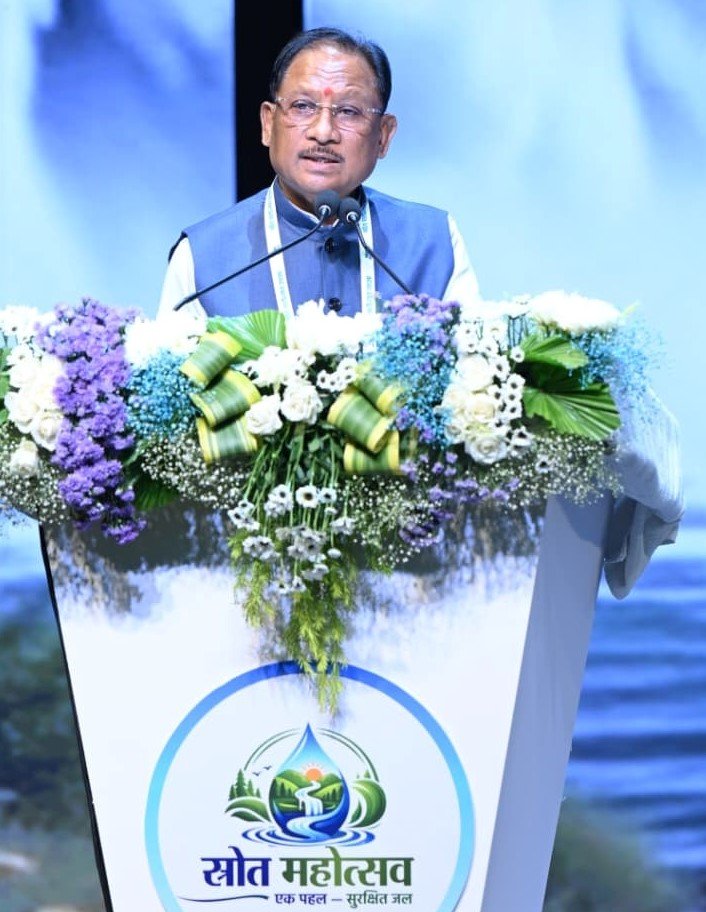
Chief Minister Vishnu Deo Sai addresses Srot Mahotsav 2026 and the state-level river-conservation workshop at Omaya Garden in Raipur on Wednesday, August 19, 2026. He called for an integrated strategy combining scientific research, traditional knowledge, modern technology and public participation-Photo Credit:channel24india.com via CMO
Sai said the state’s identity as the Rice Bowl of India had been made possible partly by its life-sustaining rivers. The rivers that nourished Chhattisgarh’s civilisation, agriculture and economy must therefore be protected through a collective effort involving the government, scientific institutions and local communities.
He said river restoration could not remain confined to cleaning or managing visible downstream stretches. The health of a river depends upon the condition of its source, catchment, surrounding vegetation, soil, groundwater and traditional water structures.
A comprehensive conservation strategy must consequently examine the entire river ecosystem—from the point of origin to the complete course of its flow.
The Chief Minister said the government was developing an integrated river-conservation framework by combining scientific research, modern technology, traditional knowledge and community participation.
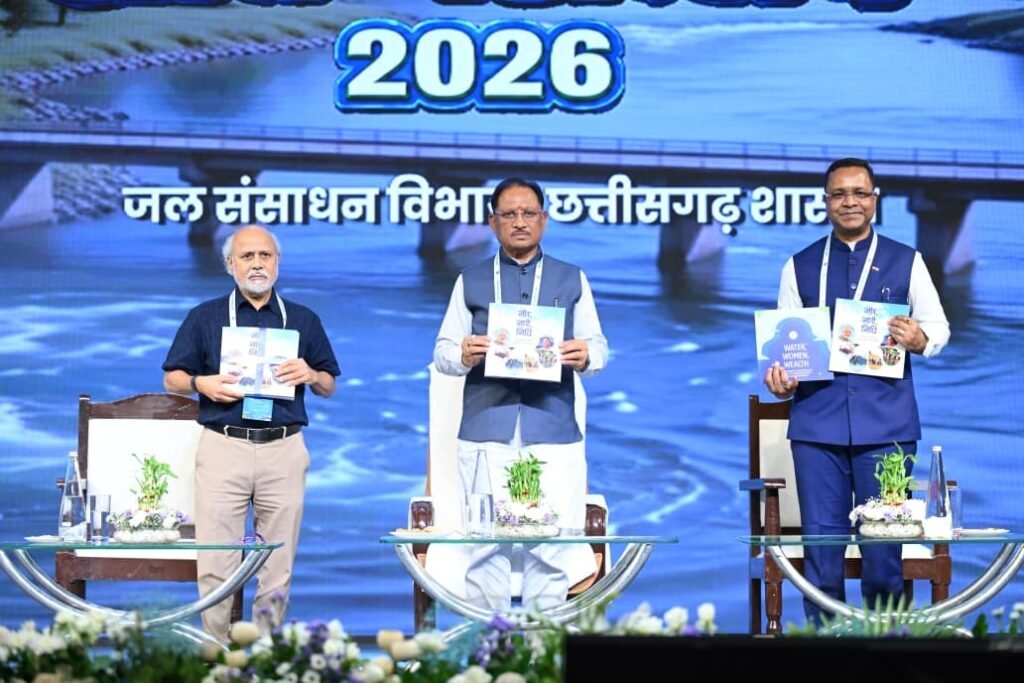
Chief Minister Vishnu Deo Sai releases Neer-Nari-Nidhi, a publication on water conservation, women’s participation and the protection of water resources, during Srot Mahotsav 2026 at Omaya Garden in Raipur on Wednesday, August 19, 2026. cGanga founder and IIT Kanpur professor Dr Vinod Tare is seen on the left, while Water Resources Department Secretary Rajesh Sukumar Toppo is on the right-Photo Credit:channel24india.com via CMO
State and district-level committees have already been constituted to take the conservation and rejuvenation programme forward. Suggestions received from experts and field representatives during Srot Mahotsav will be used to prepare practical action plans with clearly defined implementation periods.
Sai said the campaign would be organised around five principal pillars: scientific mapping, ecosystem protection, groundwater recharge, public participation and a time-bound action plan.
Every river and its catchment area would be mapped scientifically to determine its precise origin, the characteristics of its flow, changes in surrounding land use and factors affecting its natural course.
The resulting data would guide ecosystem-specific interventions, including forest and vegetation protection, prevention of soil erosion, revival of traditional water structures, construction of new water-harvesting facilities wherever necessary and measures to improve groundwater recharge.
The Chief Minister said rainfall was the primary source sustaining rivers and underground water reserves. Instead of allowing rainwater to flow away rapidly, the state must develop systems to retain it and enable maximum percolation into the ground.
Improved recharge would help restore local water sources, raise groundwater levels and sustain river flows for longer periods beyond the monsoon season.
Technology and Community Participation to Drive River Restoration
Sai emphasised that water conservation could not succeed through government programmes alone. Communities living along rivers have the strongest and most direct relationship with these water systems and must therefore become principal participants in their protection.
He asked district-level committees to establish local groups in riverside villages and carry out restoration work in coordination with gram panchayats. Residents should be informed about the condition of their rivers, the causes of deterioration and practical measures required for their revival.
“When a community assumes responsibility for protecting its river and water sources, conservation efforts become more effective and sustainable,” the Chief Minister said.
He urged experts to communicate scientific and technical information in simple and accessible language. Technology, he said, becomes meaningful only when its benefits are visible on the ground and ordinary citizens can understand and apply it.
Sai observed that human civilisations had historically developed along rivers, which had provided generations with water, food and livelihoods. Protecting these natural systems for future generations was therefore a fundamental responsibility of a civilised society.
The Chief Minister expressed confidence that the discussions and recommendations emerging from Srot Mahotsav 2026 would help create an effective roadmap for river restoration and long-term water security in Chhattisgarh.
Two important Memoranda of Understanding were exchanged during the programme to strengthen the state’s institutional and technical capabilities in water conservation.
Under the agreement with the National Water Academy, Pune, officers and field personnel associated with water conservation and management will receive specialised training and capacity-building support. The partnership is expected to take knowledge of contemporary water-management techniques and scientific practices to the implementation level.
A second agreement with Antrix Corporation Limited, Bengaluru, will facilitate the use of advanced geospatial tools and space-based expertise for analysing and monitoring water resources.
During the initial phase, approximately 1,540 square kilometres of Kunkuri tehsil will be studied using modern geospatial technology. The exercise will help assess the location and condition of water resources, changes in catchment areas and the effectiveness of conservation measures.
Sai said scientific information generated through modern technology should be integrated with local experience and traditional knowledge. Such an approach would enable the government to prepare solutions suited to the conditions of individual regions and monitor their results objectively.
The Chief Minister also released Neer-Nari-Nidhi, a publication highlighting the interconnected ideas of water protection, women’s participation and conservation of water wealth. The book documents experiences, initiatives and innovations related to water management and conservation.
Dr Vinod Tare, founder of cGanga and professor at the Indian Institute of Technology Kanpur, said protecting river origins and the water sources feeding them was essential for ensuring future water security.
He said rainwater formed the foundation of both rivers and groundwater. Its rapid surface flow must be controlled so that a greater proportion can seep into the soil and replenish underground reserves.
Dr Tare called for an effective synthesis of ancient knowledge, local and traditional experience, and modern science and technology. A long-term conservation plan built upon all three, he said, could provide the foundation for sustainable water use and the lasting protection of water sources.
Water Resources Department Secretary Rajesh Sukumar Toppo said Srot Mahotsav 2026 was intended to produce scientific, practical and time-bound action plans for conserving the origins and catchment areas of the state’s rivers.
Studying only the downstream flow of a river would be insufficient, Toppo said. Restoration planning must simultaneously examine the source area, land use, soil moisture, groundwater recharge, vegetation, erosion and the broader ecosystem.
He said participants at the workshop were holding separate deliberations on nine river groups. Each group would develop science-based and site-specific solutions reflecting the geographical and environmental conditions of the area concerned.
The plans would identify problems clearly, specify the required interventions, assign responsibility for implementation and establish a timeline for evaluating results.
Toppo said water conservation was not merely a matter of constructing infrastructure. Active community participation would determine whether conservation interventions remained successful and sustainable over the long term.
Recommendations emerging from the workshop will be used to advance the preparation of a time-bound river-source restoration roadmap for Chhattisgarh.
Dr Tare, experts associated with the National Mission for Clean Ganga, professors from the National Institute of Technology Raipur, members of state and district-level committees, district collectors, officials and specialists working in water and river conservation attended the programme.