Kumar Bahukhandi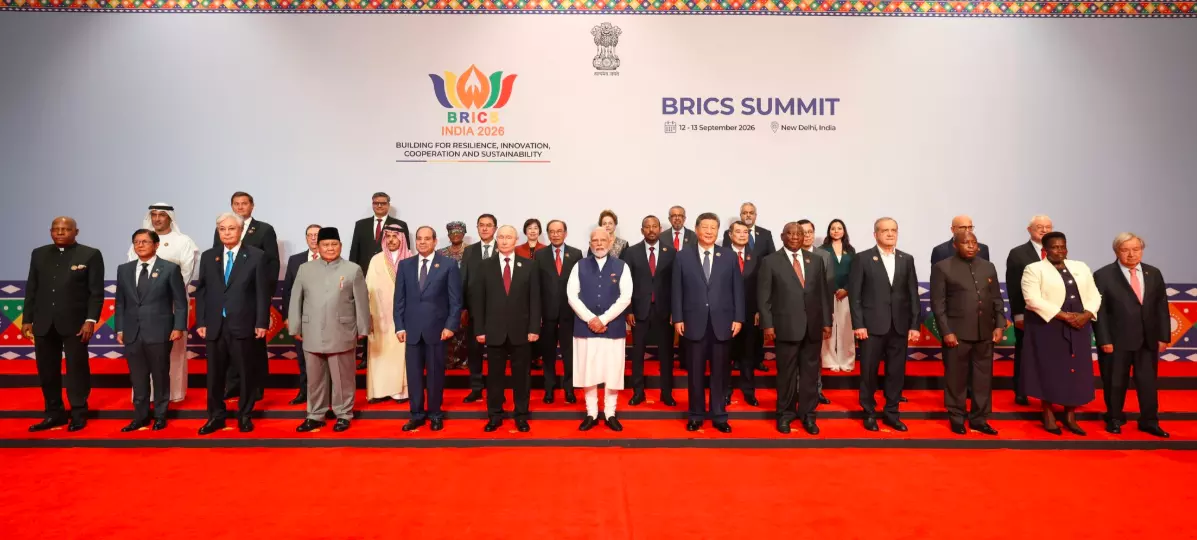
Brazil’s Foreign Minister Mauro Vieira, UAE’s Supreme Council for National Security Secretary-General Ali Mohamed Hammad Al Shamsi, Indonesia’s President Prabowo Subianto, Egypt’s President Abdel Fattah al-Sisi, Russia’s President Vladimir Putin, India’s Prime Minister Narendra Modi, China’s President Xi Jinping, South Africa’s President Cyril Ramaphosa, Iran’s President Masoud Pezeshkian and Ethiopia’s Prime Minister Abiy Ahmed pose for a family photo during the 18th BRICS Summit in New Delhi. (AFP)
Prime Minister warns against weaponisation of technology and critical minerals as India pushes resilient supply chains, startup innovation, digital agriculture and stronger Global South cooperation
Key Highlights
- PM Modi says geopolitical tensions and global crises are increasingly affecting ordinary lives.
- Warns that weaponisation of technology and critical minerals could obstruct shared progress.
- India pushes a BRICS Logistics Supply Chain Cooperation Framework to strengthen resilience.
- Modi proposes deeper cooperation involving startups, digital agriculture, AI and innovation.
- BRICS moves towards an Integrated Early Warning System for infectious diseases.
- Modi wants entrepreneurs, farmers, researchers, women and youth to participate directly in BRICS cooperation.
- New Delhi Declaration 2026 adopted by consensus during the summit.
- India argues that the Global South should move from “rule-follower” to “rule-shaper.”
- Expanded BRICS represents roughly half the world’s population and around 40 per cent of global GDP.
New Delhi: Prime Minister Narendra Modi on Sunday, September 13, 2026 warned that intensifying geopolitical tensions, disrupted supply chains, pandemics and climate-related disasters were no longer confined to individual countries or regions but were increasingly affecting the everyday lives of people across the world.
Addressing the second day of the 18th BRICS Summit at Bharat Mandapam, Modi called on the expanded grouping to translate its growing global weight into practical cooperation capable of strengthening resilience and delivering inclusive growth, particularly for the Global South.
The open session, titled “Resilience, Innovation, Cooperation and Sustainability: Shaping the Future for Inclusive Global Growth,” reflected the four pillars of India’s 2026 BRICS chairship.
Modi’s intervention came a day after BRICS leaders adopted the New Delhi Declaration, which reaffirmed cooperation across global governance, development, trade, technology, artificial intelligence, climate action and other areas. The declaration was adopted by consensus despite the considerable geopolitical differences within the expanded grouping.
“No crisis remains confined to a single region,” Modi said as he stressed the need for greater resilience and collective preparedness in an increasingly uncertain international environment.
Modi Warns Against Weaponising Technology and Critical Minerals
One of the strongest elements of the Prime Minister’s address concerned the growing strategic importance of technology and critical minerals.
“Weaponisation of technology and critical minerals can hinder our shared progress,” Modi warned, while calling for inclusivity in access to and adoption of technology.
The warning carries particular significance at a time when semiconductors, rare earths, battery materials, advanced technologies and supply chains have increasingly become elements of geopolitical and economic competition.
Rather than allowing such strategic resources to deepen global divisions, Modi’s message positioned cooperation and reliable access as essential to shared development.
The Prime Minister also highlighted the BRICS Logistics Supply Chain Cooperation Framework, saying it would help make supply chains more reliable and resilient.
From Declarations to Practical BRICS Cooperation
Modi used Sunday’s session to put forward a series of initiatives intended to turn the four pillars of India’s chairship into concrete mechanisms.
These include a proposed BRICS Startup Innovation Fund, a BRICS Incubator Network connecting startups and incubators, cooperation on digital agriculture using artificial intelligence and geospatial technologies, an Integrated Early Warning System for infectious diseases, and initiatives aimed at strengthening disaster preparedness and supply-chain resilience.
The Prime Minister also sought to take BRICS cooperation beyond governments.
“We want our entrepreneurs, farmers, researchers, women, youth and ordinary citizens to become active participants as well,” Modi said.
That approach reflects India’s effort to present BRICS not simply as a diplomatic grouping of emerging powers, but increasingly as a platform capable of connecting businesses, innovators, workers, researchers and communities across member countries.
Global South at the Centre
The second-day deliberations built on Modi’s opening-day argument that developing countries should have a greater role in shaping the international system.
He had called for the Global South to move from being a “rule-follower” to a “rule-shaper”, arguing that emerging domains including artificial intelligence, cyberspace, biotechnology, outer space and critical technologies are simultaneously creating opportunities and determining the rules of the future.
Modi also called for the traditional “pyramid of privilege” in global governance to be replaced by a “platform of partnership.”
That theme has become central to India’s BRICS presidency: the economic and demographic weight of emerging and developing economies should translate into a correspondingly greater voice in global institutions and rule-making.
New Delhi Declaration Sets Broader Direction
The New Delhi Declaration 2026, adopted on Saturday, provides the political framework for much of Sunday’s discussion.
It addresses reform of global governance, sustainable and inclusive economic growth, emerging technologies, digital transformation and cooperation across a range of developmental issues. It also backs an open, safe, secure and accessible information and communications technology environment while calling for technology to remain people-centred.
The declaration also reflects BRICS concerns over unilateral economic measures and trade barriers and seeks stronger representation for developing countries in international institutions.
For India, the consensus was significant because the expanded BRICS brings together countries whose strategic interests do not always coincide.
An Expanded BRICS With Growing Global Weight
BRICS now comprises 11 full members — Brazil, Russia, India, China, South Africa, Egypt, Ethiopia, Indonesia, Iran, Saudi Arabia and the United Arab Emirates — along with 10 partner countries.
According to figures highlighted during India’s chairship, the grouping represents roughly half of the world’s population, around 40 per cent of global GDP and more than a quarter of global trade. Modi told the BRICS Business Forum earlier that the combined GDP of BRICS countries had expanded considerably faster than the world economy since the grouping’s creation.
That scale is precisely why India’s emphasis during the summit has been on moving BRICS from declarations towards deliverable solutions.
‘Stronger in Purpose’
The 2026 summit has also demonstrated how dramatically BRICS has changed since its beginnings as a grouping of four emerging economies two decades ago.
Its expansion has increased its economic and geopolitical weight while simultaneously making consensus more difficult.
The New Delhi meeting nevertheless brought leaders representing markedly different strategic interests onto the same platform and secured agreement on a common declaration.
For Modi, the challenge now is to ensure that this wider BRICS produces practical outcomes.
His message on Sunday was therefore not simply about the size of the grouping. It was about whether that size can be converted into resilience, technological cooperation, reliable supply chains and opportunities reaching beyond governments to ordinary people.
As geopolitical rivalries increasingly intersect with trade, technology, energy and critical resources, Modi’s warning carried a broader message: BRICS will be judged not merely by the countries around its table, but by whether their cooperation can protect shared progress from an increasingly fragmented world.