Kumar Bahukhandi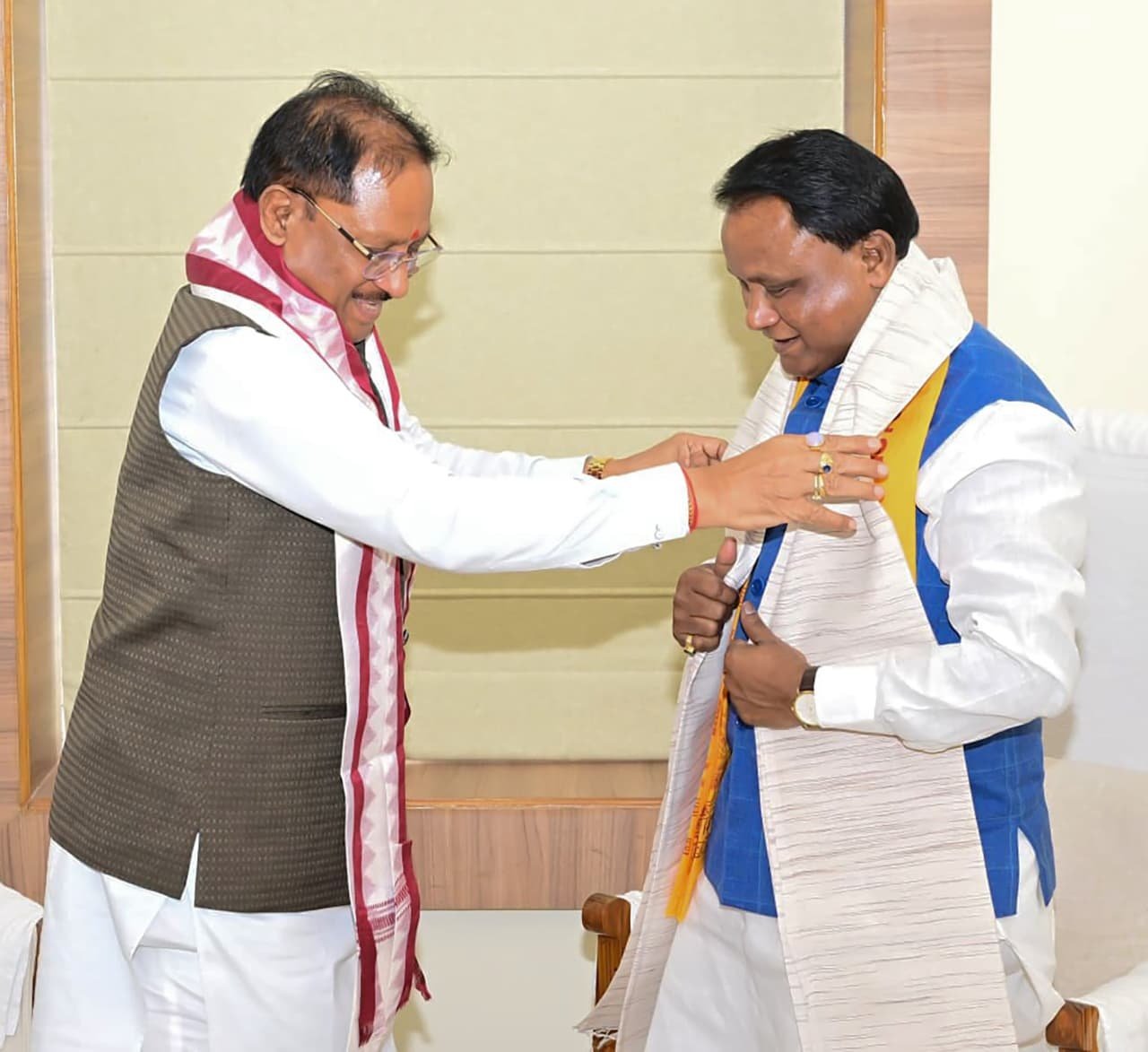
Chhattisgarh Chief Minister Vishnu Deo Sai is welcomed by Odisha Chief Minister Mohan Charan Majhi during their meeting at the Odisha Chief Minister’s residence in Bhubaneswar on Sunday, September 20, 2026. The two leaders discussed interstate cooperation, development and public welfare. Photo:channel24india.com via CMO
Chief Ministers discuss cooperation, development and public welfare as the two neighbouring states seek closer coordination; ongoing dialogue on the Mahanadi dispute adds significance to the meeting
Key Highlights
- Chhattisgarh CM Vishnu Deo Sai meets Odisha CM Mohan Charan Majhi at his Bhubaneswar residence
- Talks focus on inter-state cooperation, development and public welfare
- Sai stresses the two states’ deep social, cultural and historical connections
- Border communities provide a natural foundation for closer people-to-people cooperation
- Meeting comes amid continuing efforts by both states and the Centre to reach an amicable settlement of the Mahanadi water dispute
- Recent technical consultations have already produced consensus on several issues relating to the river dispute
- Wider cooperation can extend to connectivity, tourism, trade, culture and development of border regions
Bhubaneswar: A courtesy meeting between the Chief Ministers of Chhattisgarh and Odisha on Sunday, September 20, 2026 carried a wider message of neighbourhood cooperation as the two adjoining states sought to strengthen dialogue on development, public welfare and issues affecting people on both sides of their common boundary.
Chhattisgarh Chief Minister Vishnu Deo Sai, during his Odisha visit on September 20, met Odisha Chief Minister Mohan Charan Majhi at the latter’s residence in Bhubaneswar. Majhi welcomed Sai, and the two leaders discussed various matters concerning cooperation between Chhattisgarh and Odisha, according to the Chhattisgarh government release supplied for the story. Contemporary reports also confirmed the meeting at Majhi’s residence.
For two states joined not only geographically but through communities, languages, traditions, rivers and economic activity, the interaction has significance beyond diplomatic courtesy.
“Chhattisgarh and Odisha are not only neighbouring states, but are also deeply connected socially, culturally and historically. People living in the border areas of the two states also share close bonds,” Sai said, according to the official release.
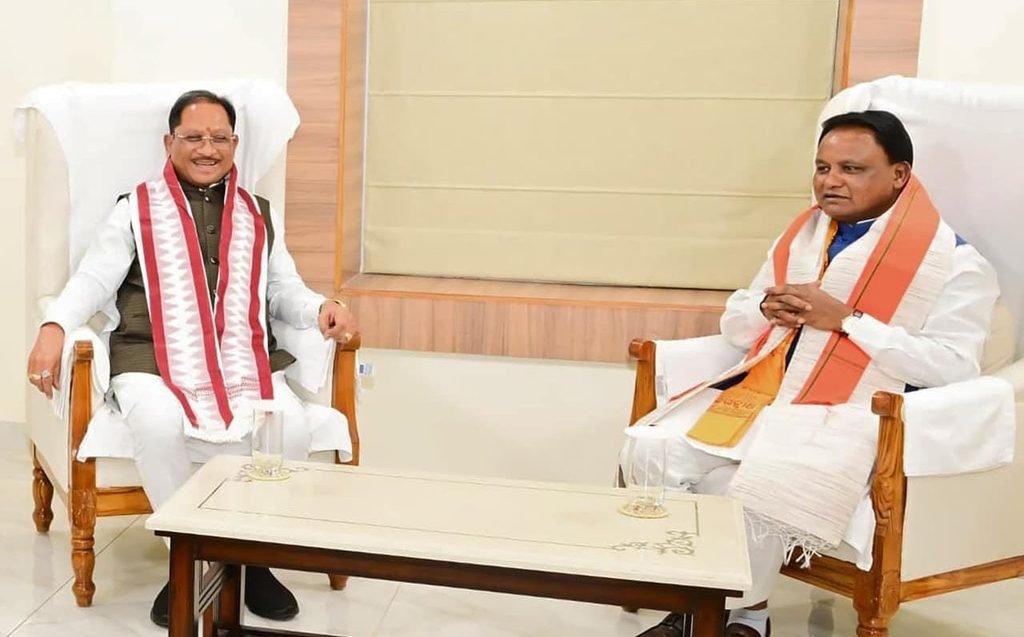
Chhattisgarh Chief Minister Vishnu Deo Sai and Odisha Chief Minister Mohan Charan Majhi hold discussions in Bhubaneswar on September 20. The meeting underscored the two neighbouring states’ emphasis on dialogue and closer coordination on issues of mutual interest. Photo:channel24india.com via CMO
He argued that stronger coordination on development and public welfare could benefit citizens of both states while accelerating progress across the wider region.
“Better coordination between the two states on issues related to development and public welfare will not only benefit citizens but will also give new momentum to the progress of the entire region,” Sai said.
Neighbours With Shared Interests
The Chhattisgarh-Odisha relationship is unusual in its breadth.
The states share a long interstate boundary, while communities living along it maintain social and cultural relationships that predate their present administrative borders. Transport, commerce, migration, tribal communities, tourism and natural resources create areas where policy decisions in one state can have consequences in the other.
That makes regular political and administrative dialogue important.
The relationship also provides scope for cooperation in road and transport connectivity, border-area development, tourism circuits, cultural exchanges, trade and markets, healthcare access and coordination in areas where residents may depend upon facilities located across the state boundary.
The official release from Sunday’s meeting does not announce specific agreements in these sectors. They represent, however, the broader areas in which stronger interstate coordination could potentially develop.
Mahanadi Gives Meeting Added Significance
The meeting also takes place against the backdrop of perhaps the most consequential issue between the two neighbours: the long-running dispute over sharing and management of the Mahanadi River.
That dispute was not specifically mentioned in the Chhattisgarh release supplied for Sunday’s meeting. It should therefore not be presented as an announced agenda item of the private interaction.
But it forms an important part of the current relationship between the two governments.
On July 30, Union Jal Shakti Minister C. R. Paatil chaired a meeting with Sai and Majhi in New Delhi aimed at facilitating an amicable settlement. The Centre said both Chief Ministers reaffirmed their commitment to continue technical consultations constructively.
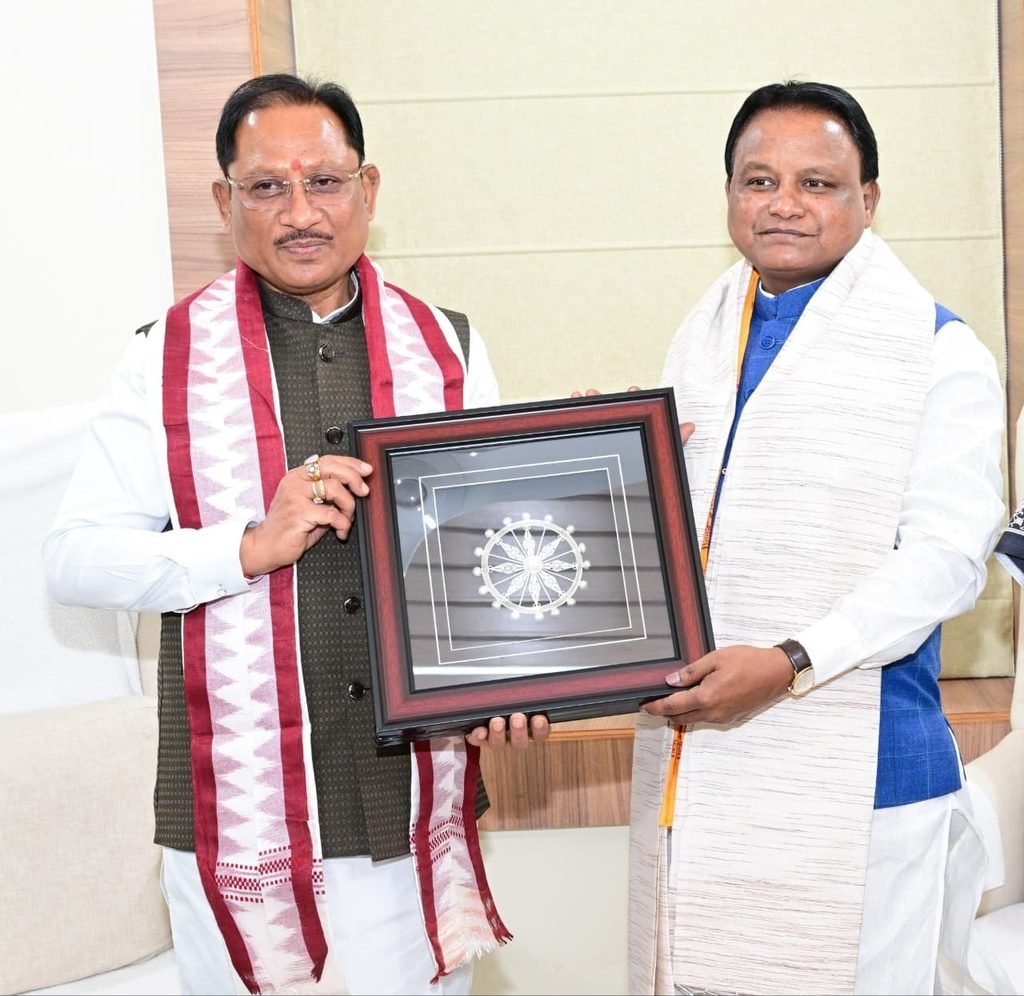
Odisha Chief Minister Mohan Charan Majhi presents a framed memento to Chhattisgarh Chief Minister Vishnu Deo Sai during their meeting in Bhubaneswar on Sunday. Photo:channel24india.com via CMO
The process has moved beyond political statements to technical discussions. According to the Union government, a Joint Technical Committee had already achieved consensus on several technical issues, while an expanded committee chaired by the Central Water Commission chairman was constituted to pursue the remaining questions.
Odisha has maintained that its people’s rights, farmers’ interests and water resources must be protected, while publicly committing itself to an “amicable, equitable and lasting resolution” through dialogue and cooperation.
Majhi said after the July discussions that the two states were seeking to resolve the dispute through intensified technical consultations.
Sai, during his current Odisha visit, has also said publicly that he expects the Mahanadi dispute to be resolved soon.
The competing substantive positions have not disappeared. Odisha has raised concerns about upstream structures and downstream flows, while Chhattisgarh has maintained that its utilisation of the river is within its equitable share and necessary for development. Those issues continue to require technical and political resolution.
What has changed is the emphasis on resolving them through dialogue.
From Dispute to Cooperative Federalism
That makes Sunday’s image of the two Chief Ministers sitting together particularly relevant.
Neighbouring states will inevitably have disagreements. Rivers cross political boundaries. Roads need coordination. Markets overlap. Families and communities live on both sides of borders. Environmental questions rarely stop at administrative lines.
The test of a mature interstate relationship is therefore not the absence of disputes but whether mechanisms exist to manage them without allowing one disagreement to define the entire relationship.
The Centre itself has described the ongoing Mahanadi process in terms of dialogue, technical cooperation and cooperative federalism, with the longer-term objective of establishing an equitable and sustainable framework for management of the river basin.
That approach could have implications beyond water sharing.
Culture Can Be a Bridge
Sai’s emphasis on the social and cultural relationship between the two states is particularly relevant.
Political boundaries define administrations; they do not necessarily define cultural landscapes.
Neighbouring regions of Chhattisgarh and Odisha share tribal traditions, festivals, food practices, religious connections and patterns of movement. These links provide an existing people-to-people foundation on which institutional cooperation can be built.
Cultural and tourism collaboration could therefore become another component of the relationship.
Chhattisgarh is attempting to expand the visibility of destinations such as Sirpur and Bastar, while Odisha has an internationally recognised cultural and religious tourism identity. Better transport links and thoughtfully designed interstate tourism circuits could potentially allow visitors to experience the wider region rather than viewing each state in isolation.
Again, Sunday’s official release announces no such programme. But a broader neighbourhood relationship creates space for these possibilities.
Majhi’s Position: Cooperation With Odisha’s Interests Protected
While the release supplied for Sunday’s meeting does not contain a direct quotation from Majhi, his documented public position during the recent interstate discussions provides the Odisha side of the relationship.
Following the July 30 Mahanadi meeting, Majhi said Odisha remained committed to an amicable, equitable and lasting solution through “constructive dialogue, mutual cooperation and goodwill between both States,” while emphasising the rights of Odisha’s people, farmers and water resources.
That position captures an important feature of interstate cooperation: partnership does not require either state to abandon its interests.
Rather, it requires institutions capable of reconciling them.
A Relationship Larger Than One Issue
The Mahanadi will understandably remain a major test of Chhattisgarh-Odisha relations until a durable settlement is achieved.
But the relationship between two neighbouring states is larger than one river dispute.
It encompasses the daily movement of people, border communities, trade, transport, culture, tourism, natural resources and development aspirations.
Sunday’s meeting therefore matters not because it produced a dramatic new agreement—it did not—but because it reinforces a continuing channel of communication between two governments whose citizens have many shared interests.
If that political warmth is followed by sustained administrative coordination, the relationship can gradually move from neighbourhood by geography to partnership by policy.
For Chhattisgarh and Odisha, that may ultimately be the more consequential outcome of continuing dialogue.