Kumar Bahukhandi
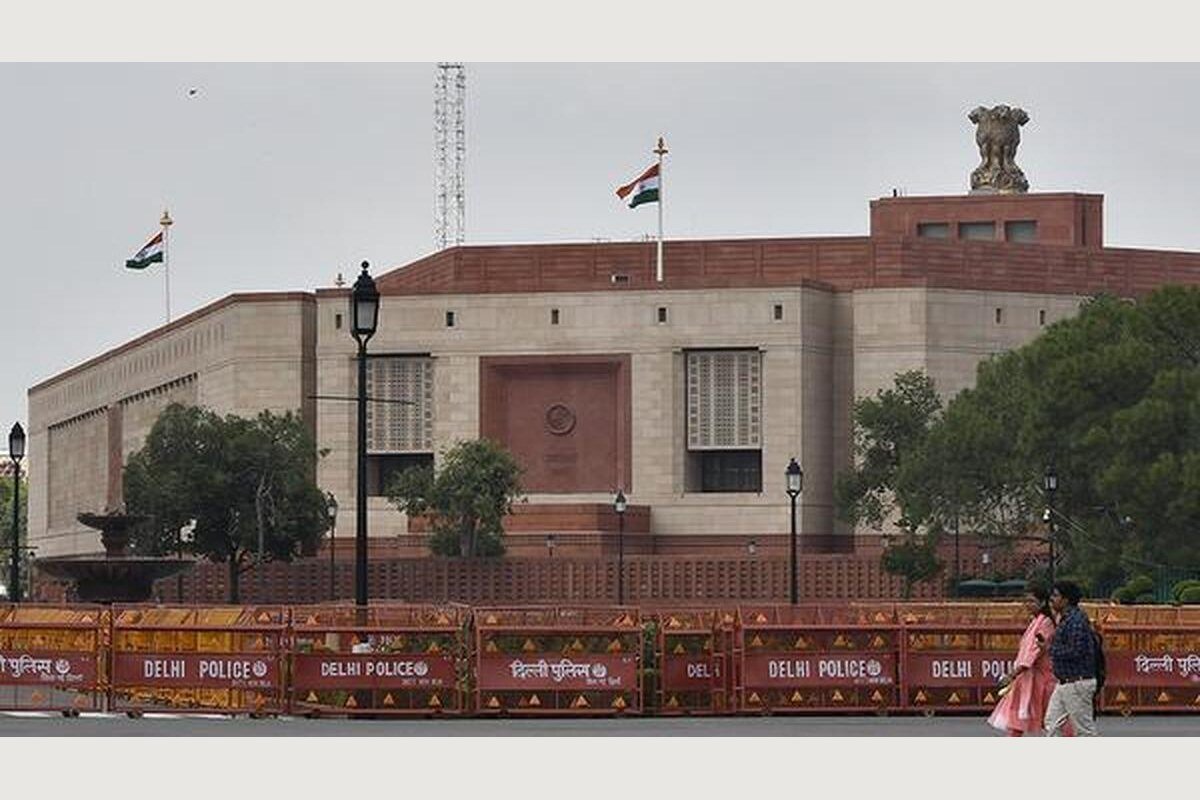
The Parliament building in New Delhi. The Centre has proposed a 50 per cent increase in Lok Sabha seats for each State and Union Territory while preserving their relative share of seats until 2051. File photo.
The Cabinet-cleared package seeks to redraw constituencies using the 2011 Census and bring into effect the one-third reservation for women
Key Highlights
- The proposed constitutional amendment provides for a 50 per cent increase in Lok Sabha seats for each State and Union Territory at the first delimitation.
- States’ relative share of Lok Sabha seats would be protected until 2051, while the 2011 Census would guide the redrawing of constituencies
- The accompanying delimitation Bill provides for a commission and an exercise intended to give effect to the constitutional reservation for women.
New Delhi: The Union Cabinet on Friday, 27 November, cleared a fresh legislative package that would expand the Lok Sabha while preserving the balance of representation among States until 2051. The Constitution (132nd Amendment) Bill proposes a 50 per cent increase in Lok Sabha seats for every State and Union Territory at the first delimitation. A companion Bill sets out the machinery for redrawing constituencies and implementing the one-third reservation for women. Both measures now face parliamentary scrutiny.
The proposal changes the approach the Centre took in April. The earlier Constitution (131st Amendment) Bill sought to use the 2011 Census population figures for reallocating Lok Sabha seats among States. That approach raised a concern for States whose share of India’s population had declined since the earlier population base was fixed. Even if they gained MPs in a larger House, they could have ended up holding a smaller share of all seats. The November package seeks to address that concern by applying the same percentage increase across States and Union Territories.
What the freeze would protect
The freeze concerns the distribution of seats among States. Constituency boundaries within each State could still change. The distinction matters because delimitation deals with two questions that have different consequences. One is how many MPs a State sends to the Lok Sabha. The other is which towns, villages and neighbourhoods those MPs represent. Under the new package, the first exercise would expand each State’s allocation by a common percentage, while the second would use 2011 Census figures to draw the new electoral map.
Consider two hypothetical States with 20 and 40 seats. A 50 per cent increase would take them to 30 and 60. Each would elect more MPs, and the ratio between their delegations would stay the same. Inside either State, however, the additional seats could be distributed in ways that change the boundaries of existing constituencies. For voters, the most visible consequence could be a different constituency or a new set of neighbouring areas voting for the same MP.
A larger House would leave the population debate open
The proposal addresses a federal concern that has long complicated delimitation. States with slower population growth have argued that they should retain their relative influence in Parliament. At the same time, population growth has been uneven, leaving some MPs to represent substantially more people than others. Increasing each State’s allocation by the same percentage would create room to redraw seats within States, but differences in population per MP between States would persist. The 2051 provision would defer a fresh reckoning with those differences.
The use of the 2011 Census carries its own implications. That count gives the proposed exercise a common population base. It also means that changes since 2011, including the growth of suburbs and shifts in where people live, would fall outside that population snapshot. How the commission translates those figures into boundaries will matter especially in areas that have grown or changed rapidly since the Census
Women’s reservation moves from principle to electoral design
The Constitution (106th Amendment) Act, passed in 2023, provided for reserving roughly one-third of seats in the Lok Sabha, State Assemblies and the Delhi Assembly for women, including a share of seats already reserved for Scheduled Castes and Scheduled Tribes. It tied implementation to a delimitation exercise after publication of figures from the first Census taken after the amendment came into force. The new package seeks to accelerate implementation through the proposed delimitation exercise.
For political parties, the immediate question will be which constituencies are designated for women and how that affects candidate selection. For voters, the effect will become clear when constituency boundaries and reservation designations are published. A larger House would give parties more seats in which to field candidates, while the quota would establish a floor for women’s representation in the elected chamber.
The April vote hangs over the fresh proposal
The previous constitutional amendment failed in the Lok Sabha in April, when it received 298 votes in favour and 230 against. A constitutional amendment requires a majority of the total membership of each House and the support of at least two-thirds of members present and voting. The earlier vote shows why the revised formula matters politically. Preserving States’ relative shares addresses one source of resistance, while the choice of Census base, the timing of implementation and the process of redrawing seats remain open to parliamentary debate.
The Lok Sabha is scheduled to meet for a four-day special session beginning on 30 November, with the Rajya Sabha due to meet on 2 December. The Centre proposes to replace the earlier delimitation measure with the Delimitation (Second) Bill, 2026. Parliament’s first decision is whether to approve the framework. The decisions voters will encounter directly, including the boundaries of their constituencies and which seats will be reserved for women, would come through the delimitation process that follows.