Kumar Bahukhandi
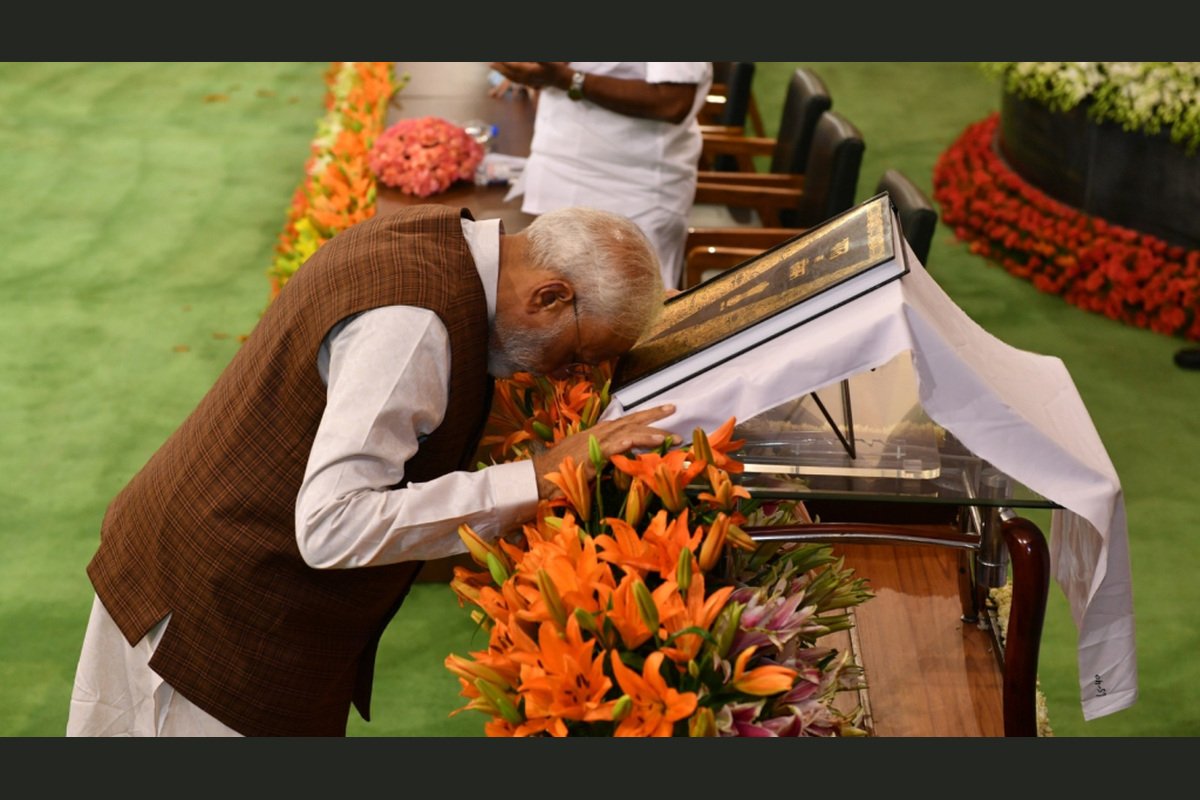
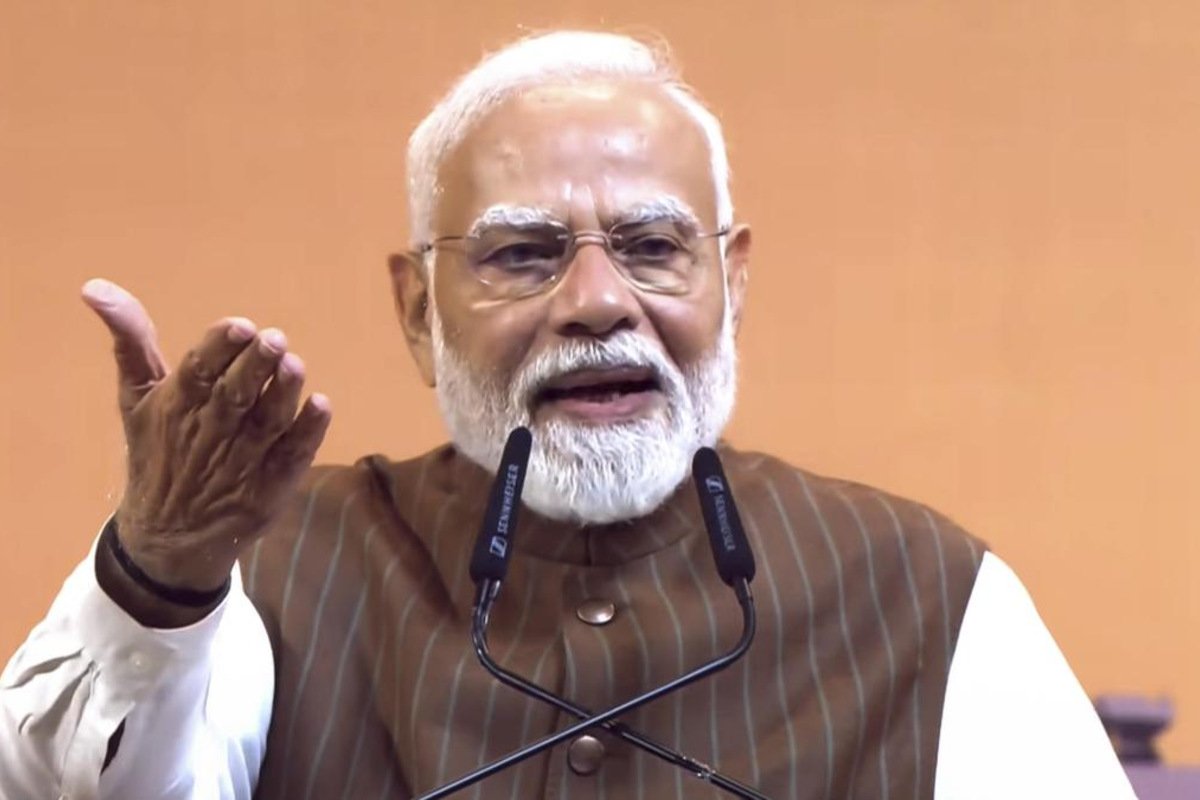
Prime Minister Narendra Modi bows before a copy of the Constitution of India in Parliament’s Central Hall in New Delhi on 25 May 2019. File photo.
In a personal essay, the Prime Minister reflects on the opportunities the Constitution opened for him, pays tribute to its makers and argues that its promise of dignity must reach people in their everyday lives.
Key Highlights
- Narendra Modi recalls his childhood and credits the Constitution with making it possible for someone born into modest circumstances to serve as Prime Minister.
- He honours Dr Rajendra Prasad, Dr B.R. Ambedkar and the members of the Constituent Assembly, including the women who helped shape the document.
- He links the Constitution’s promise of social and economic justice to housing, healthcare, access to credit and digital payments.
- He revisits the Emergency, the use of Article 356 and the 2019 changes in Jammu and Kashmir, and addresses the recent parliamentary dispute over women’s representation.
- Looking towards 2047, he calls for “India First in our thinking and Kartavya (Duties) in our actions”.
New Delhi: On Constitution Day, Prime Minister Narendra Modi went back to his childhood. He recalled a family of modest means, the struggles of daily life and the gratitude he feels when he considers the distance between those early years and the responsibility he would one day assume. He turned that memory into a question with a wider meaning for India. How far should a child be able to go when the circumstances of birth offer few advantages?
“For crores of Indians, including me, the Constitution of India is an inseparable part of our life journeys,” Modi wrote in his Constitution Day essay, published on 26 November 2026. He described the opportunity to serve the world’s largest democracy as a reason for personal gratitude and said his government’s efforts to strengthen the Constitution were one way of expressing it.
The people who gave India its Constitution
The Constituent Assembly adopted the Constitution on 26 November 1949. Modi paid tribute to Dr Rajendra Prasad, Dr Babasaheb Ambedkar and every member of the Assembly. He credited them with drawing on India’s traditions and civilisational experience while drafting a modern Constitution for a country of many languages, faiths and customs.
For Modi, that diversity explains why the Constitution should “have a resonance far beyond the precincts of Parliament and the courts”. He said his government decided to observe 26 November as Constitution Day to deepen that connection, particularly among young people. He also pointed to the availability of an updated text in all 22 languages listed in the Eighth Schedule, saying it brings the document closer to people who want to read it in their own language.
What dignity means at home, in hospital and at work
Modi invoked constitutional scholar Granville Austin to underline how central social and economic justice was to the framers’ work. He cited a World Bank report on poverty reduction and asked readers to consider what a change in living conditions can mean to parents who have spent years wondering whether their children will have the same opportunities as other families.
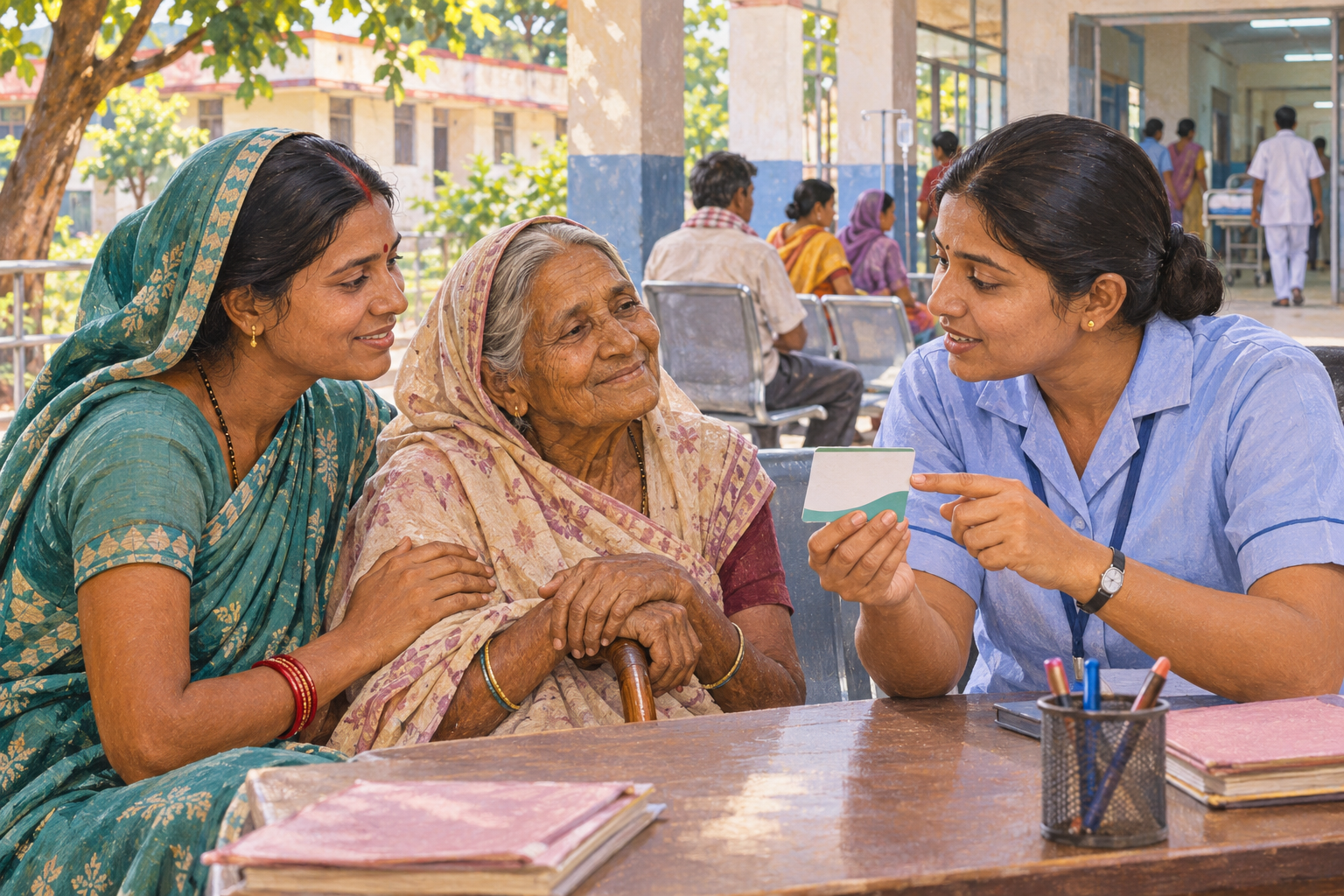
His examples began with the household. He described a family moving into a permanent home through PM Awas Yojana and a woman gaining access to cleaner cooking fuel through the Ujjwala scheme. He pointed to Ayushman Bharat as a way for eligible families to seek hospital treatment with less fear of debt. For street vendors and small entrepreneurs, he cited access to collateral-free loans through PM SVANidhi and MUDRA. He also held up UPI as an example of how digital payments can make services more widely accessible.
Amendments, criminal justice and the duties of citizenship
Modi cited three constitutional amendments in making his case for his government’s record. The 101st paved the way for the Goods and Services Tax. The 102nd gave constitutional status to the National Commission for Backward Classes. The 103rd provided for reservation for Economically Weaker Sections outside the existing reservation framework, a step he said responded to the aspirations of families that had long been outside it.
He also discussed the Bharatiya Nyaya Sanhita, describing it as an attempt to shift criminal law away from the priorities of the colonial-era penal code and towards justice for citizens. His appeal to kartavya, or civic duty, drew on examples outside government institutions. He cited public participation in Swachh Bharat, water conservation and environmental protection as ways people can act on responsibilities they share with their neighbours.
The limits of power and the lessons of the Emergency
The essay grew more pointed as Modi turned to the First Amendment of 1951, introduced months before India’s first general election. He argued that the government of the day used its majority in the provisional Parliament to restrict freedoms and stifle dissent. Seventy-five years later, he asked readers to consider the timing and purpose of those restrictions.
Modi also marked 50 years since the 42nd Amendment, passed during the Emergency. He said it curtailed judicial review and altered the balance of power among institutions. He urged young people to study the 38th and 39th Amendments from the same period. He cited repeated resort to Article 356 to dismiss elected state governments as another example of constitutional power being misused.
Jammu and Kashmir, tribal regions and reservation
Modi defended the 2019 changes to Jammu and Kashmir’s constitutional status. In his account, Articles 370 and 35A had prevented the full application of the Constitution and held back rights for Scheduled Castes, Scheduled Tribes, Other Backward Classes and women. He presented the 2019 changes as a correction of that longstanding grievance. I
He also turned to communities in tribal regions affected by Naxalite violence. Modi said armed groups had for decades kept some of the poorest citizens from exercising their constitutional rights without fear. He described armed Naxalism as having been eliminated in 2026 and accused its remaining ideological supporters of trying to obstruct development. In a separate political charge, he accused the largest opposition party of seeking to reduce OBC reservation to provide quotas for Muslims, a move he said Ambedkar would have opposed.
The women who helped frame the Constitution and those seeking a seat in the House
Modi paid tribute to the women who helped frame the Constitution and linked their contribution to the continuing debate over women’s representation. He blamed the leading opposition party for blocking a constitutional amendment Bill in April 2026 and said his government would continue pursuing greater representation for women in legislatures. He also criticised the party’s conduct in Parliament, arguing that opposition carries constitutional responsibilities of its own.
The April vote concerned how and when to implement the one-third reservation for women provided for in the 2023 constitutional amendment. The government’s 2026 Bill sought to bring it forward alongside an expansion of the Lok Sabha and the redrawing of constituencies. Opposition parties said they supported women’s reservation and objected to tying its implementation to that delimitation plan. The Bill fell short of the required two-thirds majority in the Lok Sabha.
From the Constitution’s promise to India’s centenary
Modi closed with an appeal for citizens to put India first and act with a sense of duty as the country works towards becoming a developed nation by 2047, the centenary of Independence. His essay began with a boy who could scarcely have imagined the office he would one day hold. It ended with a question for the generations that follow. How much of the freedom to shape one’s own future will a child growing up today be able to count on?