Kumar Bahukhandi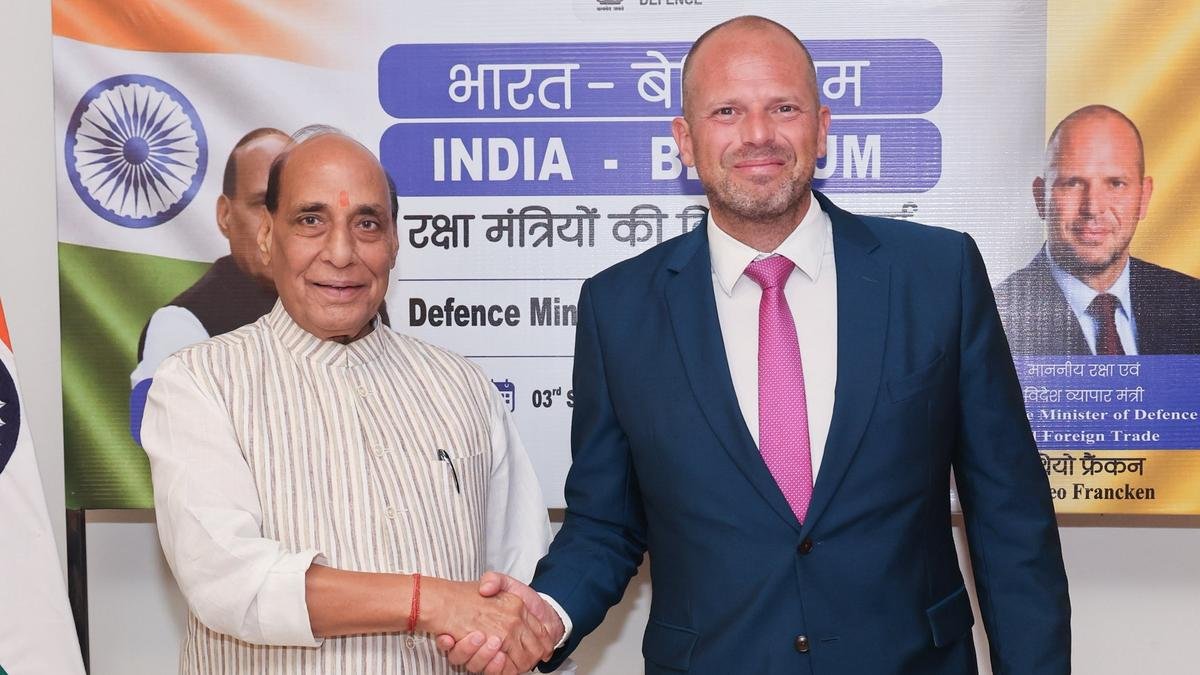
Defence Minister Rajnath Singh with Belgium’s Minister of Defence and Foreign Trade Theo Francken during their bilateral meeting in New Delhi on Thursday. The two sides reviewed defence and industrial cooperation and agreed to deepen engagement in training, technology, manufacturing and maritime security. Photo Credit : Ministry of Defence/PIB
Rajnath Singh and Belgian Defence Minister Theo Francken review defence and industrial cooperation; focus on technology, co-production, training and Indo-Pacific maritime security
Key Highlights
- Belgium assures India it will not extend defence equipment or technology cooperation to Pakistan
- Rajnath Singh and Theo Francken review the full spectrum of bilateral defence and industrial ties
- Multiple agreements signed to combine Belgian technology with Indian manufacturing capabilities
- Both countries agree to strengthen training, capacity building and high-level military exchanges
- Maritime security and cooperation in the Indo-Pacific emerge as key areas
- India pushes for co-development and co-production rather than dependence on defence imports
New Delhi Belgium has assured India that it will not undertake defence cooperation with Pakistan involving the supply of military equipment or technology, as New Delhi and Brussels move towards a significantly deeper defence and strategic partnership.
The assurance came during talks between Defence Minister Rajnath Singh and Belgium’s Minister of Defence and Foreign Trade Theo Francken in New Delhi on Thursday, September 3, 2026 . According to defence and security establishment sources, the issue of possible Belgian military technology or expertise reaching Pakistan figured in the discussions, with the Belgian side assuring India that such cooperation was not envisaged.
The assurance is significant for India, which remains concerned about advanced military technologies supplied by foreign partners potentially strengthening Pakistan’s defence capabilities.
Defence Partnership Moves Beyond Buyer-Seller Relationship
During their bilateral meeting, Singh and Francken reviewed the entire spectrum of India-Belgium defence relations and defence-industrial cooperation.
The two countries agreed to expand engagement through a structured defence cooperation dialogue, high-level visits, training and capacity building. They also discussed regional peace and security and acknowledged the importance of closer maritime-security collaboration in the Indo-Pacific.
Singh described the talks as productive and said multiple agreements and contracts had been concluded with the objective of bringing together Belgian technology and India’s skills and manufacturing scale.
The engagement comes at a time when India is seeking to transform its defence partnerships from conventional procurement arrangements into relationships involving technology, domestic production and long-term industrial collaboration.
Belgian companies are exploring opportunities across several specialised defence sectors, including ammunition, rockets, autonomous maritime systems, mine-countermeasure technology, electro-optics, counter-drone systems and armoured-vehicle technologies.
One of the industrial agreements involves Kalyani Strategic Systems and Thales’ Belgian unit for production of 70-mm rocket systems in India, with the first fully assembled rocket expected in early 2027.
At the India-Belgium Defence CEOs Roundtable and B2B meetings later in the day, Francken underlined the potential for deeper industrial collaboration, while Minister of State for Defence Sanjay Seth called on Belgian manufacturers to combine their technological expertise with India’s manufacturing capabilities for co-development and co-production of specialised defence products.
The broader discussions also reflected growing strategic convergence between India and Belgium, particularly in maritime security, advanced technology and defence manufacturing.
“United we stand, divided we fall,” Francken said while emphasising the importance of international defence cooperation.
The defence talks took place during Belgian Prime Minister Bart De Wever’s official visit to India. Prime Minister Narendra Modi and De Wever also held discussions in New Delhi, with defence, technology, semiconductors and other strategic sectors forming part of the expanding bilateral relationship.