Kumar Bahukhandi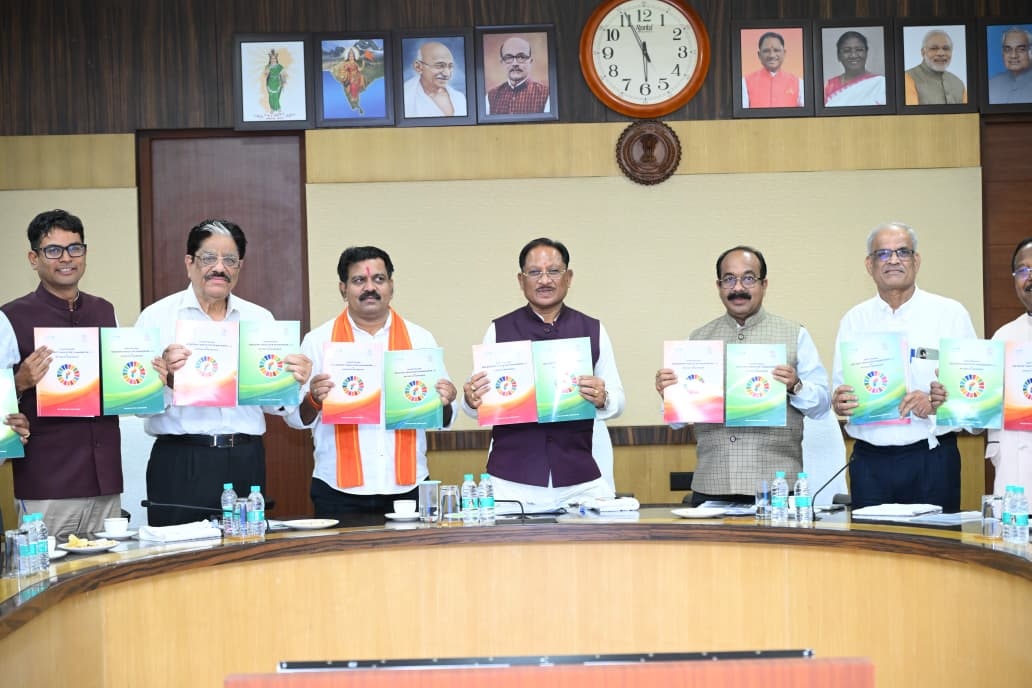
Chief Minister Vishnu Deo Sai, along with Cabinet colleagues, releases the Chhattisgarh SDG 2.0 Framework and the Metadata Handbook at Mahanadi Bhawan, marking a major step towards evidence-based governance and the Vision 2047 roadmap on Wednesday July 8, 2026- Photo Credit-channel24india.com via CMO
Key Factors
- Chief Minister Vishnu Deo Sai launched the SDG 2.0 Framework.
- ‘Bastar Anjor’ introduced as a convergence-based tribal development initiative.
- State-level monitoring indicators increased from 275 to 343.
- District-level indicators expanded from 82 to 99.
- Metadata Handbook standardises data collection and reporting.
- 3+4 convergence model integrates district initiatives with national development frameworks.
- Initiative supports the vision of Viksit Chhattisgarh @2047 through measurable, data-driven governance.
Chief Minister Vishnu Deo Sai launches upgraded Sustainable Development Goals framework and convergence-based Bastar development model with expanded monitoring indicators
Raipur: The Chhattisgarh government on Wednesday July 8, 2026 unveiled an ambitious roadmap to strengthen evidence-based governance and accelerate inclusive development with the launch of the Sustainable Development Goals (SDG) 2.0 Framework and the ‘Bastar Anjor’ initiative. Chief Minister Vishnu Deo Sai released the new framework in the presence of Cabinet colleagues at Mahanadi Bhawan, describing it as a transformative step towards achieving the vision of ‘Viksit Chhattisgarh @2047.’
Along with the SDG 2.0 Framework, the Chief Minister also released the State and District SDG Indicator Framework 2.0 and the Metadata Handbook, while formally launching ‘Bastar Anjor’, a convergence-driven development model designed to ensure measurable and inclusive growth across Bastar division.
Data-Driven Governance at the Core
Addressing the gathering, Chief Minister Sai said that effective implementation of government schemes, reliable data and outcome-based monitoring are essential for building a developed Chhattisgarh.
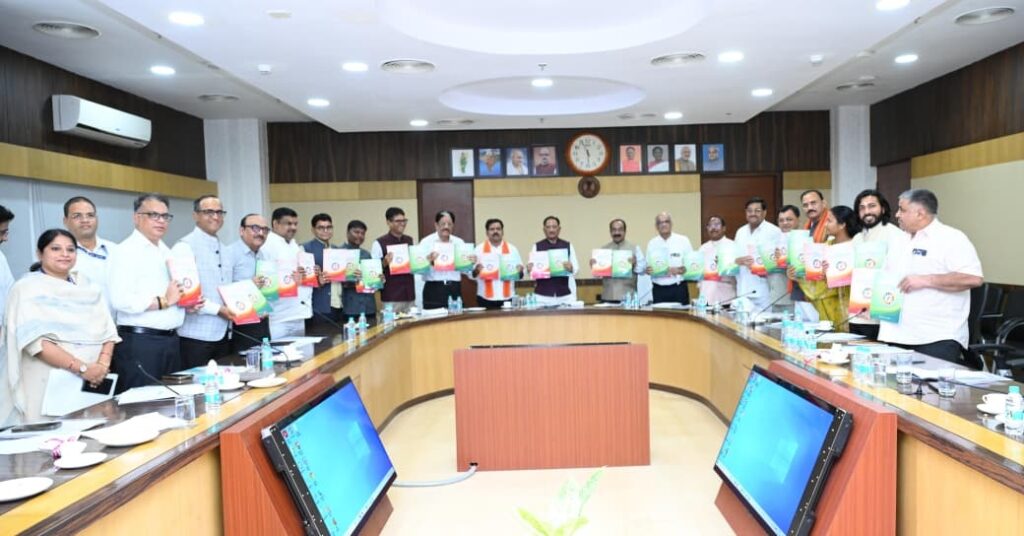
Senior ministers and officials display the newly launched SDG 2.0 Framework documents following the inauguration of the ‘Bastar Anjor’ initiative, aimed at accelerating inclusive, measurable and convergence-driven development across Bastar and the state at Mahanadi Bhawan on Wednesday July 6, 2026 -Photo Credit-channel24india.com via CMO
He said the upgraded SDG framework would provide a strong foundation for evidence-based policymaking, improved inter-departmental coordination and continuous monitoring of development programmes, ensuring that welfare schemes create measurable impact at the grassroots level.
“The objective is not merely to implement schemes but to ensure that their benefits reach the last person in society in a transparent and accountable manner,” the Chief Minister said.
Expanded Monitoring Framework
The SDG 2.0 Framework significantly expands the state’s monitoring mechanism.
- State-level indicators have increased from 275 to 343.
- District-level indicators have increased from 82 to 99.
The expanded framework will enable more comprehensive, scientific and accurate tracking of developmental outcomes across sectors such as health, education, livelihoods, infrastructure and governance.
The newly released Metadata Handbook standardises indicator definitions, calculation methodologies and reporting mechanisms, ensuring uniformity, reliability and high-quality data across all districts.
‘Bastar Anjor’: A New Development Model
State Planning Commission Vice-Chairman Ganesh Shankar Mishra presented the concept behind ‘Bastar Anjor’, describing it as a convergence-based development model aimed at transforming Bastar into India’s most developed tribal region.
The initiative integrates three district-level flagship programmes—
- Niyad Nellanar 2.0
- Bastar Munne
- Swasth Bastar
—with four major national and state development frameworks:
- SDG 2030
- Viksit Chhattisgarh @2047
- Aspirational District Programme
- Aspirational Block Programme
This innovative 3+4 convergence model seeks to achieve measurable improvements in education, healthcare, livelihoods and infrastructure through better coordination among departments, without requiring additional financial resources.
Towards Inclusive and Sustainable Growth
Officials said the initiative embodies the philosophy of “Antyodaya to Sarvodaya”, ensuring that development reaches the most vulnerable sections while promoting sustainable and balanced growth.
The government believes that by integrating planning, monitoring and implementation through a unified framework, Bastar can emerge as a national model of tribal development.
Senior Leadership Present
The launch ceremony was attended by Deputy Chief Ministers Arun Sao and Vijay Sharma, members of the Council of Ministers, Chief Secretary Vikas Sheel, Principal Secretary to the Chief Minister Subodh Kumar Singh, Vice-Chairman of the State Planning Commission Ganesh Shankar Mishra, and other senior administrative officials.