Kumar Bahukhandi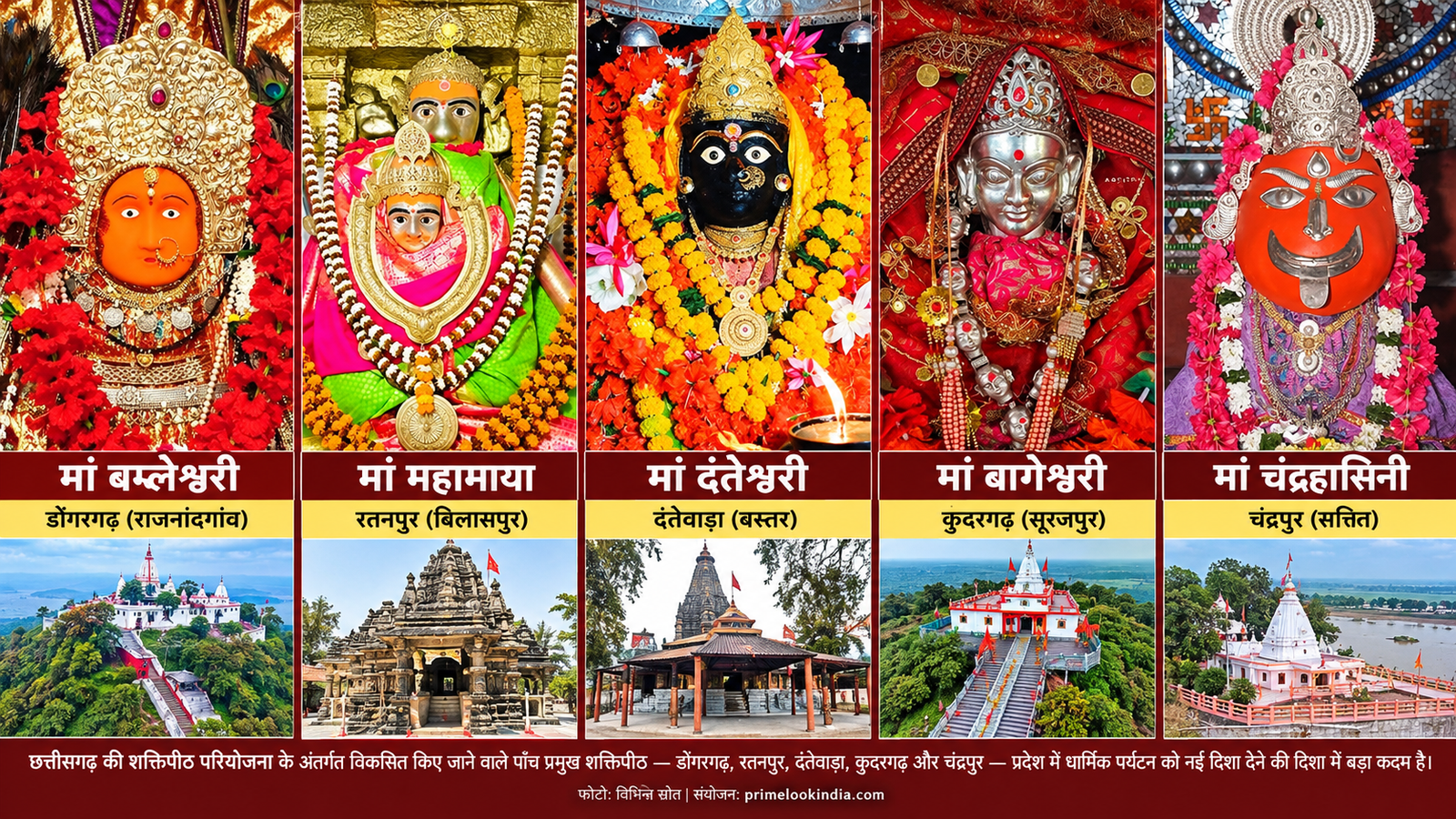
The five revered Goddesses of Chhattisgarh—Maa Bamleshwari of Dongargarh, Maa Mahamaya of Ratanpur, Maa Danteshwari of Dantewada, Maa Bageshwari of Kudargarh and Maa Chandrahasini of Chandrapur—feature in a composite presentation accompanying the State Government’s ambitious Shaktipeeth development project. The initiative aims to strengthen pilgrimage facilities, preserve sacred heritage and promote religious tourism across Chhattisgarh. Photo: channel24india.com via Dhananjay Rathore CG/DPR
The Vishnu Deo Sai Government’s ambitious initiative seeks to connect Dongargarh, Ratanpur, Dantewada, Kudargarh and Chandrapur through a 1,000-km pilgrimage corridor, combining religious faith, cultural preservation, modern infrastructure and sustainable economic development.
Raipur: Chhattisgarh, a land blessed with ancient temples, sacred rivers, picturesque hills, dense forests and an extraordinary wealth of cultural traditions, is preparing to strengthen its position on India’s spiritual tourism map through an ambitious Shaktipeeth development project. Under the leadership of Chief Minister Vishnu Deo Sai, the State Government has initiated a plan to connect five prominent centres of Goddess worship—Maa Bamleshwari at Dongargarh, Maa Mahamaya at Ratanpur, Maa Danteshwari at Dantewada, Maa Bageshwari at Kudargarh and Maa Chandrahasini at Chandrapur—through an integrated pilgrimage corridor extending approximately 1,000 kilometres. With ₹5 crore provided in the 2026–27 state budget for the Chhattisgarh Aastha Path initiative, the project envisages improved roads, drinking water, sanitation, lighting, security and visitor facilities, while promoting cultural preservation, local livelihoods and sustainable tourism.
Tourism: A Journey Through Nature, Culture and Human Civilisation
Tourism has remained an integral part of human civilisation since ancient times. It is not merely a journey undertaken for recreation or leisure but also an opportunity to discover unfamiliar landscapes, understand different societies, appreciate cultural diversity and broaden one’s knowledge of the world.
India’s timeless philosophy of Atithi Devo Bhava, which regards the guest as equivalent to God, reflects the country’s longstanding tradition of hospitality and respect for visitors.
Chhattisgarh possesses remarkable potential in this field. Its natural landscapes, historical monuments, archaeological sites, ancient temples, tribal customs, traditional festivals and wildlife resources together create a distinctive tourism identity.
According to the state tourism information presented for this initiative, approximately 138 destinations have been accorded priority on the basis of their national and international significance. The state’s heritage and natural resources include 58 protected monuments, 11 wildlife sanctuaries and three national parks.
These attractions provide a strong foundation for developing tourism as an important contributor to economic growth, cultural exchange and social development.
Religious tourism occupies a particularly significant place in Chhattisgarh because faith is closely connected with the daily lives, traditions and collective memories of its people.
The proposed Shaktipeeth project seeks to strengthen this relationship by bringing together five major pilgrimage destinations within a coordinated tourism network.
Shaktipeeth Project: Connecting Five Sacred Centres of Faith
Inspired by the integrated pilgrimage experience associated with Uttarakhand’s Char Dham circuit, the Chhattisgarh Government has initiated a programme to connect five prominent Shaktipeeths through an approximately 1,000-kilometre spiritual tourism corridor.
The project envisages comprehensive development and beautification of the temples and their surrounding areas, together with improvements in infrastructure essential for pilgrims.
Better approach roads, drinking water facilities, lighting, sanitation, resting places and security arrangements are among the priorities.
The government is also preparing to introduce the Chhattisgarh Aastha Path, or Shaktipeeth Darshan initiative, to facilitate visits to the five sacred destinations.
A provision of ₹5 crore has been made in the state budget for 2026–27.
The development initiative is expected to improve the pilgrimage experience while creating opportunities for tourism-related economic activity across several districts.
The Chhattisgarh Tourism Board and district administrations are undertaking measures relating to temple beautification and visitor facilities.
The larger objective is to ensure that pilgrims can travel between the shrines more conveniently while experiencing the distinctive historical, cultural and natural heritage associated with each destination.
₹200-Crore Development Proposal for Maa Mahamaya Temple
One of the major proposals under consideration concerns the comprehensive development of Maa Mahamaya Temple at Ratanpur in Bilaspur district.
Under the Central Government’s Pilgrimage Rejuvenation and Spiritual Heritage Augmentation Drive (PRASHAD), a development plan valued at approximately ₹200 crore has been prepared and forwarded to the Union Ministry of Tourism.
Once the proposal receives the necessary approval, an implementing agency would be selected and development work initiated.
The proposal is intended to strengthen infrastructure and improve facilities at one of Chhattisgarh’s most important historical pilgrimage centres.
Preparatory work concerning development proposals for Dongargarh, Kudargarh, Chandrapur and Dantewada is also under process.
Proposals seeking central support for important religious destinations, including Maa Mahamaya and Maa Danteshwari temples, have been prepared for submission to the Union Government.
The development programme envisages landscaped gardens, resting facilities, lighting systems, designated spaces for religious ceremonies, railings, drinking water arrangements, community toilets and organised seating areas.
Depending on local requirements and feasibility, facilities such as ropeways, tourist information centres, CCTV surveillance, security infrastructure and homestay accommodation may also be developed.
Better road connectivity, organised parking, digital information systems and primary medical facilities are among the other proposed improvements.
Special attention is to be given to protecting local architectural traditions, cultural identity and natural surroundings.
The objective is to ensure that modern facilities complement the sacred character of these destinations rather than alter their historical and religious significance.
Maa Bamleshwari Temple, Dongargarh: A Sacred Shrine Among the Hills
Situated amid the picturesque hills of Dongargarh in Rajnandgaon district, Maa Bamleshwari Temple is among the most revered centres of Goddess worship in Chhattisgarh.
Located at an elevation of approximately 1,600 feet above sea level, the shrine attracts large numbers of devotees from within and outside the state.
The temple is associated with ancient religious traditions and historical accounts extending back more than two millennia.
According to popular belief, Dongargarh was once known as Kamakhya Nagari and was ruled by King Veersen.
The king, who was without children, is believed to have worshipped Lord Shiva and Goddess Durga with deep devotion.
Following the birth of a son, he is said to have established the temple as an expression of gratitude to the Goddess.
The shrine’s history is also associated with the Kalachuri ruler Karnadev, who is believed to have contributed to its development during the eleventh century.
Subsequently, Gond rulers are said to have expanded the temple and surrounding region during the fifteenth and sixteenth centuries.
Traditional accounts describe the shrine as approximately 2,200 to 2,500 years old, reflecting its longstanding place in regional religious memory.
Over the centuries, Maa Bamleshwari Temple has developed into an important pilgrimage destination.
During Navratri, devotees travel from different parts of Chhattisgarh and neighbouring states to seek the blessings of the Goddess.
The proposed Shaktipeeth development programme is expected to strengthen visitor facilities while preserving the temple’s natural surroundings and spiritual atmosphere.
Maa Mahamaya Temple, Ratanpur: The Enduring Legacy of the Kalachuri Dynasty
Maa Mahamaya Temple at Ratanpur in Bilaspur district occupies an important place in the religious and historical landscape of Chhattisgarh.
Situated along the Bilaspur–Korba route, the temple is closely associated with the Kalachuri dynasty, which ruled the region for several centuries.
Ratanpur served as an important political and cultural centre during the Kalachuri period.
The establishment of the temple is traditionally attributed to King Ratnadev I, with its origins generally associated with the eleventh and twelfth centuries.
Some accounts place its early construction around 1050 CE.
The Goddess was revered as the family deity of the Kalachuri rulers and continues to occupy a central place in the religious traditions of the region.
Traditional accounts also associate the temple with King Bahar Sai, who is said to have undertaken restoration work in the late fifteenth century.
The shrine is known for its distinctive sacred iconography, including traditions concerning the forms of Mahishasuramardini and Goddess Saraswati.
Religious beliefs associate the site with the sacred narratives of Goddess Sati.
The temple’s historical importance extends beyond its religious significance. Its architecture, cultural traditions and association with the Kalachuri period make Ratanpur an important destination for visitors interested in the history of Chhattisgarh.
The proposed ₹200-crore development plan under the PRASHAD scheme could substantially improve the pilgrimage experience while supporting the preservation of the temple’s architectural and cultural heritage.
Maa Danteshwari Temple, Dantewada: Where Tribal Tradition and Sacred Faith Meet
In the heart of Bastar, Maa Danteshwari Temple stands as one of Chhattisgarh’s most important religious and cultural landmarks.
Situated near the sacred confluence of the Shankini and Dankini rivers in Dantewada district, the temple represents a remarkable relationship between Goddess worship and the living traditions of Bastar’s tribal communities.
According to religious belief, a tooth of Goddess Sati fell at this location, giving rise to the names Dantewada and Danteshwari.
The shrine is traditionally associated with the fourteenth century and the rulers of Bastar, who revered Maa Danteshwari as their family deity.
The temple’s sanctum houses a sacred image of the Goddess, traditionally described as a six-armed form of Mahishasuramardini carved from dark stone.
For generations, the shrine has remained a centre of devotion for tribal communities and other worshippers.
Its significance becomes especially prominent during the internationally recognised Bastar Dussehra celebrations.
Unlike conventional Dussehra celebrations in many other parts of India, Bastar Dussehra is deeply rooted in regional traditions and the worship of Maa Danteshwari.
Ceremonial processions and rituals associated with the Goddess connect Dantewada with Jagdalpur.
Thousands of devotees and members of tribal communities participate in the festivities, reflecting the region’s cultural unity and the continuity of longstanding customs.
The proposed Shaktipeeth tourism circuit could improve access to the temple while introducing visitors to Bastar’s distinctive cultural heritage.
However, the development of tourism in the region must remain sensitive to local traditions, community rights and the preservation of the sacred environment.
Maa Bageshwari, Kudargarh Dham: A Symbol of Strength Amid Forested Hills
Kudargarh Dham, situated in the Odgi development block of Surajpur district, is a revered pilgrimage destination surrounded by dense forests and picturesque hills.
Located at an elevation of approximately 1,500 feet, the shrine is dedicated to Maa Bageshwari, who is worshipped as a symbol of strength, courage and divine protection.
Local religious traditions identify Kudargarh as a sacred landscape associated with Goddess Parvati.
According to popular belief, the Goddess assumed a powerful form here to destroy evil forces.
The shrine’s history is associated with King Baland, who is believed to have established the worship of Maa Bageshwari approximately four centuries ago.
Subsequently, the Chauhan rulers are said to have assumed responsibility for the temple.
Traditional accounts indicate that descendants of the Chauhan dynasty continue to perform the first morning worship during Navratri.
The Baiga community also holds an important place in the religious traditions of Kudargarh.
According to local accounts, responsibility for the worship and care of the deity was entrusted to members of the Baiga community during the eighteenth century.
Their continued association with the shrine reflects the deep relationship between indigenous communities and Chhattisgarh’s sacred traditions.
Kudargarh is therefore significant not only as a religious destination but also as a living example of the relationship between faith, community traditions and the natural environment.
Its development under the proposed Shaktipeeth circuit could improve facilities for pilgrims while encouraging environmentally responsible tourism.
Maa Chandrahasini Temple, Chandrapur: Faith on the Banks of the Mahanadi
Maa Chandrahasini Temple at Chandrapur in Sakti district is another important centre of Goddess worship in Chhattisgarh.
Located near the confluence of the Mahanadi and Mand rivers, the shrine attracts devotees who associate the Goddess with divine protection and blessings.
According to local tradition, the temple was established by King Chandrahas of Sambalpur, from whom the names Chandrapur and Chandrahasini are believed to have originated.
The temple’s history is also associated with Gond rulers who contributed to the continuation of Goddess worship in the region.
Traditional accounts refer to restoration work undertaken during the sixteenth century.
Religious beliefs associate the shrine with Goddess Sati and identify it as an important sacred centre.
The temple is also connected with a local tradition concerning the devastating Mahanadi flood of 1935.
According to the account, a descendant of King Chandrahas offered prayers to the Goddess during the flood, after which the river’s water level reportedly receded.
This narrative continues to form part of the shrine’s devotional folklore.
Sacred footprints associated with the Goddess are also worshipped near the river.
The proposed development of Chandrapur under the Shaktipeeth circuit could improve facilities for pilgrims while helping preserve the temple’s historical and religious significance.
Religious Tourism as an Engine of Local Economic Development
The Shaktipeeth project has the potential to generate economic opportunities beyond the temple complexes themselves.
Improved connectivity and organised pilgrimage facilities can encourage visitors to explore nearby towns, historical sites, natural attractions and cultural destinations.
Such activity may benefit local transport operators, accommodation providers, tourist guides, food vendors, artisans and small businesses.
Homestay facilities could provide additional income opportunities for rural households.
Tourism development may also encourage private investment in hospitality and related services.
These initiatives could contribute to employment generation, particularly in regions where alternative economic opportunities remain limited.
At the same time, the interests of local communities must remain central to development planning.
Their traditional knowledge, cultural practices, intellectual property and rights deserve recognition and protection.
A successful tourism model should ensure that the economic benefits of increased visitor activity are shared with the communities that have preserved these sacred destinations for generations.
Sustainable Tourism and Environmental Responsibility
Chhattisgarh’s natural environment is one of its greatest strengths.
Many religious destinations are situated near forests, rivers, hills and other ecologically sensitive landscapes.
Unplanned construction, unmanaged waste and excessive commercial activity could undermine the very qualities that make these destinations attractive.
The Shaktipeeth project therefore offers an opportunity to demonstrate that tourism development and environmental conservation can advance together.
Responsible waste management, water conservation, environmentally sensitive construction and protection of natural habitats should remain important priorities.
The preservation of local architecture and traditional cultural expressions must also guide infrastructure development.
Alongside spiritual tourism, the state has opportunities to encourage eco-tourism, adventure tourism and other forms of responsible travel.
The broader objective is to strengthen Chhattisgarh’s tourism identity while ensuring that its natural and cultural resources remain protected for future generations.
Preserving Sacred Heritage While Building a New Tourism Future
The five Shaktipeeths represent different dimensions of Chhattisgarh’s spiritual and cultural identity.
Dongargarh reflects devotion amid the hills. Ratanpur preserves the legacy of an ancient political and cultural centre. Dantewada embodies the relationship between Goddess worship and Bastar’s tribal traditions. Kudargarh represents the spiritual significance of forested landscapes and community worship. Chandrapur connects religious faith with the enduring cultural importance of the Mahanadi.
Together, these destinations offer a pilgrimage experience extending far beyond individual temples.
The proposed Shaktipeeth circuit has the potential to encourage visitors to appreciate the state’s history, natural beauty, religious traditions and cultural diversity.
Under Chief Minister Vishnu Deo Sai’s leadership, the initiative reflects the State Government’s stated emphasis on combining cultural preservation with infrastructure development and tourism promotion.
Its long-term success will depend on effective planning, availability of funds, timely implementation, environmental safeguards and the meaningful participation of local communities.
The true achievement of the project will not be measured solely by the number of roads, buildings or visitor facilities constructed.
It will be reflected in the extent to which the initiative improves the pilgrimage experience, protects sacred heritage, strengthens local livelihoods and enables Chhattisgarh’s cultural traditions to flourish for generations to come.
Author : Dhananjay Rathore serves as Joint Director in the Public Relations Department, Raipur, Chhattisgarh. In this special article, he presents an overview of the State Government’s Shaktipeeth development initiative, the historical and religious importance of five prominent Goddess temples, and the potential of spiritual tourism to promote cultural preservation, infrastructure development and economic opportunities for local communities.