Kumar Bahukhandi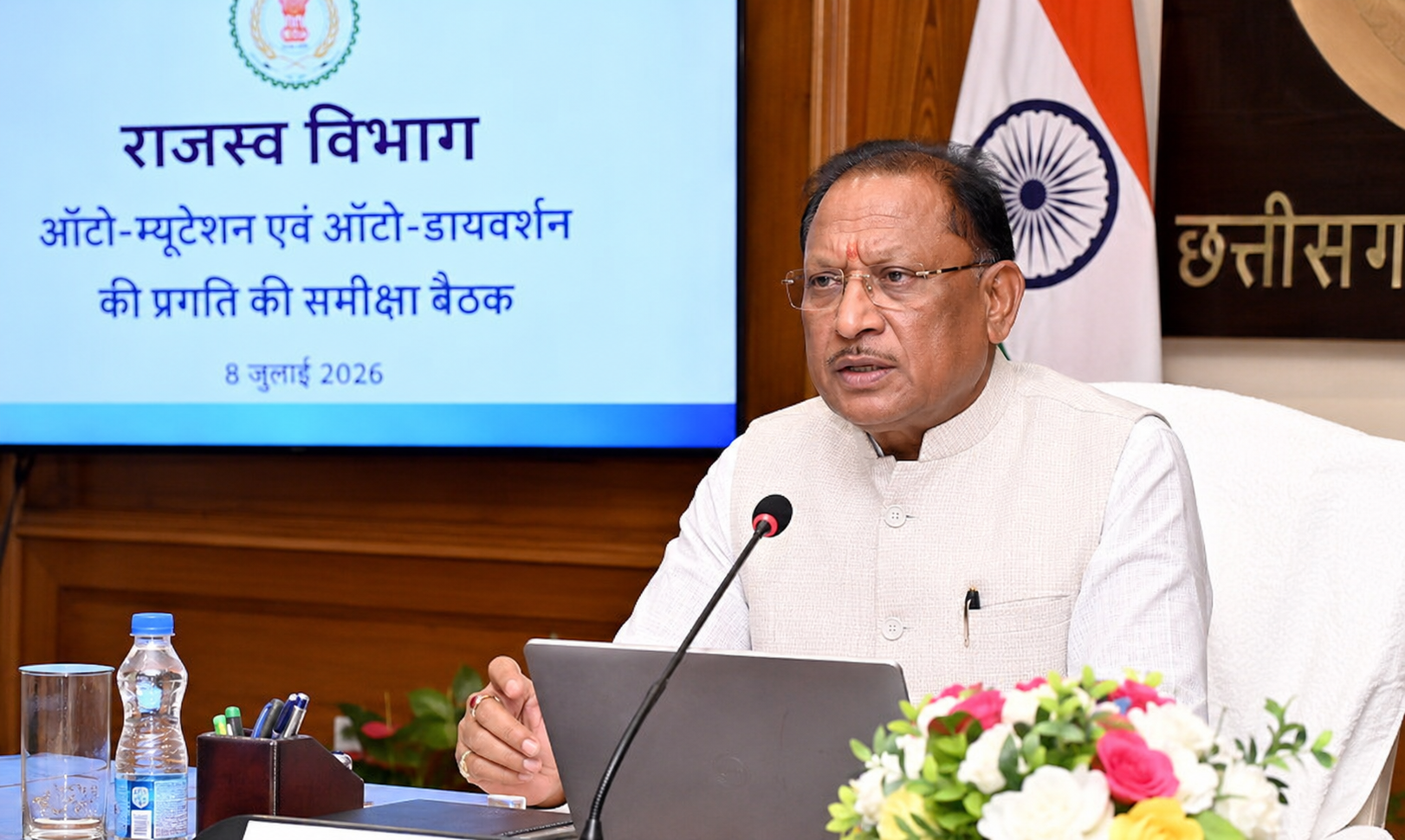
Chhattisgarh Chief Minister Vishnu Deo Sai reviews the state’s digital revenue reforms, as Auto Mutation and Auto Diversion transform land administration with faster, transparent and citizen-centric services, setting a new benchmark in e-governance-Photo Credit-channel24india.com
Key Factors
- 99.95% Auto Mutation success rate (1,40,536 out of 1,40,607 registrations).
- 83.71% Auto Diversion disposal rate (4,739 out of 5,661 applications).
- Koriya tops the state with a perfect 100% disposal rate.
- Dhamtari secures a place among the top five performing districts.
- NIC technical lock system strengthens accountability.
- NGDRS integration automates premium calculations.
- Multiple Khasra and Recovery Modules scheduled for rollout in July and August 2026.
- Digital reforms significantly reduce citizen visits to government offices while promoting transparency and efficiency.
99.95% Success in Auto Mutation, 83.71% Disposal in Auto Diversion Marks a New Era of Citizen-Centric Governance
Raipur: Chhattisgarh has emerged as one of India’s leading examples of digital governance in land administration, transforming revenue services through the successful implementation of Auto Mutation and Auto Diversion. Spearheaded by the state’s Revenue, Disaster Management and Rehabilitation Department, these technology-driven reforms have significantly reduced bureaucratic delays, eliminated unnecessary human intervention, and enhanced transparency in land-related services.
The initiative represents a major leap in the state’s governance model, ensuring that citizens no longer have to navigate lengthy administrative procedures for mutation of land records or diversion of land use. With digital integration and automation, Chhattisgarh is steadily positioning itself as a national benchmark in revenue administration.
Historic Success in Auto Mutation
One of the most remarkable achievements has been the implementation of Auto Mutation, under which ownership records are automatically updated following property registration.
According to official figures, out of 1,40,607 registered sale deeds, 1,40,536 cases have been successfully auto-mutated, leaving only 71 cases pending. This translates into an exceptional 99.95% success rate, one of the highest recorded in the country.
Previously, property buyers were required to submit separate applications for mutation, undergo physical verification, and make repeated visits to revenue offices—a process that often consumed months and created opportunities for delays and corruption. Today, ownership records are updated almost seamlessly, saving both time and money while ensuring real-time accuracy in land records.
To strengthen accountability, the National Informatics Centre (NIC) has introduced a technical lock mechanism. If an earlier auto mutation remains pending for any property, the concerned Sub-Registrar Office cannot register any subsequent transaction until the previous mutation is completed. This innovation ensures administrative discipline and prevents manipulation of land records.
Auto Diversion Accelerates Land Use Conversion
The state’s Auto Diversion system has similarly streamlined the process of converting agricultural land into residential, commercial or industrial use.
Between February and June 2026, the department received 5,661 applications, out of which 4,739 cases were successfully disposed of, achieving an impressive 83.71% disposal rate.
The system now automatically calculates diversion premiums based on government guideline values, eliminating manual calculations and improving transparency.
Officials clarified that the remaining 922 pending applications are largely due to incomplete documentation, discrepancies in challan payments, or proposed land use not conforming to approved Town and Country Planning (TNCP) master plans. Publicly disclosing these reasons reflects the department’s commitment to transparency.
District Performance Reflects Administrative Accountability
The implementation of digital revenue reforms has fostered healthy competition among districts.
Top Performing Districts in Auto Diversion
| Rank | District | Success Rate |
|---|---|---|
| 1 | Koriya | 100% (59 out of 59 cases) |
| 2 | Korba | 98.46% |
| 3 | Mungeli | 94.16% |
| 4 | Balod | 93.72% |
| 5 | Dhamtari | 92.73% (153 out of 165 cases) |
Koriya’s perfect performance demonstrates how technology, coupled with administrative efficiency, can ensure timely delivery of public services. Dhamtari’s entry into the state’s top five also reflects consistent monitoring and accountable governance at the district level.
Next Generation Digital Revenue Ecosystem
Building upon these achievements, the Revenue Department is now developing an integrated digital ecosystem with several new modules.
NGDRS API Integration
Government guideline rates are now being fetched directly through API integration with the National Generic Document Registration System (NGDRS), enabling fully automated and transparent premium calculations without human intervention.
“Diverted to Diverted” Module
A new module will allow landowners to change the internal usage of already-diverted land—for example, converting residential land into commercial use. Applications under this category will be processed within 15 days.
Multiple Khasra Module
Scheduled for rollout in July 2026, this module will enable applicants to include multiple khasra numbers in a single application, with automatic fee calculation and integrated e-challan generation.
Recovery Module
Expected by August 2026, the Recovery Module will help resolve long-pending diversion cases by facilitating previous payment entries, calculating pending premiums, generating revenue demands, and monitoring recoveries through a centralized dashboard.
Citizen-Centric Governance in Action
The reforms extend beyond technological advancement—they directly improve the lives of nearly 27.5 million residents of Chhattisgarh. Farmers, homeowners, entrepreneurs, developers and industrial investors now benefit from faster, transparent and predictable revenue services accessible from their homes.
The reduction in physical visits to government offices has minimized delays, reduced opportunities for corruption, and enhanced public trust in the revenue administration.
Roadmap Towards a National Benchmark
The government has already outlined an ambitious roadmap extending through December 2026, which includes:
- Satellite and drone mapping of land records across the state.
- Integration of Town and Country Planning (TNCP) No Objection Certificates (NOCs).
- Comprehensive upgradation of the state’s land records portal.
- Expanded digital integration across all revenue services.
- Enhanced citizen services through a unified online platform.
These initiatives are expected to establish Chhattisgarh as one of India’s most digitally advanced revenue administration systems.