Kumar Bahukhandi
As Vietnam pursues its ambition of becoming a high-income developed economy by 2045, artificial intelligence (AI) is expected to play a growing role in supporting productivity and innovation. Alongside technology adoption, developing the skills and management capabilities to apply AI effectively is becoming an important part of the country’s workforce agenda.
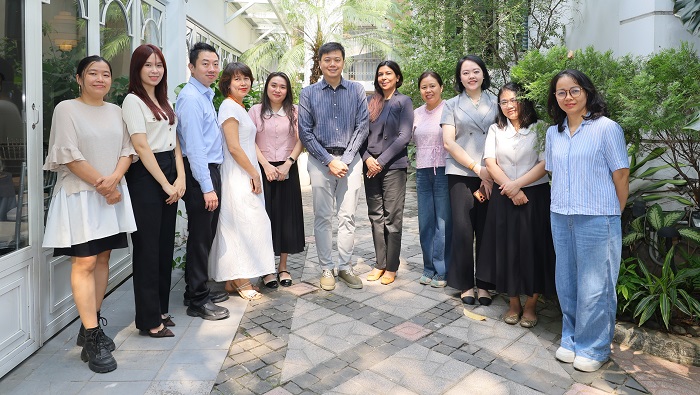 |
Dr Tan Hong Ming, Assistant Dean (Digital Operations), NUS Business School (sixth from left), with Ms Tara Bal, Head of Corporate Communications, NUS Business School (fifth from right), together with representatives from the Vietnamese media
A 2026 study commissioned by Amazon Web Services (AWS) found that 26 per cent of Vietnamese businesses have adopted AI, up from 18 per cent a year earlier. However, 61 per cent of adopters remain at the experimentation stage, while 87 per cent of surveyed employers consider reskilling existing employees important to their AI strategies.
Vietnam has also prioritised workforce development through its national AI human resources development programme, approved in August 2026. The programme includes plans to equip around 10 million workers with basic AI skills by 2030, alongside developing specialised AI talent and strengthening AI education.
Dr Tan Hong Ming, Assistant Dean (Digital Operations) at the National University of Singapore (NUS) Business School, said workforce development needs to extend beyond technical proficiency.
“AI literacy is only the starting point. The bigger challenge is whether organisations know how to redesign work around AI. A company can train every employee to use AI tools and still see little improvement in productivity if its processes and management practices remain unchanged. This is why leadership capability matters just as much as technical skills,” said Dr Tan at a media engagement session in Hanoi.
From adopting AI to creating business value
As AI tools become more accessible, businesses face decisions about where the technology can be applied, how existing work processes may need to change and what employees need to learn.
Dr Tan believes that while AI can improve productivity by automating tasks, organisations must also consider how its growing use affects the way employees learn and develop expertise.
“Struggle is an important part of learning. We develop expertise and judgement by working through difficult problems, making mistakes and figuring things out for ourselves. AI can now take away much of that struggle by providing answers almost instantly. While this improves productivity, we need to be careful that we are not also removing the experiences that help people learn and grow. Organisations need to rethink how employees develop these capabilities in an AI-enabled workplace,” he said.
Beyond developing AI literacy, organisations need to consider how employees assess AI-generated information, how managers incorporate the technology into workflows and how senior leaders oversee its use in business decisions.
Rethinking how professionals learn
The growing use of AI also raises questions about how professionals acquire the experience and judgement needed to take on more complex responsibilities.
While AI can help generate information and recommendations, learning to make business decisions still requires opportunities to question assumptions, evaluate competing perspectives and work through problems without complete information.
NUS Business School is piloting an AI-enabled business simulation that allows MBA and Executive MBA students to practise these capabilities.
The simulation uses ScholAIstic, a generative AI platform developed by the NUS AI Centre for Educational Technologies (AICET). Dr Emir Hrnjic, Senior Lecturer in Finance at NUS Business School, has been working with AICET to adapt and refine the platform’s capabilities for management education, creating AI-simulated executives whom students interview before making business recommendations.
Professor Teo Chung Piaw, Dean of NUS Business School, said the growing capabilities of AI require business schools to examine not only what students learn, but also how they develop and apply their knowledge.
“The role of business education is changing as AI becomes part of how organisations operate and make decisions. We cannot simply introduce new technology into existing teaching methods and assume that learning will improve. Business schools need to examine what students should learn, how they acquire that knowledge and how their ability to apply it is assessed. Our approach is to use AI to create more opportunities for students to think critically, engage with different perspectives and exercise independent judgement,” said Prof Teo.
Beyond preparing graduates for the workplace, postgraduate programmes and Executive Education can provide opportunities for working professionals and senior executives to update their knowledge and develop the capabilities needed to manage technological and organisational change.
Building Vietnam’s golden workforce
Vietnam’s Vision 2045 places continued emphasis on productivity, innovation and the development of higher-value industries. As AI becomes more widely adopted, higher education and professional training can contribute by equipping graduates, managers and senior executives with the capabilities to apply technology effectively in business.
Dr Tan said the country’s demographic advantage provides a foundation for developing these capabilities throughout people’s careers.
“Vietnam’s demographic advantage gives it an important opportunity, but a young workforce alone does not guarantee economic success. The real opportunity is to develop a workforce that can continuously learn, adapt and create value alongside AI. If Vietnam can combine its human capital with the effective adoption of AI, it can turn its golden population into a golden workforce,” he said.
About NUS Business School
With 50,000 alumni and 60 global chapters, the National University of Singapore (NUS) Business School is known for providing management thought leadership from an Asian perspective, enabling its students and corporate partners to leverage global knowledge and Asian insights.
The school has consistently ranked first in Asia by independent publications and agencies, such as The Financial Times and Quacquarelli Symonds, in recognition of the quality of its programmes, faculty research and graduates.
The school is accredited by AACSB International (Association to Advance Collegiate Schools of Business) and EQUIS (European Quality Improvement System), endorsements that the school has met the highest standards for business education.
For more information about NUS Business School, please visit bschool.nus.edu.sg.
To discover our MBA, MSc or Executive Education courses, visit mscbiz.nus.edu.sg, mba.nus.edu.sg or executive-education.nus.edu.sg.