Kumar Bahukhandi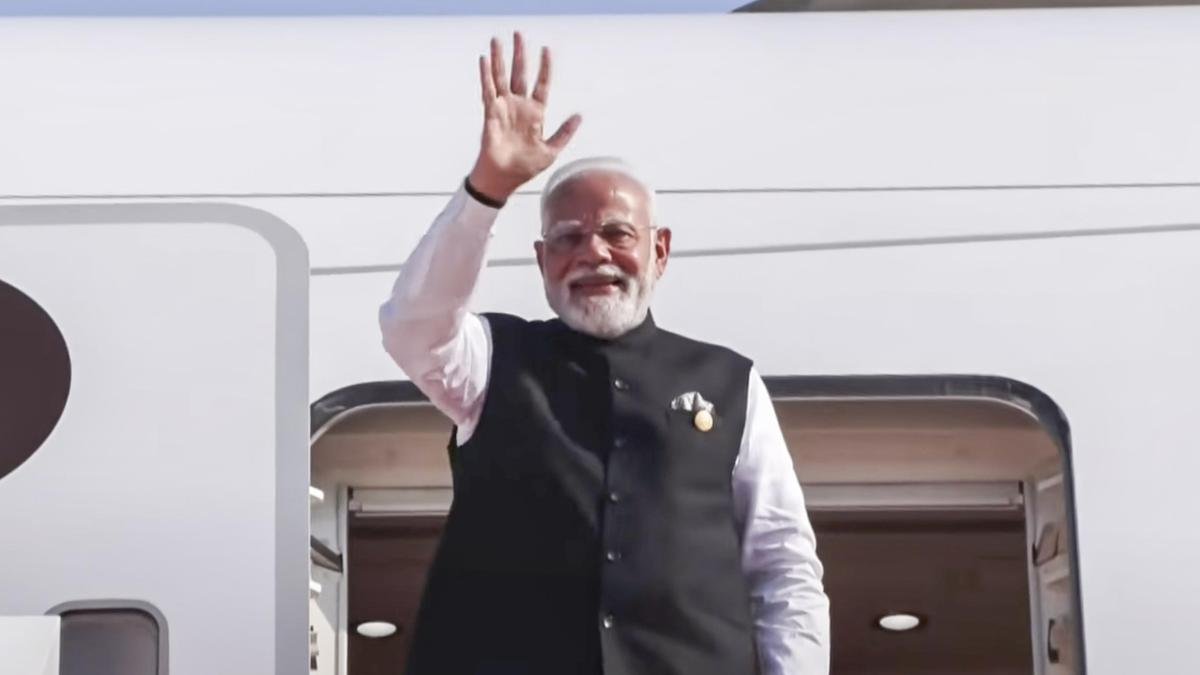
Prime Minister Narendra Modi waves before departing on his four-day visit to Uzbekistan and the Kyrgyz Republic on Saturday, August 29, 2026. Beyond the SCO Summit in Bishkek, the visit carries wider diplomatic significance for India’s Central Asia engagement, BRICS diplomacy and campaign for a 2028-29 UN Security Council seat-Photo Credit: X/@Narendra Modi.
Prime Minister begins four-day Uzbekistan-Kyrgyz Republic visit as India seeks deeper Central Asian engagement, stronger connectivity and diplomatic support ahead of major multilateral challenges
Key Factors
- Modi visits Uzbekistan on August 29-30 before travelling to Bishkek for the 26th SCO Summit
- India will emphasise Security, Connectivity and Opportunity at the SCO
- Visit comes ahead of the September BRICS Summit and India’s bid for a 2028-29 UN Security Council seat
- Engagement with Iran and Tajikistan could assume particular diplomatic importance
- India is seeking to revive momentum behind the long-pending India-Central Asia Summit
- Pakistan takes over the SCO presidency for 2027, putting future Indian participation under scrutiny
Prime Minister Narendra Modi’s four-day visit to Uzbekistan and the Kyrgyz Republic, beginning Saturday, August 29, 2026, carries significance well beyond bilateral diplomacy or his participation in the Shanghai Cooperation Organisation Summit.
The visit comes as New Delhi attempts to strengthen its strategic presence in Central Asia while preparing for a series of important diplomatic engagements — including the BRICS Summit in September and its candidature for a non-permanent seat on the United Nations Security Council for 2028-29.
Modi is visiting Tashkent on August 29 and 30 at the invitation of Uzbek President Shavkat Mirziyoyev before travelling to Bishkek for the 26th SCO Summit on August 31 and September 1. This is Modi’s fourth visit to Uzbekistan.
In his departure statement, Modi placed Security, Connectivity and Opportunity at the centre of India’s SCO approach and called for cooperation towards a region free from terrorism, separatism and extremism.
Central Asia Returns to the Strategic Centre
India’s engagement with Central Asia has long been constrained by geography.
New Delhi launched its Connect Central Asia policy in 2012, and Modi gave the engagement greater political visibility in 2015 when he became the first Indian Prime Minister to visit all five Central Asian republics — Kazakhstan, Kyrgyzstan, Tajikistan, Turkmenistan and Uzbekistan — during a single tour.
Yet connectivity has remained India’s fundamental difficulty. Pakistan stands between India and overland access to Afghanistan and Central Asia, while wider geopolitical disruptions have complicated alternative connectivity projects.
At the same time, China’s economic presence across Central Asia has expanded substantially, making India’s task less about matching Beijing financially and more about building on areas where New Delhi retains advantages — including education, information technology, healthcare, trade, capacity-building and longstanding cultural ties.
The Uzbekistan leg reflects that approach. Modi and Mirziyoyev are expected to review cooperation in trade and investment, defence, digital connectivity, energy, education and people-to-people relations. Modi is also scheduled to visit the Shastri Memorial and the Mahatma Gandhi Centre in Tashkent.
The diplomatic calculations become more complex when Modi reaches Bishkek.
Chinese President Xi Jinping is expected at the SCO gathering, while Russian President Vladimir Putin will also attend, giving Modi opportunities for high-level engagement at a time of considerable geopolitical churn.
Pakistan is due to assume the SCO presidency for 2027. That inevitably raises a politically sensitive question: would Modi travel to Pakistan if Islamabad hosts next year’s summit?
There is no decision at present, and any suggestion that Modi will or will not attend would be premature.
The current summit also provides India with opportunities to engage other strategically important SCO members, including Iran and the Central Asian republics.
Iran matters to India’s connectivity ambitions and to the emerging calculations ahead of the next BRICS gathering. Tajikistan assumes additional importance because of India’s campaign for a non-permanent UNSC seat for the 2028-29 term.
New Delhi would naturally prefer to consolidate Asian support well before the election rather than face competing candidatures that could divide votes.
The visit also puts renewed attention on the India-Central Asia Summit mechanism.
The first summit was held virtually in January 2022. India subsequently revived ministerial-level engagement, but another leaders’ summit has yet to take place. For New Delhi, restoring regular summit-level interaction would demonstrate that Central Asia remains a sustained strategic priority rather than an episodic diplomatic interest.
Modi’s visit therefore operates simultaneously on several levels: strengthening bilateral relations with Uzbekistan and Kyrgyzstan, positioning India within the SCO, maintaining engagement with Russia, China and Iran, preparing diplomatic ground for BRICS and the UNSC contest, and rebuilding momentum in India’s wider Central Asian policy.
The Prime Minister himself framed the tour in broader terms before leaving India, saying he expected it to strengthen India’s strategic partnerships in Central Asia and advance the shared pursuit of peace, stability and prosperity.
For India, the larger challenge will be turning diplomatic engagement into sustained economic and physical connectivity with a region that New Delhi has long considered strategically important but remains geographically difficult to reach.