Kumar Bahukhandi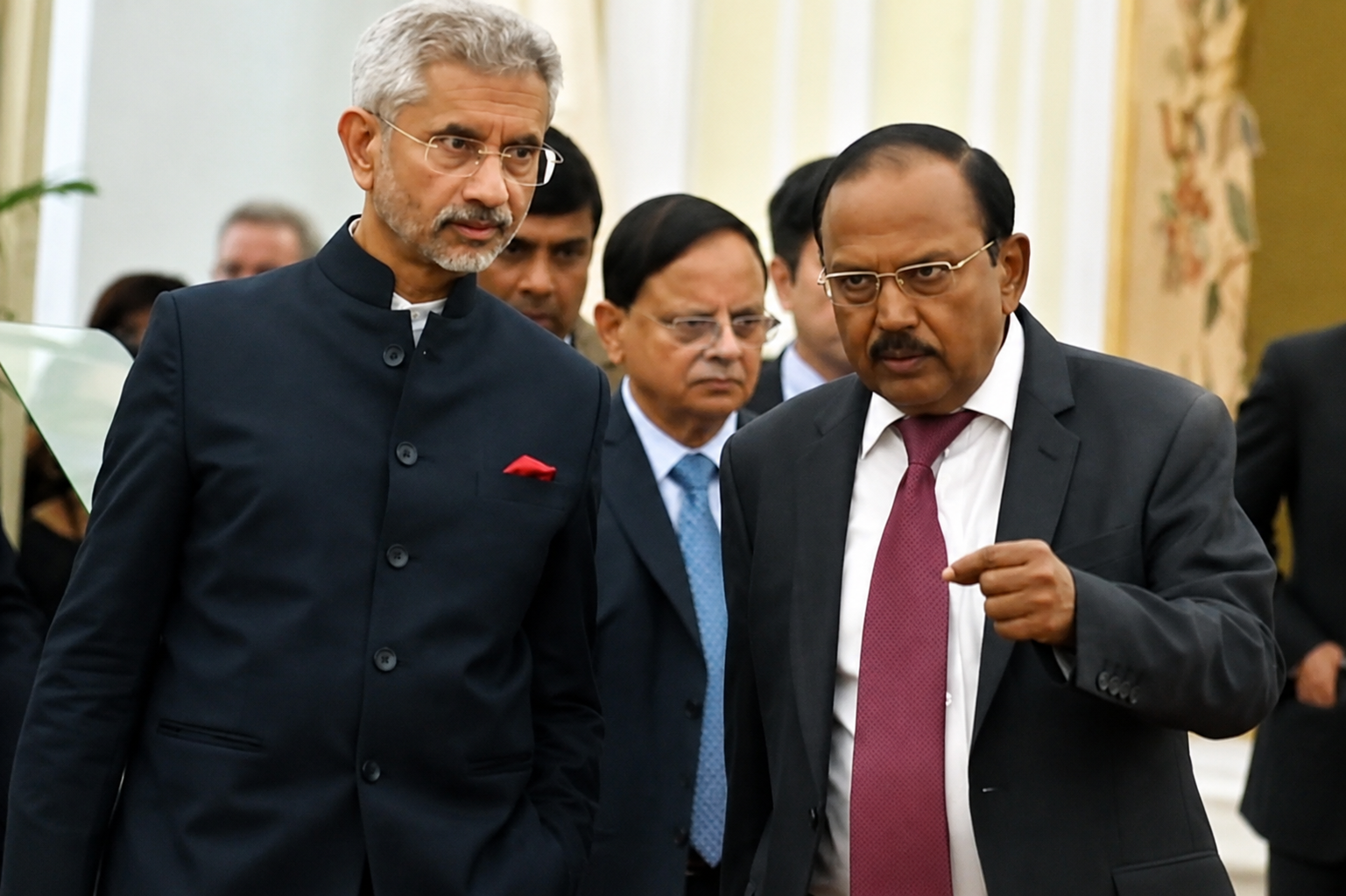
Diplomacy and Security: External Affairs Minister S. Jaishankar and National Security Adviser Ajit Doval represent two important arms of India’s foreign-policy and national-security establishment under Prime Minister Narendra Modi. (Photo: By Arrangement)
One gives India’s diplomacy its public voice; the other works largely away from the spotlight. Together, S. Jaishankar and Ajit Doval have become indispensable pillars of Narendra Modi’s foreign and security establishment
India’s foreign policy under Prime Minister Narendra Modi is increasingly defined by an unusual combination of public diplomacy and strategic security management.
At the centre of this system stand two men with markedly different backgrounds and working styles: External Affairs Minister S. Jaishankar and National Security Adviser Ajit Doval.
Jaishankar is the visible diplomat. Doval is the security strategist whose influence is more often exercised away from cameras. Their responsibilities overlap at crucial moments, but their institutional roles remain distinct. Together, they represent two sides of the machinery through which New Delhi navigates an international order that has become considerably more complicated.
India today maintains a strategic partnership with the United States while preserving its long-established relationship with Russia. It participates in the Quad while remaining a central member of BRICS and the Shanghai Cooperation Organisation. It competes with China but must simultaneously manage an enormous and difficult bilateral relationship with Beijing.
This is not conventional bloc politics. It requires India to keep several diplomatic doors open at the same time.
Jaishankar: The Public Voice of Indian Diplomacy
Few Indian foreign ministers have acquired as prominent an international profile as Jaishankar.
His years as a career diplomat — including assignments as India’s ambassador to China and the United States and later as Foreign Secretary — gave him an understanding of both the bureaucratic machinery of diplomacy and the political calculations behind it.
As External Affairs Minister, however, his role has extended well beyond conventional diplomacy.
Jaishankar has become one of the government’s principal international communicators. Whether discussing strategic autonomy, relations with Russia, terrorism, trade or India’s disagreements with Western governments, he frequently articulates New Delhi’s position in language designed for audiences far beyond the diplomatic community.
The approach has helped give contemporary Indian foreign policy a recognisable public vocabulary: India will cooperate where interests converge but is increasingly reluctant to allow another capital to determine its strategic choices.
This approach becomes particularly important when India’s partnerships appear contradictory.
Washington wants a deeper strategic relationship with New Delhi. Moscow remains an important defence and geopolitical partner. Europe is economically important. The Gulf is central to India’s energy and diaspora interests. Iran retains strategic significance, while Israel has become an increasingly important partner.
Managing these relationships requires negotiation as well as explanation. Jaishankar performs both functions.
Doval: Strategy Away From the Podium
Doval’s influence operates differently.
A former Intelligence Bureau chief with decades of experience in security and intelligence, the National Security Adviser occupies a position where diplomacy, intelligence, defence and internal security frequently intersect.
His public appearances are fewer and his language generally less political. That should not be mistaken for limited influence.
The NSA’s importance becomes particularly visible during security crises, sensitive negotiations and engagements requiring coordination between India’s diplomatic establishment and its intelligence and defence institutions.
Where Jaishankar frequently explains India’s position after policy has taken shape, Doval is closely associated with the strategic processes through which security choices are assessed.
That difference is important.
Modern foreign policy is no longer conducted exclusively by foreign ministries. Terrorism, cyber threats, technology, intelligence, military deterrence, energy security and economic coercion have blurred the traditional boundary between diplomacy and national security.
India’s foreign-policy architecture increasingly reflects that reality.
Modi Remains the Centre
Yet neither Jaishankar nor Doval operates independently of the political leadership.
The defining characteristic of India’s present foreign-policy system is its concentration around the Prime Minister’s Office. Major international relationships are strongly associated with Modi himself, while the External Affairs Minister and National Security Adviser provide two different institutional instruments for executing that policy.
Their importance consequently comes not from competition with one another but from complementarity.
Jaishankar provides diplomatic reach, institutional experience and public articulation. Doval brings intelligence experience, security assessment and strategic coordination.
For a Prime Minister pursuing simultaneous relationships with competing powers, having both capabilities close to the political centre is valuable.
Kerala Shows How Power Consolidates Differently
The consolidation of political authority is also visible, though in a completely different setting, in Kerala.
V. D. Satheesan became Chief Minister following the Congress-led UDF’s victory in the 2026 Assembly election. K. C. Venugopal and other senior Congress figures had also figured in the leadership discussions before Satheesan emerged as the choice.
More than 100 days into office, Satheesan’s administrative choices provide an indication of how he intends to exercise that mandate.
He has retained important portfolios including finance, planning and economic affairs, general administration and personnel and administrative reforms. The official allocation of portfolios confirms the unusually broad range of responsibilities concentrated in the Chief Minister’s office.
The political message is difficult to miss: irrespective of the equations that preceded his selection, Satheesan is seeking to establish his own administrative authority.
Why Senior Officers Are Reluctant to Come to Delhi
A different contest for institutional influence is unfolding within India’s bureaucracy.
Central deputation was once regarded as an almost inevitable milestone for ambitious IAS and IPS officers. Delhi provided exposure to national policymaking and access to the highest levels of government.
That attraction has weakened for some officers.
Greater scrutiny of appointments, empanelment requirements and intense competition for senior positions have made Central assignments less predictable. At the same time, senior officers serving in their state cadres can command substantial administrative authority and direct access to political leadership.
The numbers reveal the broader personnel problem.
Government data placed the sanctioned strength of the IAS at 6,877, with around 1,300 posts vacant. That represents a shortage approaching 19 per cent.
Vacancies do not by themselves prove that officers are avoiding Delhi — cadre shortages, recruitment levels, retirement and deputation policies all contribute — but difficulties in attracting experienced officers for Central assignments deserve attention.
A system designed to select only the most suitable officers can become counterproductive if talented administrators conclude that the uncertainty surrounding Central deputation outweighs its professional advantages.
India needs capable officers in the states. It also needs them in New Delhi.
That balance cannot be maintained merely by directing state governments to release officers. Central service must remain professionally attractive in its own right.
From India’s foreign-policy establishment to Kerala’s new government and the country’s administrative services, the underlying issue is ultimately the same: institutions matter, but so do the people entrusted with operating them.
Power may be concentrated at the top, but effective governance still depends upon choosing capable people, defining their responsibilities clearly and giving them enough institutional space to perform.