Kumar Bahukhandi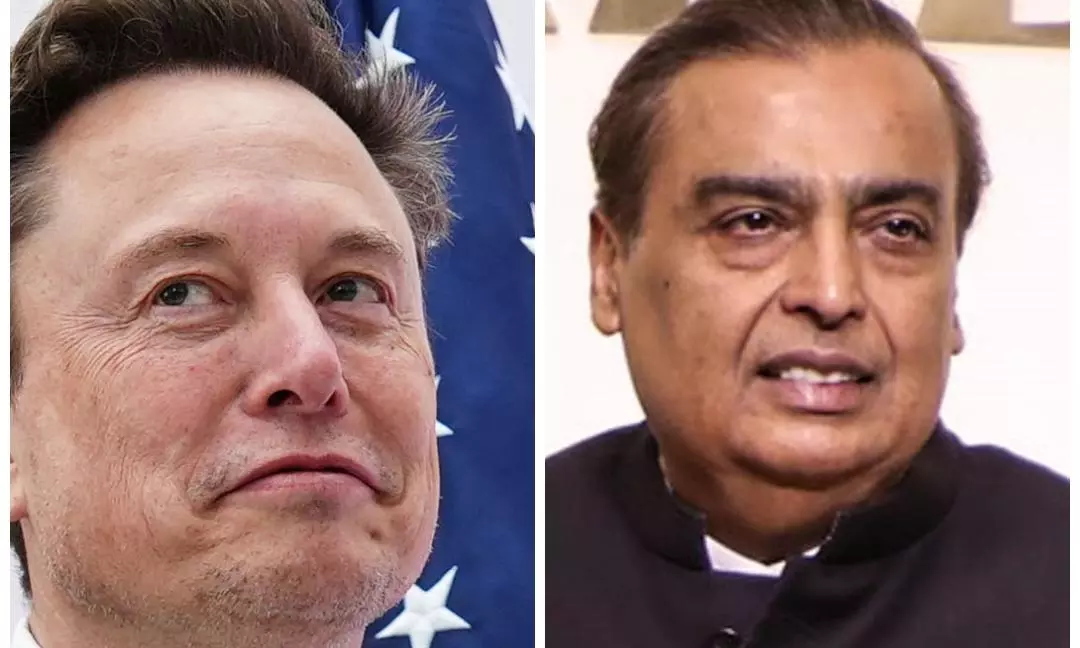
SpaceX and Tesla chief Elon Musk has criticised arguments advanced by online supporters of Reliance Industries Chairman Mukesh Ambani over Starlink’s proposed entry into India, maintaining that competition in satellite internet services would expand consumer choice and encourage more affordable connectivity. Photo:AP
Tesla and SpaceX chief argues that satellite internet competition will expand consumer choice, challenge existing market dominance and ultimately benefit ordinary Indians
Key Highlights
- Elon Musk renews criticism of arguments advanced by Mukesh Ambani’s online supporters over Starlink’s proposed entry into India.
- Musk describes their claims as “absurd hypocrisy and hyperbole.”
- SpaceX chief questions how Starlink can simultaneously be considered too expensive to compete and a serious competitive threat.
- Musk argues that greater competition will benefit Indian consumers through wider choice.
- He acknowledges that competition could affect Ambani’s profits but says the businessman will not be driven out of business.
- Musk maintains that consumers will reject Starlink if its services are unaffordable, forcing the company to adjust its pricing.
Musk Challenges Contradictory Arguments Over Starlink Competition
New Delhi: Elon Musk has reignited the debate over competition in India’s telecommunications sector, accusing online supporters of Reliance Industries Chairman Mukesh Ambani of making contradictory arguments about Starlink’s proposed entry into the Indian market. In a post on X on Sunday, October 11, 2026, the SpaceX chief questioned claims that his satellite internet service would be unable to compete with the low prices offered by Ambani’s telecommunications business while simultaneously being portrayed as a serious competitive threat. Musk maintained that greater competition would ultimately benefit ordinary Indians by expanding consumer choice and encouraging more affordable services.
The latest exchange highlights the growing commercial significance of satellite-based internet connectivity in India, where conventional mobile and broadband networks already serve a substantial customer base.
Musk’s remarks focused on what he characterised as inconsistencies in arguments advanced by supporters of Ambani’s business interests.
‘Absurd Hypocrisy and Hyperbole,’ Says Musk
Musk questioned the reasoning behind claims that Starlink’s services would be too expensive to compete effectively against the established telecommunications market.
At the same time, he argued, some of those making such claims were suggesting that Starlink represented a major competitive threat.
Describing the arguments as “absurd hypocrisy and hyperbole,” Musk challenged the apparent contradiction.
He referred to the “amazing low prices offered by Ambani’s de facto monopoly in India,” using the expression to criticise what he perceives as the existing concentration of market power.
The description of Ambani’s business as a de facto monopoly represents Musk’s characterisation, rather than an established regulatory finding.
India’s telecommunications sector includes other operators, and any assessment of market dominance requires consideration of competition across different services and market segments.
Competition Will Benefit Ordinary Indians, Musk Argues
The SpaceX chief maintained that allowing Starlink to compete in India would give consumers more options for accessing internet services.
His argument was that competition should be welcomed rather than resisted, particularly when it offers the possibility of improved connectivity and greater consumer choice.
Musk suggested that the presence of another service provider could place competitive pressure on established businesses.
He also acknowledged that stronger competition might affect the profitability of Ambani’s telecommunications interests.
However, he dismissed suggestions that Starlink’s entry would threaten the survival of Ambani’s business.
“He is not going out of business,” Musk said, referring to Ambani.
The statement underlined Musk’s position that competition should not be confused with the elimination of existing operators.
If Starlink Is Too Expensive, Consumers Will Reject It
Musk also addressed concerns that satellite internet services could be too costly for Indian consumers.
He argued that affordability would ultimately determine whether Starlink could attract customers.
According to his reasoning, consumers would have little incentive to subscribe if the service were priced beyond their willingness or ability to pay.
In such circumstances, Starlink would have to reconsider its pricing to compete effectively.
The argument reflects a basic principle of consumer markets: service providers must offer sufficient value at a price customers are prepared to accept.
However, the commercial prospects of satellite internet also depend on factors beyond subscription charges, including equipment costs, network capacity, service quality and regulatory conditions.
Starlink and Conventional Telecom Networks Serve Different Connectivity Needs
Starlink’s satellite-based internet technology differs significantly from conventional mobile and fibre broadband networks.
Traditional telecommunications operators generally depend on terrestrial infrastructure, including mobile towers, fibre-optic cables and associated network facilities.
Starlink uses satellites operating in low Earth orbit to provide internet connectivity through specialised ground equipment.
Such systems may offer particular advantages in remote, mountainous and sparsely populated regions where extending conventional infrastructure can be difficult or expensive.
Nevertheless, satellite broadband is not necessarily a direct replacement for low-cost mobile internet services.
Its competitiveness in India will depend on the pricing structure, intended customer segments, technical performance and applicable regulatory requirements.
Debate Extends Beyond Two Billionaires
Although Musk’s remarks have placed him in direct rhetorical confrontation with arguments associated with Ambani’s supporters, the broader issue concerns the future structure of India’s internet connectivity market.
For consumers, the central questions are likely to be whether additional operators can improve coverage, maintain reliable services and offer competitive prices.
Satellite broadband could potentially complement existing telecommunications networks, particularly in areas where terrestrial connectivity remains inadequate.
At the same time, the introduction of new technologies requires an appropriate framework for spectrum use, licensing, security compliance and consumer protection.
The commercial interests of major companies must therefore be considered alongside the wider public interest in affordable and reliable connectivity.
Consumer Choice Remains at the Centre of Musk’s Argument
Musk’s latest intervention places consumer choice at the centre of the debate over Starlink’s proposed Indian operations.
His position is that market competition should be allowed to determine whether customers prefer established telecommunications services or a new satellite-based alternative.
The SpaceX chief has also suggested that fears about Starlink’s competitive impact are difficult to reconcile with claims that the service will be too expensive to attract Indian subscribers.
The disagreement reflects competing assessments of Starlink’s potential role in India’s telecommunications market.
For existing operators, the emergence of satellite broadband raises questions about future competition, investment and the economics of connectivity.
For Starlink, the challenge will be to demonstrate that its services can meet Indian consumers’ requirements at commercially viable prices.
Affordability and Service Quality Will Decide Starlink’s Future
India’s telecommunications market is highly sensitive to pricing, making affordability an important consideration for any new entrant.
Starlink’s ability to establish a meaningful customer base will depend on whether its technology provides benefits that justify the cost to subscribers.
While satellite connectivity may be particularly useful in underserved areas, widespread adoption will depend on practical factors such as equipment availability, installation requirements, monthly charges and service reliability.
Musk’s criticism of Ambani’s online supporters has brought renewed attention to these issues, but the ultimate outcome will depend on market conditions and the services actually offered to consumers.
The larger question is not whether Elon Musk or Mukesh Ambani wins a public argument, but whether the expansion of competition delivers more affordable, accessible and reliable internet connectivity to the people of India.