Kumar Bahukhandi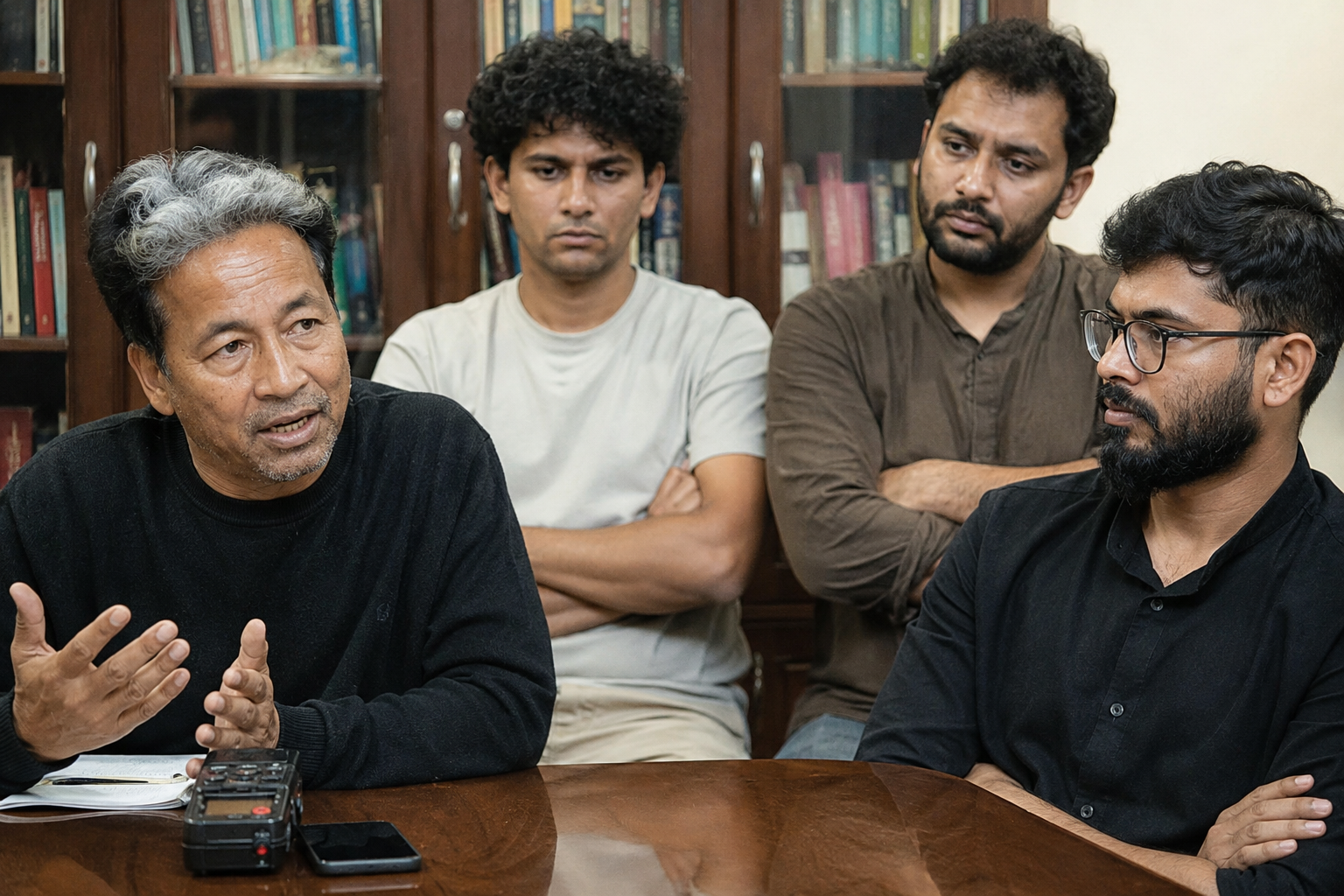
A representational depiction of Sonam Wangchuk in discussion with young activists, reflecting the debate over political ambition and the need to preserve the independent character of student movements.
There is something significant in Sonam Wangchuk’s assessment of the people behind the Cockroach Janta Party (CJP). He believes they have political ambitions. He also sees nothing inherently wrong with that.
That distinction deserves attention.
Speaking in a podcast with Prakhar Gupta, Wangchuk said his assessment of CJP founders Abhijeet Dipke, Saurav Das and Ashutosh Ranka was that they probably harbour political ambitions, although they had not themselves told him so. His remark that “they are not saints” may sound provocative when separated from the rest of his comments, but his larger argument was considerably more nuanced.
Wangchuk was not accusing the CJP leadership of secretly manipulating the student movement for political gain. On the contrary, he said that while working closely with them during the nearly two-month-long agitation seeking the removal of Dharmendra Pradhan as Education Minister, he repeatedly advised them to keep the movement politically neutral.
His reasoning is worth examining. Individual organisers may eventually enter politics, contest elections or join political parties. That is their democratic right. But a student movement presented to the public as an independent platform cannot simultaneously become an undeclared vehicle for somebody’s political career.
There lies the difference between political ambition and political exploitation.
The Movement Must Remain Bigger Than Its Leaders
India has an unfortunate tendency to demand political innocence from people until the very moment they formally enter politics. An activist expressing political ambition immediately attracts suspicion; a student leader contemplating elections is accused of having an agenda; and somebody previously associated with a political party can find every subsequent public activity viewed through that association.
That approach is neither realistic nor particularly democratic.
Wangchuk himself referred to criticism surrounding Dipke’s reported earlier association with the Aam Aadmi Party. His position was essentially that having worked with a political party in the past should not automatically disqualify somebody from participating in an independent public movement.
That is reasonable. Previous political association is relevant information, but it is not proof that a later movement is controlled by that party.
The stronger test is conduct.
Did the organisers allow different political interests to take control of the platform? Were students being mobilised for an educational cause or for an undeclared electoral purpose? Was the movement’s position determined by students’ concerns, or by what benefited a particular political organisation?
Wangchuk says that during his involvement he wanted the platform to remain a pressure group that students could regard as belonging neither to the BJP, Congress nor AAP. He also says he was satisfied that the organisers maintained that character during that period.
That endorsement, however, should not exempt CJP from future scrutiny. In some respects, it creates a benchmark against which the organisation can now be judged.
If Dipke, Das, Ranka or other CJP office-bearers eventually enter electoral politics, there is nothing inherently objectionable about it. Democratic politics needs younger leaders, and public movements have historically produced many of them.
But there is an important difference between a genuine movement producing political leaders and aspiring political leaders producing a movement primarily to promote themselves.
Which of those descriptions ultimately fits CJP cannot fairly be decided today merely from speculation about the ambitions of its founders. Their future conduct will provide a better answer.
CJP’s leadership should therefore not be uncomfortable with questions about transparency, political associations, decision-making and future ambitions. An organisation seeking public confidence must accept public scrutiny, particularly when it presents itself as an independent voice of students and young citizens.
Equally, critics should resist declaring the movement politically compromised merely because some of its organisers may eventually seek political office.
Wangchuk’s comments offer a useful middle ground. Political ambition need not be treated as a character defect. Neither should good intentions be accepted as a permanent substitute for transparency.
India needs young people willing to enter politics. It also needs student movements and citizens’ platforms capable of challenging governments regardless of which party occupies office. Those two democratic requirements can coexist, but only when the boundary between a public cause and personal political advancement remains visible.
“They are not saints” will inevitably attract attention. Yet the more consequential message in Wangchuk’s remarks is much simpler:
One does not have to be a saint to serve a public cause. But those leading such a cause must be clear about where the movement ends and personal politics begins.