Kumar Bahukhandi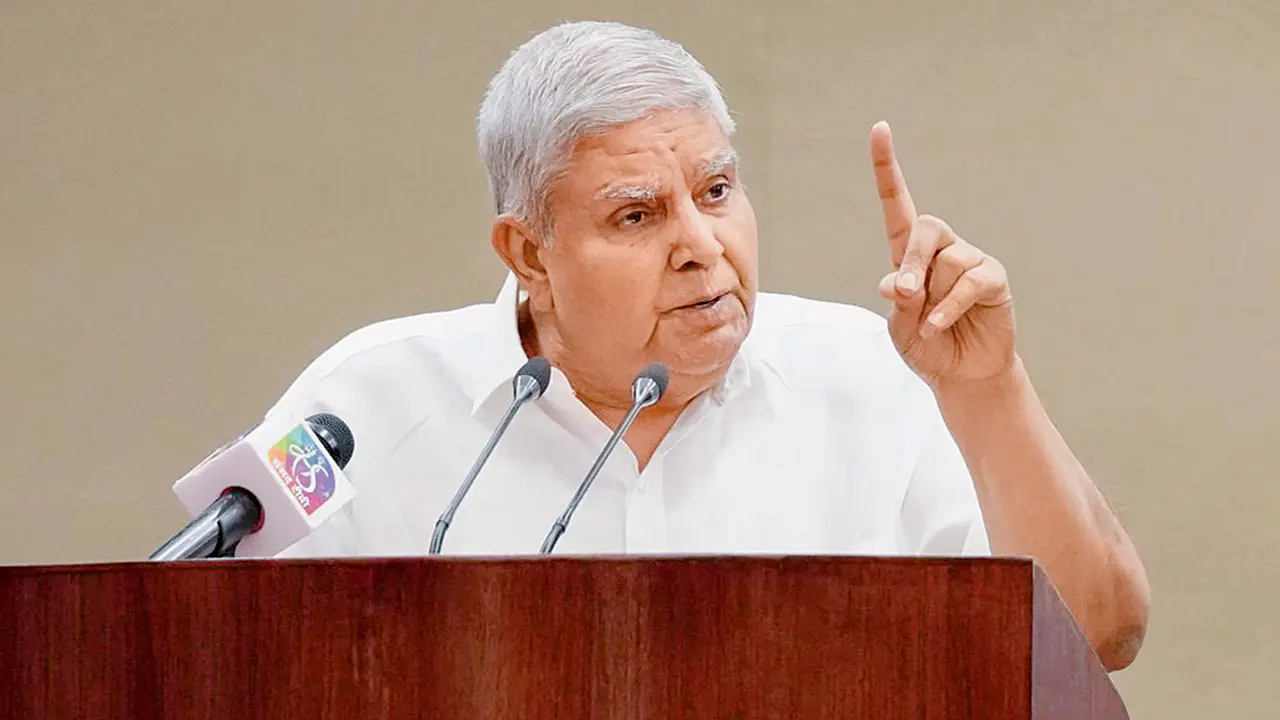
Jagdeep Dhankhar addresses the valedictory ceremony for the sixth batch of Rajya Sabha interns at the Vice-President Enclave in New Delhi on April 17. File photo -PTI
Author
The medical reason Dhankhar cited in his resignation letter is universally disbelieved, suggesting the nation reflexively knows a wide spectrum of democratic politics has increasingly become invisible to it. Silence and secrecy do not a vibrant democracy make
Seldom has India been as keen for one man to speak as it is for Jagdeep Dhannkar to explain his sudden decision to resign as the vice-president of India. The medical reason Dhankhar cited in his resignation letter is universally disbelieved, suggesting the nation reflexively knows a wide spectrum of democratic politics has increasingly become invisible to it. Silence and secrecy do not a vibrant democracy make.
Internecine battles in the ruling establishment have always been an aspect of India’s political story. It’s also true that the extraordinary powers of the Prime Minister unfailingly enabled his/her team to control the media narrative on the challenge his/her rivals mounted against him/her. Yet the rivals never became silent. They would brief journalists; their versions were published — and attributed to “sources close to” them.
An example of this was the tussle between President Zail Singh and Prime Minister Rajiv Gandhi in the 1980s. As the rift between them widened, Singh took to raising objections against Gandhi’s decisions, triggering the outcry that the President was transgressing the constitutional limits imposed on him. Yet Singh had his say through the media. A 1987 story in the newsmagazine India Today reads: “Commented a source close to Singh: ‘When the entire country is questioning the wisdom of the prime minister’s actions, it is the duty of the head of the state to satisfy himself that the Government is being run in accordance with the Constitution.’”
A week after Dhankhar’s resignation, we have yet to hear his side of the story, either on record or from “sources close to him.” We have only the government’s narrative on his resignation. According to it, Dhankhar incurred the Bharatiya Janata Party’s wrath because of his temerity to mention in the Rajya Sabha the Opposition’s notice to impeach Justice Yashwant Varma, from whose residence sacks of currency notes were allegedly found. The BJP felt upstaged as it intended to bring a similar notice in the Lok Sabha for impeaching Varma — and gain publicity for its crusade against corruption.
Dhankhar was perceived to have turned against the government as he had also mentioned in the Rajya Sabha the Opposition’s notice to impeach Justice Shekhar Kumar Yadav, for delivering what is deemed hate speech against Muslims at a Vishwa Hindu Parishad function. The BJP is not interested in impeaching Yadav as it believes his speech articulated the party’s Hindutva ideology. No ruling party, the government narrative contends, will allow the Rajya Sabha chairman to undermine its interests. Dhankhar was, thus, ordered to either resign or face the ignominy of being removed.
This narrative doesn’t explain why Dhankhar turned hostile to the BJP, which is synonymous with Prime Minister Narendra Modi and Home Minister Amit Shah. Here was a man who fawned over them, regularly interrupted the speeches of Opposition leaders, suspended 46 MPs at a go, often hailed the Rashtriya Swayamsevak Sangh, and lambasted the judiciary for encroaching upon the realm of the executive. The Opposition felt provoked to move a no-confidence motion against him in December.
The timeline of Dhankhar’s conduct shows he was alienated from the ruling dispensation after December. It’d be incredible to claim that the no-confidence motion brought about a metamorphosis in a man such as Dhankhar, prompting him to play fair. Indeed, Dhankhar’s decision to mention Opposition’s notices of impeachment could only have been an outcome of the breakdown in the relationship between the vice-president and the Prime Minister. So deep is the bitterness between them that Dhankhar has been denied the courtesy of delivering a farewell speech. He won’t be wrong to feel insulted.
It reflects poorly on Indian democracy that the nation is unaware why their relationship soured, other than what is known through the government’s narrative. Dhankhar hasn’t spoken even through “sources close to him.” His silence is in itself a result of the distancing consciously crafted, over the last decade, between the media and the ruling establishment, which is averse to multiple narratives emerging on any issue. Sources speak to journalists because of the trust based on years of interaction. Perhaps Dhankhar doesn’t know a journalist whom he can trust.
It’s also debatable whether a story citing sources close to Dhankhar will get featured in legacy media, given its hesitation to displease the ruling regime, in sharp contrast to the daring that journalists would show only a decade ago. Dhankhar can obviously tell his side of the story on social media, where he posted his resignation letter last week, or turn to digital media to give interviews a la Satyapal Malik the former governor of Jammu and Kashmir. Dhankhar’s continued silence will otherwise be interpreted as emanating from his fear of retribution from the ruling regime, which has sent several political
luminaries to jail.
Dhankhar was undoubtedly a Sangh-BJP partisan, who harassed the Opposition without respite. Nonetheless, he also occupied as high an office as that of vice-president, from which he was, all accounts suggest, summarily compelled to resign, in circumstances unknown to the nation. This is a sign of democracy’s decline, which will go unchallenged in case the Opposition fails to demand from the government a statement in Parliament on the real reason behind Dhankhar’s resignation.
The writer is a senior journalist and author of Bhima Koregaon: Challenging Caste.
The views expressed in this column are the individual’s and don’t represent those of the channel24india.com