Kumar Bahukhandi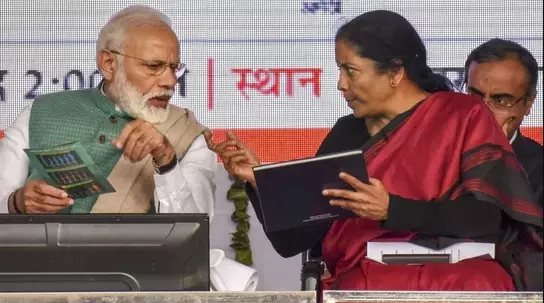
Prompted by Prime Minister Modi, Finance Minister Nirmala Sitharaman led a complete overhaul of GST, scrapping 12% and 28% slabs to simplify the tax regime, lower rates, and ease compliance for businesses.
Finance Minister calls it a “people’s reform” as GST slabs cut to 5%, 18% and 40%
New Delhi: ‘Ek baar aap GST dekh lo!’ – Prime Minister Narendra Modi’s gentle nudge to Finance Minister Nirmala Sitharaman in December last year sparked the beginning of a mammoth exercise to overhaul the tangled goods and services tax regime. And the final outcome is a significantly simplified system with lower tax rates and easier compliance for businesses.Sitharaman, who, along with her team, began work to identify anomalies in the present four-tier structure and compliance issues faced by businesses, was once again reminded by the Prime Minister when she was preparing the Budget for the 2025-26 fiscal year. ‘Aap GST ke upar kar rahi ho na kaam?’ Modi had inquired.
Her discussion with the Prime Minister led Sitharaman to begin work on reviewing everything in GST – not just rates and tax slabs but how to make the regime more friendly for businesses, particularly small and medium businesses. In an interview with PTI, Sitharaman recalled the parallel works that happened – from overhauling the indirect tax regime to ensuring the backend software is ready to implement the massive change in the offing.
“Even before the last GST council meeting, which happened in Jaisalmer in Rajasthan (in December 2024), the Prime Minister had called me and said, ‘ek baar aap GST dekh lo. Business ke liye subvidhajanak banao and rates par itne sare confusion kyun hai’ (please look at the GST regime once. Why is there so much confusion on rates? Make it easier for businesses),” he said.
Soon after, during the discussion on income tax relief measures outlined in the Budget, Modi again reminded her: “Aap GST ke upar kar rahi ho na kaam (You are working on GST, right?)”. What came handy was the work of a group of ministers on different GST issues during the last one and half years.
“What I decided after hearing from Prime Minister, was (that) it’s time for us, now that eight years are over, to have a thorough review of everything in GST, not just the rates, not just the number of slabs, but also looking at it from the point of view of how will a business, small or medium business approach this,” she said.
Classification issues – such as different tax rates on salted and caramel popcorn and cream buns being taxed at higher rates while buns and cream separately attracting much lower taxes – and the rates were reviewed. “So since February 1, 2025, till about May 15 we kept doing this study, review and so on,” she said.
“Sometime in mid-May, when I was through with the first cut, I went to the Prime Minister (and) told him we are somewhere near some formulation, which can be a proposal and asked him to give me time so that I can brief him. He gave me time. I briefed him.”
The final decision on changes in the GST rested with the GST Council, which is headed by the Union Finance Minister and includes representatives of all states and Union Territories. Sitharaman said once broad contours were agreed upon, it was decided that this should be the central government’s proposal to the group of ministers from six different states that was tasked with looking at rate rationalisation before they come up at the full-body council.
“So we wanted to make it clear that we respect all that the GoMs have done, but here is a proposal coming exclusively from the Centre, which is a one-third partner in the Council,” she said. The GoM started examining the issue. A separate group of ministers that was looking at sunset clause for compensation cess, which is currently levied on sin and luxury goods to create a corpus for funding deficits of states arising from amalgamation of central and state levies into GST from July 2017, also participated in deliberation of the GoM on rate rationalisation to arrive at an all-encompassing decision, she said.
Then the rate rationalisation GoM, which actually started off under former Karnataka chief minister Basavaraj Somappa Bommai and was later headed by Bihar Deputy Chief Minister Samrat Chaudhary, went through the Centre’s proposal. The GoM backed the proposal to scrap 12 per cent and 28 per cent GST slabs and have just two – 5 per cent for common use goods and 18 per cent for everything else. A third rate of 40 per cent has been earmarked for a small list of sin goods and ultra-luxury items. “Then (GoM) they came to a decision that it is better this whole thing is placed in the Council itself, rather than for them to further go into the proposal.
Then all this came to the Council, and the Council took a decision on September 3 on lines of the Centre’s proposal,” she said. Sitharaman called the landmark GST overhaul a “people’s reform” that will benefit every family, boost consumption, and bolster the economy. All 140 crore people will be touched by this landmark reform directly or indirectly, she said.
Nearly 400 products – from soaps to cars, shampoos to tractors and air conditioners – will cost less when the rejig of the GST is effective from the first day of Navaratri on September 22. Premiums paid on individual health and life insurance will be tax-free. In the revamped GST structure, most daily food and grocery items will fall under the 5 per cent GST slab with bread, milk and paneer attracting no tax at all. EVs and small cars will be taxed at 5 per cent while other white goods at 18 per cent – slabs that are lower than current rates. With the tax rate cut, her focus will now shift to implementation.
Sitharaman said while the backend software will be ready for the changes at least a couple of days before the date of implementation, she would from September 22 focus on seeing that businesses pass on the benefit of tax cuts to consumers. The Finance Minister highlighted that the reforms go far beyond rate cuts. They also focus on making it easier for businesses – especially small and medium enterprises – to operate. Simplified compliance norms, faster refunds, and easier registration are part of the reform package, she added.
( Source : PTI )