Kumar Bahukhandi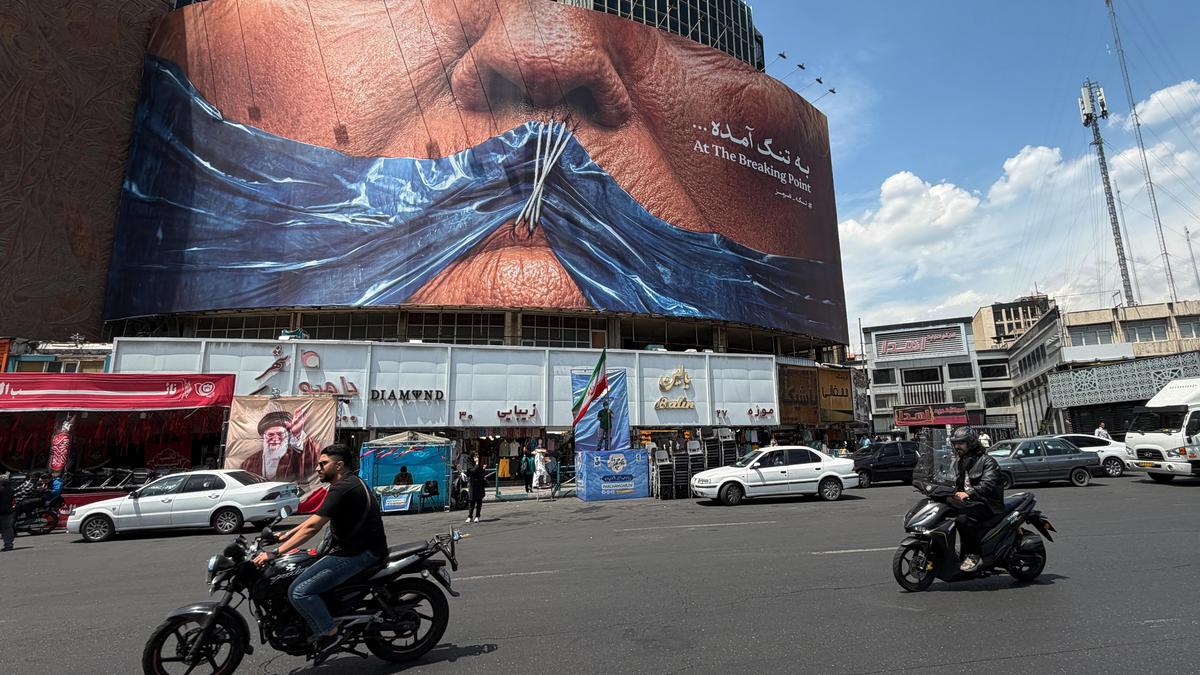
Vehicles drive past a billboard with graphic showing Strait of Hormuz and sewn lips of U.S. President Donald Trump in a square in downtown Tehran, Iran, Saturday, May 2, 2026. – Photo Credit: AP
A slogan on a wall nearby in Farsi read, “Meydan bashuma, khayabane ba ma.” ‘The battlefield is yours. The streets are ours.’ Addressed to the Islamic Revolutionary Guard Corps (IRGC), it was a message to the soldiers to focus on the battlefield with ordinary Iranians in control of their homes.
Fifty-three-year-old Mulook stood for hours at the same spot in a crowded square holding her phone aloft. Late into the night, its screen displayed two images — one of Ayatollah Ali Khamenei, who was assassinated on February 28 by U.S.-Israeli air strikes, and the other of the new Supreme Leader, Mojtaba Khamenei.
These past 62 days, through the fasting of Ramzan, come rain or cold, she has been among tens of thousands who gather each night at the center of the Meydan-e Vali Asr in the Iranian capital to express solidarity with their nation amid an ongoing war.
Between a fatwa and war: how Iran makes sense of its nuclear capability
“We will keep coming until Iran has given a befitting reply for the martyrdom of our Supreme Leader,” says Mulook, who lived through eight years of the war with Iraq. “We supported our leader then. We supported our country then. What is happening now is nothing compared to those eight years.”
The square that holds the city’s memory
Meydan in Farsi or Maidan in Hindi and Urdu is a gathering ground. Meydan Vali Asr is Tehran’s largest public square, where the city’s radial roads converge from every direction. Friday May 1 , 2026 nights draw the largest crowds here following the evening prayers.
The reason is practical, almost cynical. Attacks tend to happen on weekends while U.S. markets open on Monday. People here understand Donald Trump’s calculations even though the American President clearly miscalculated their resilience and nationalism.
Historically, Iranians have gathered in the past here to speak in one voice whenever the need arose. Above the square hung a billboard bearing a caricature of Donald Trump, his mouth sealed with the image of the Strait of Hormuz and a caption: “At the breaking point”.
The Strait has been cast in Iran’s strategic imagination as a weapon — a chokepoint for the world’s oil supply that Tehran has made no secret of its willingness to use. The billboard was not a threat, but a reminder.
Why is the Strait of Hormuz critical to global energy flows?
A second slogan on a wall nearby in Farsi read, “Meydan bashuma, khayabane ba ma.” ‘The battlefield is yours. The streets are ours.’ Addressed to the Islamic Revolutionary Guard Corps (IRGC), it was a message to the soldiers to focus on the battlefield with ordinary Iranians in control of their homes.
People say they do not want the army ‘to worry about what is behind you’, referring to the reports of mass protests against the government earlier in January this year. Iranian authorities called the protests “terror” incidents provoked by pro-American and pro-Israeli elements.
A queue for the flag
There was a serpentine queue to register when we entered the square to carry a large Iranian national flag aloft at the center of the gathering. Hundreds of men and women — young and old — waited patiently for their turn, each allotted 10 minutes.
A girl, no more than seven or eight, held the flag with a sense of pride, despite the visible effort required to carry the weight. As her time ended, a young man stepped forward and quietly took it from her.
Twenty-four hours a day, since the assassination of Ayatollah Ali Khamenei, this ritual has carried on without any interruptions. The atmosphere also reminds one of Sikh Langars or community kitchens. People brought food, donuts, tea, whatever they could carry or afford.
The teacher who stayed past midnight
Last Friday May 1, 2026 also happened to be Iran’s National Teachers’ Day. And a young teacher stood at Meydan until the very end of the night. Her parents, she admitted, were not happy with her decision to return home so late. “I think this is a duty. I have to come. I have to stand here with other people,” she said not willing to be named.
She was not speaking of ideology but of obligation. The square, for her, was not a political statement so much as a place she felt she had to be. Around her, women with headscarves stood shoulder to shoulder with those without watching visuals of the late Supreme Leader play out on the large screen.
A 63-year-old cleric wearing a long robe lifted a copy of the Quran to his lips choked with tears. Since the war broke out on February 26, he has attended these gatherings every single day in Tehran and beyond. “America wanted to break our confidence, to make us feel weak. I come here to show that we are stronger than before,” he says.
A new flag beside the old one
Look carefully at the crowd and you see two flags being carried together.
The Iranian tricolour, green, white and red. And the yellow flag of Hezbollah, the Lebanese militant movement and political party that’s at war with Israel.
A reminder that Washington and Tel Aviv have failed in many of their objectives cited for justifying this unilateral war. From regime change to weakening the ‘axis of resistance’ [the network of Iran’s allies in the region].
To separate Iran from Lebanon, to isolate Hezbollah, to make each front fight alone. The Iranians defied again and again.
Nationalist songs, invoking Imam Ali, mixing religious sentiment with pride in the Iranian nation played out loud in signs of shifting sands. Historically, religious identity was primary in Iran’s public life and national identity was secondary.
But last year’s 12-day conflict changed the dynamics. The establishment’s message to the people now reads: “Even if you do not believe in the Islamic Republic, you believe in Iran. Come on that basis. You are welcome here.”
The night does not end
As midnight passed, the square did not thin out. The flag changed hands again and again, the queue replenishing itself sipping cups of Iranian chai. A child slept off against a parent’s shoulder somewhere in the crowd.
When Donald Trump had said, a few weeks ago, that he would “obliterate” their civilisation, people had come to the bridges and the overpasses and stood there in the open. Come then, was the answer. “We are here”.
The regime change that was spoken of so confidently in the early days of this conflict is not visible here, not in any form. What is visible is a city that has decided, for now, that the street is where it needs to be.
Tehran doesn’t sleep any more.