Kumar Bahukhandi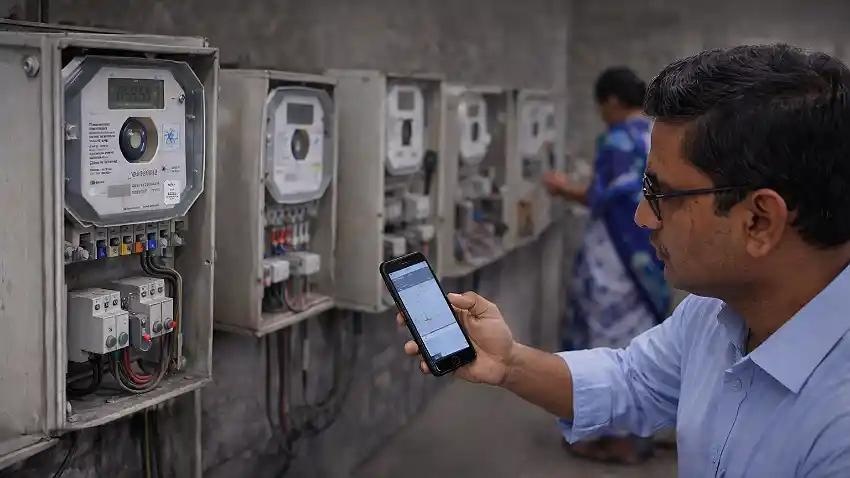
A consumer checks electricity usage through the Mor Bijli App. The Chhattisgarh Government says smart meters provide greater transparency by allowing consumers to monitor their power consumption, while the Opposition continues to question billing accuracy.-Photo Credit-channel24india.com
The debate over smart electricity meters in Chhattisgarh highlights the growing challenge of balancing public trust, technological reforms and political narratives
Technology has increasingly become a battleground in Indian politics. For years, Electronic Voting Machines (EVMs) remained at the centre of political debates, with allegations of manipulation frequently surfacing after election results. Now, a similar political contest appears to be unfolding in Chhattisgarh—not over votes, but over smart electricity meters.
The issue has moved beyond electricity billing and entered the political arena, with both the ruling government and the Opposition presenting sharply different narratives.
The Congress, including former Chief Minister Bhupesh Baghel, has alleged that smart meters are leading to inflated electricity bills and that consumers are being charged more than their actual electricity consumption. The Opposition argues that households have witnessed unusually high bills after the installation of smart meters and has demanded greater transparency in billing and meter testing.
The Chhattisgarh Government, however, has consistently rejected these allegations. The State Government and the Chhattisgarh State Power Distribution Company Limited (CSPDCL) maintain that smart meters do not increase electricity consumption and that the claims are based on misinformation being circulated for political reasons.
Recently, CSPDCL released the findings of a comparative study conducted among smart meter consumers in Raipur, Bilaspur and Durg. According to the utility, electricity consumption in July 2026 declined significantly compared with May and June.
Among the findings presented by the power utility:
- Electricity consumption among surveyed smart-meter consumers in Raipur reportedly fell by around 28 per cent during July.
- High-consumption consumers reportedly recorded reductions of about 44 per cent.
- Similar declines were reported in Bilaspur and Durg, where July consumption was substantially lower than in the previous two months.
- The company also stated that 4,500 check meters installed alongside smart meters recorded matching readings, which it says supports the accuracy of the smart metering system.
- Consumers have been encouraged to verify their own electricity usage through the Mor Bijli App, which provides detailed consumption data.
The Government attributes higher electricity bills during April, May and June primarily to seasonal increases in electricity usage, particularly due to heavy operation of air conditioners, coolers and other appliances during peak summer.
Yet, public perception does not always change with technical explanations.
Electricity bills directly affect household budgets, making them one of the most politically sensitive issues for any government. Even when technical data is presented, consumer confidence depends largely on transparency and independent verification.
This is where the debate should move beyond political slogans.
If consumers genuinely believe that their bills are excessive, their concerns deserve prompt investigation. At the same time, allegations of overbilling should be supported by verifiable evidence rather than assumptions alone. Independent meter testing, accessible grievance mechanisms and transparent public communication can help bridge the trust deficit.
The comparison with the EVM debate is instructive. In both cases, technology itself became the subject of political contest. Supporters argued that the systems are reliable and scientifically validated, while critics questioned transparency and accountability. Regardless of which side one supports, the larger lesson is that public trust is as important as technological capability.
For the Chhattisgarh Government, merely stating that misinformation is being spread may not be sufficient. Continuing to publish detailed data, facilitating third-party audits where appropriate, and ensuring that consumer complaints are addressed quickly can strengthen confidence in the reform.
For the Opposition, raising public concerns is a legitimate democratic role. However, allegations should ultimately rest on demonstrable evidence rather than speculation, especially when they involve public utilities that affect millions of consumers.
Technology will continue to reshape governance—from elections to electricity distribution. Whether these innovations succeed will depend not only on engineering, but also on transparency, accountability and the willingness of all stakeholders to place verified facts above political rhetoric.