Kumar Bahukhandi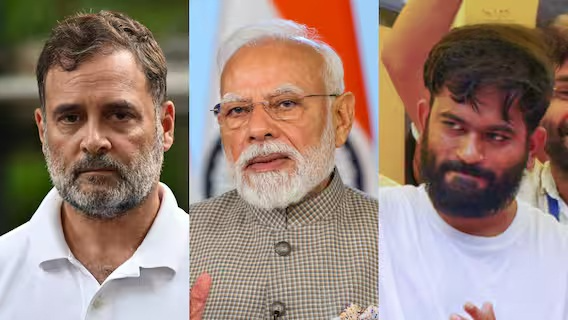
Prime Minister Narendra Modi(C) , Leader of the Opposition Rahul Gandhi(L) and CJP founder Abhijeet Dipke (R) feature in a recent C-Voter survey examining leadership preferences among young respondents. Modi leads the three-way comparison with 39.8 per cent, followed by Gandhi at 27.9 per cent and Dipke at 12.6 per cent, while separate findings on paper leaks reveal a younger generation increasingly willing to question those in authority-Photo Arrangements .
A youth survey places Narendra Modi ahead of Rahul Gandhi and emerging activist Abhijeet Dipke, while dissatisfaction over paper leaks suggests young Indians are separating admiration for leaders from accountability
A generation that grew up with smartphones, instant information and unrestricted access to competing opinions is beginning to change an old assumption of Indian politics — that supporting a leader necessarily means supporting everything the government or political organisation associated with that leader does.
A recent C-Voter survey provides an interesting glimpse of that change.
Among Prime Minister Narendra Modi, Leader of the Opposition Rahul Gandhi and youth activist Abhijeet Dipke, Modi emerged as the most popular, receiving 39.8 per cent support. Gandhi was preferred by 27.9 per cent, while Dipke, whose national visibility has grown through recent student protests, received 12.6 per cent.
At first sight, the result appears straightforward: Modi leads.
But the other answers in the survey tell a more complicated—and perhaps more important—story.
Popularity Without Unconditional Approval
The same survey found that 50.7 per cent of respondents were dissatisfied with the steps taken to prevent examination paper leaks. Only 33.2 per cent expressed satisfaction, while 16.1 per cent were unsure.
This is where the survey moves beyond a political popularity contest.
The leader who tops the popularity question can coexist with substantial dissatisfaction over an issue involving his government.
That suggests something important about younger citizens: political preference does not necessarily mean political surrender.
For a generation whose education, careers and employment prospects often depend upon competitive examinations, a paper leak isn’t an abstract controversy debated in Parliament. It can represent lost preparation, financial burden on families and uncertainty about whether merit will actually be rewarded.
Modi Still Holds the Strongest Position
Modi’s 39.8 per cent nevertheless demonstrates that his connection with younger audiences remains formidable.
His political communication has adapted remarkably well to the digital age. Social platforms allow him to speak to young Indians without the traditional intermediary of newspapers or television.
But digital reach brings its own challenge.
The same technology that allows a leader to communicate instantly also allows young citizens to question instantly.
A viral video can create enormous engagement, but it cannot permanently substitute for answers on education, examinations, employment and opportunities.
That is the new political equation.
Rahul Gandhi Has Space — and a Challenge
Gandhi’s 27.9 per cent shows that he retains a substantial presence among younger respondents.
The figure also demonstrates that dissatisfaction with the government does not automatically translate into support for the principal opposition.
For Gandhi, therefore, the opportunity and challenge exist simultaneously.
Young voters may listen when the opposition raises questions about examination irregularities or unemployment. But eventually they will also ask what alternative solutions it proposes.
Opposition cannot survive indefinitely on identifying problems; it must convince voters that it can solve them.
Why Dipke’s Number Is Different
Dipke’s 12.6 per cent requires a different interpretation.
Comparing his percentage directly with Modi’s or Gandhi’s would be misleading. The other two have national parties, established political organisations and decades of public visibility behind them.
Dipke does not.
His recognition has grown primarily through the recent student agitation and CJP’s advocacy on educational issues.
Therefore, 12.6 per cent should not be portrayed as evidence that he has suddenly become a national political challenger.
What it does demonstrate is something potentially significant about the digital generation: a person associated strongly with one issue can move from relative obscurity into the national conversation much faster than conventional politics once allowed.
Whether that recognition survives after the immediate agitation is another question.
From Protest to Organisation
CJP has already begun confronting that question.
On August 6, 2026, the organisation constituted its National Working Committee and named Dipke its National Convener, with Sourav Das and Ashutosh Ranka serving as co-conveners.
CJP maintains that it does not presently intend to become a political party and instead wants to develop its grassroots organisation.
That may prove to be the more difficult phase of its journey.
A protest can unite people around dissatisfaction. An organisation must keep them together around objectives.
And if CJP wishes to remain outside electoral politics, it will eventually have to demonstrate that it can influence public policy without becoming merely another political pressure group.
Parliament Is Also Being Judged
The survey contains another figure political parties on both sides should notice.
Asked whether Parliament had held a satisfactory discussion on the paper-leak issue, 39 per cent said no, while 35.6 per cent said yes. Another 25.3 per cent were uncertain.
The difference between the two principal responses is not enormous, so it would be wrong to present this as an overwhelming rejection of Parliament.
But it does indicate unease.
And that unease isn’t necessarily directed at one political party.
When young people believe an issue affecting their futures has not received adequate institutional attention, the credibility question extends beyond government to the opposition and Parliament itself.
Prime Look Insight | The Real Winner Is the Questioning Generation
The temptation after any opinion survey is to declare winners and losers.
Modi leads. Gandhi follows. Dipke emerges.
But that may be the least interesting interpretation of these numbers.
The more consequential development is the emergence of a generation willing to support and question at the same time.
It can admire Modi’s leadership while demanding answers from his government. It can listen to Gandhi without automatically accepting Congress as the alternative. It can rally behind Dipke on student issues without necessarily wanting him to become a politician.
That makes Gen Z harder to categorise—and perhaps healthier for democracy.
Political parties have traditionally invested enormous energy in discovering how to win young voters.
They may now have to confront a different question:
How do you retain the confidence of a generation that can fact-check you, challenge you, organise against you and change its mind—all from the same mobile phone?
The C-Voter numbers will change. Another survey will produce another ranking.
The deeper shift may endure: India’s young are no longer content merely to choose their leaders. Increasingly, they expect those leaders to answer them.