Kumar Bahukhandi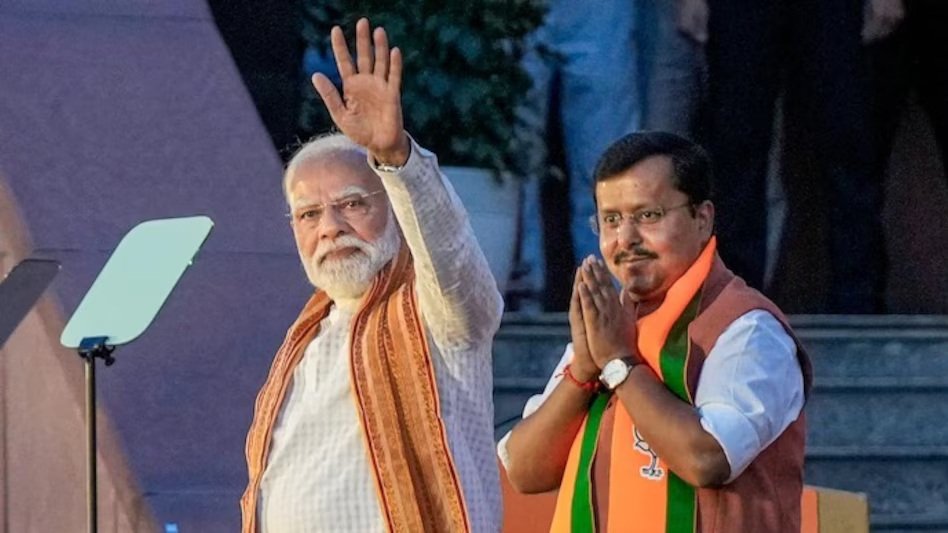
Prime Minister Narendra Modi with BJP National President Nitin Nabin. The party’s new organisational structure signals an early effort to combine experienced leaders with a new generation as the BJP prepares for Assembly contests from 2027 and, ultimately, the 2029 Lok Sabha election. (Photo: ITG)
Sweeping organisational changes combine experienced leaders, younger faces and wider social and regional representation as BJP begins preparing well ahead of the 2029 Lok Sabha election
Key Highlights
- BJP begins strengthening its organisation for the electoral cycle leading to 2029
- Nitin Nabin brings a large number of new faces into the national structure
- Smriti Irani returns to a major organisational responsibility
- Ram Madhav and Vasundhara Raje Scindia receive important national roles
- Team seeks a balance between experience and a new generation of leadership
- Women, minorities and different regions receive representation
- Assembly elections from 2027 onwards emerge as the first major test
- Prime Minister Narendra Modi remains the central political force around which the organisation prepares for 2029
New Delhi: The announcement of BJP National President Nitin Nabin’s new organisational team is more than a redistribution of party posts. Viewed against the electoral calendar ahead, the changes offer an early indication of how the Bharatiya Janata Party intends to prepare itself for the political battles beginning with crucial Assembly elections in 2027 and eventually leading to the 2029 Lok Sabha election.
The scale of the exercise itself makes the reshuffle politically significant.
With a substantial number of new faces entering the organisational structure, Nabin appears to have chosen renewal without completely abandoning experience. Established political figures have been given important responsibilities, while newer leaders have been brought forward to create a wider organisational pool for future campaigns.
That combination is important for a party preparing for several elections rather than one immediate contest.
The return of Smriti Irani to an important organisational position is particularly noteworthy. A former Union Minister with extensive campaigning experience, Irani brings political visibility, organisational familiarity and communication skills to the national structure.
Ram Madhav’s presence is equally significant from an organisational perspective. His experience in political strategy and party organisation gives the BJP another senior figure who can potentially be deployed in politically demanding states and regions.
Former Rajasthan Chief Minister Vasundhara Raje Scindia also remains part of the national leadership. Her inclusion demonstrates that the attempt to introduce new faces does not necessarily mean pushing all veteran leaders to the margins.
Instead, the emerging formula appears to be renewal alongside selective continuity.
The Real Test Begins in 2027
The significance of Nabin’s team becomes clearer when viewed through the electoral calendar.
The BJP does not have the luxury of waiting until 2029 to prepare for the next Lok Sabha election. Important state elections will arrive much earlier, and each of them will test different sections of the new organisation.
Among these, Uttar Pradesh will inevitably command enormous attention in 2027.
No national party can treat Uttar Pradesh as an ordinary Assembly election. With 80 Lok Sabha constituencies, political developments in the state can have consequences far beyond Lucknow. An Assembly result there can influence party morale, organisational momentum and the political narrative ahead of the subsequent general election.
The BJP therefore needs an organisation capable not merely of conducting large rallies but of maintaining coordination from the national leadership down to the booth level.
And that is where Nabin’s restructuring assumes greater importance.
A national executive is ultimately useful only when its members can be assigned political responsibilities on the ground. Some leaders may be required to manage election campaigns; others may handle particular regions, communities, organisational disputes, communication strategies or coordination between state and central leadership.
The new team consequently provides the BJP with a larger leadership pool from which such responsibilities can be distributed.
There is another element that deserves attention: generational transition.
Every political organisation eventually confronts the challenge of creating its next line of leadership. Depending exclusively on established faces can provide experience but may also restrict opportunities for younger politicians to acquire organisational responsibility.
Bringing new leaders into the national structure allows the BJP to test them before they are required to shoulder greater responsibilities.
The years between 2026 and 2029 can therefore function as a political training ground for some of Nabin’s new office-bearers.
Their performance during Assembly elections, membership programmes, organisational expansion and public campaigns could determine who among them emerges as a more important national figure by the time the Lok Sabha election approaches.
At the same time, experience remains valuable.
That explains why recognised leaders such as Smriti Irani, Ram Madhav and Vasundhara Raje have relevance within a substantially reshaped organisation. They represent different kinds of political experience — electoral campaigning, organisation, administration and public communication.
The combination may prove particularly useful because the BJP faces different political circumstances in different states.
A strategy effective in Uttar Pradesh cannot simply be reproduced in Odisha, Rajasthan, Maharashtra, Karnataka or the Northeast. Social equations, local leadership, regional aspirations and the strength of opposition parties differ considerably.
A national organisation consequently requires leaders who understand these variations.
Regional representation in the new structure can help the BJP maintain communication between its central leadership and state units while simultaneously identifying political issues that cannot be managed through a uniform national approach.
The representation given to women leaders also carries political significance.
Women have increasingly emerged as an important electoral constituency across India. Welfare programmes, household economics, employment, security and political representation have all become significant components of electoral campaigns directed towards women voters.
Giving women greater visibility within the organisation therefore has both organisational and political dimensions.
Similarly, the inclusion of leaders belonging to minority communities suggests an attempt to broaden the social character visible within the national organisation.
Representation by itself, however, cannot guarantee electoral support.
The real test will be whether leaders occupying these positions can establish connections beyond party offices and contribute to expanding the BJP’s political reach among communities where its electoral support may be limited.
This distinction is important. An appointment is an organisational decision; converting representation into voter confidence is a political challenge.
The restructuring also establishes Nitin Nabin’s authority as BJP President.
Every national president eventually needs a team capable of implementing political decisions. By introducing a large number of new faces while assigning responsibilities to established leaders, Nabin has begun putting his organisational stamp on the party.
But the appointments also increase expectations from him.
The success of a party president is not measured by how impressive an office-bearers’ list appears on the day it is announced. It is measured by what that organisation subsequently delivers.
Nabin’s team will have to manage election preparations, coordinate with state units, address internal disagreements, mobilise workers and ensure that the BJP’s political message reaches voters at the grassroots.
That makes the period ahead particularly important.
At the centre of this entire arrangement remains Prime Minister Narendra Modi.
The BJP’s national political campaigns continue to revolve substantially around Modi’s leadership, governance record and political appeal. The organisational challenge for Nabin is therefore different from that of creating an alternative political centre.
His task is to build and manage the machinery that can translate the party’s national leadership into effective electoral mobilisation.
This political-organisational relationship will become increasingly important as 2029 approaches.
The next Lok Sabha election will also bring a changed electorate. Millions of young Indians who were too young to vote in earlier elections will become first-time or relatively new voters. Their political expectations may not necessarily mirror those of previous generations.
Employment, technology, education, entrepreneurship, national security, economic opportunities and aspirations for a better standard of living are likely to compete strongly for their attention.
A political organisation preparing for 2029 therefore needs more than experienced election managers. It also requires leaders capable of communicating with a younger and increasingly digitally connected electorate.
This is where the generational mixture within the organisation could become important.
The BJP appears to be attempting to preserve institutional memory while simultaneously creating space for politicians who may shape the organisation over the coming decade.
There is also a message for those who have been replaced.
A major organisational reshuffle inevitably creates winners and losers. Some leaders move closer to the centre of decision-making, while others find themselves without the responsibilities they previously held.
Such changes can produce dissatisfaction within any political party.
Managing those reactions without allowing internal disappointment to affect electoral preparations will be another test of Nabin’s leadership.
The reshuffle therefore needs to be judged at several levels simultaneously.
At one level, it is simply the formation of a new national team under a new party president.
At another, it represents an attempt at generational and organisational renewal.
And at the most politically consequential level, it provides the leadership structure with which the BJP intends to navigate the elections that will shape the road towards 2029.
There will inevitably be changes along the way. Leaders who perform effectively may acquire larger responsibilities; others may be moved or replaced according to political requirements.
That is why the current list should not be regarded as the final electoral architecture for 2029.
It is better understood as the starting formation.
The Assembly elections beginning in 2027 will reveal whether the balance Nabin has attempted — between experience and youth, national prominence and grassroots organisation, continuity and change — works effectively on the ground.
If it does, the present reshuffle could eventually be remembered as an important early stage of the BJP’s preparation for its next national electoral battle.
If it does not, further organisational corrections will inevitably follow.
Either way, one political message already stands out: for the BJP, preparations for the 2029 Lok Sabha election are unlikely to begin in 2029 — they are taking shape years earlier within the organisation itself.