Kumar Bahukhandi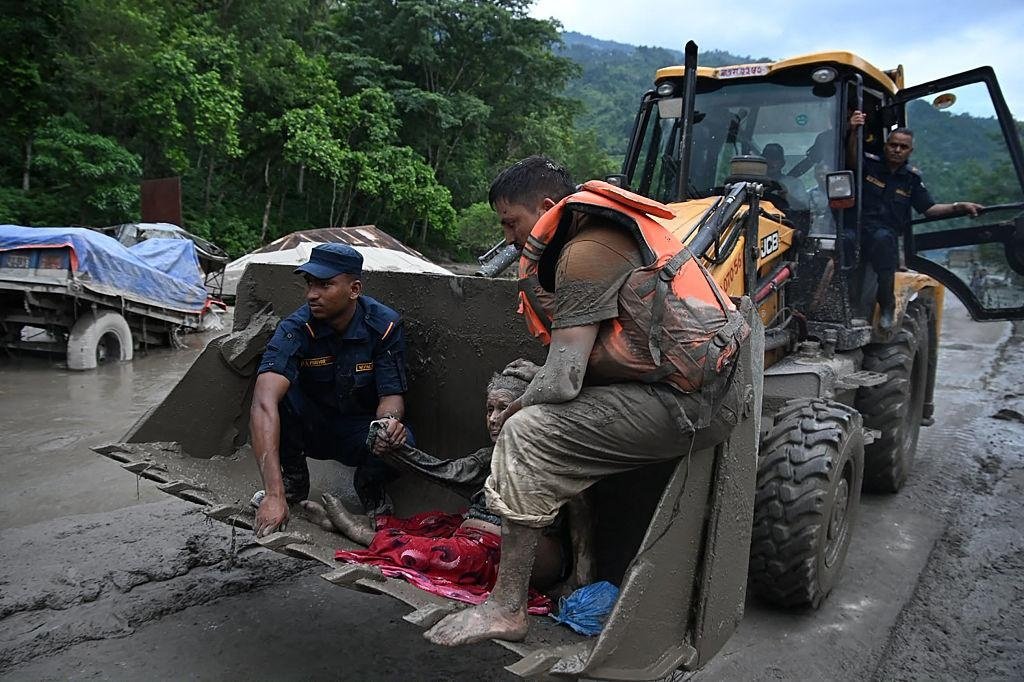
Rescue amid devastation: Rescue personnel use an excavator to carry a survivor affected by devastating flash floods at Devghat in Nepal’s Nuwakot district on Wednesday, August 26, 2026. (Photo: AFP)
Nepal has every right to manage its own disaster response, but when lives remain at stake, sovereignty and geopolitical sensitivities must not stand in the way of assistance that could make a difference
Nepal’s devastating floods have created more than a humanitarian emergency. They have also raised an uncomfortable question: when hundreds of people remain missing, how long should a government continue declining offers of specialised international search-and-rescue assistance?
Kathmandu’s position is clear. Nepal says its own security agencies are capable of conducting the operation and that, for now, foreign search-and-rescue teams are not required. Several countries have nevertheless offered assistance, particularly because foreign nationals are among those still unaccounted for.
Nepal is entirely within its rights to make that decision.
A sovereign country cannot be expected to admit foreign teams into a disaster zone merely because assistance has been offered. Nor should foreign expertise automatically be considered superior to the knowledge and capability of Nepal’s own Army, police and disaster-response personnel.
There is also a practical reason for Kathmandu’s caution. Nepal’s experience following the catastrophic 2015 earthquake demonstrated how the arrival of numerous international teams can itself create problems of coordination, logistics and operational management.
That context matters. It would therefore be unfair to portray Nepal’s decision simply as rejection of international goodwill.
But this disaster presents another dimension that cannot easily be ignored.
The Tibet Question Cannot Simply Be Wished Away
Rasuwa, one of the areas devastated by the flooding, lies along Nepal’s frontier with China’s Tibet Autonomous Region. That geography inevitably gives an otherwise humanitarian decision a geopolitical dimension.
Former Nepali diplomat Dinesh Bhattarai has suggested that the sensitivity of the location may have figured in Kathmandu’s calculations. Nepal’s Foreign Ministry has rejected such an interpretation, maintaining that the decision is based on the ability of its own agencies to handle the rescue operation.
There is presently no basis to state as fact that Chinese sensitivities dictated Nepal’s decision. Doing so would turn legitimate scrutiny into speculation.
Yet asking the question is equally legitimate.
Nepal occupies one of the most delicate strategic positions in South Asia. Sandwiched between India and China, it has long had to balance relations with two vastly larger neighbours while preserving its own political and strategic autonomy. The presence of foreign rescue personnel close to the Tibet frontier could understandably acquire sensitivities that would not arise in an ordinary disaster zone.
That is precisely why transparency becomes important.
South Korea has a particularly direct interest because its nationals are among those reported missing. Seoul has indicated that it will continue discussing the deployment of assistance with Kathmandu. India and several other countries have also offered help, while humanitarian and relief assistance continues to reach Nepal.
None of these offers should become instruments of diplomatic competition.
India, China, South Korea, the United States or any other country offering assistance should respect Nepal’s authority over operations conducted on its territory. Equally, Kathmandu should continually reassess whether its domestic resources remain sufficient as the search becomes more difficult and the chances of finding survivors diminish with time.
The real issue, therefore, is neither Nepal’s pride nor another country’s influence.
It is capacity.
Can Nepal’s existing rescue machinery reach the missing quickly enough? Does it have sufficient specialist personnel, equipment and technological resources for an exceptionally difficult Himalayan operation? And could expertise offered by another country materially increase the possibility of finding people who might still be alive?
If Nepal can answer those questions confidently, its decision deserves to be respected.
But if the scale or complexity of the catastrophe begins to exceed domestic capabilities, accepting specialised international assistance should not be viewed as surrendering sovereignty. Countries far larger and more powerful than Nepal routinely seek international assistance when confronted with disasters beyond their immediate capacity.
There will inevitably be questions later about Tibet, China, India’s regional role and Nepal’s delicate geopolitical balancing act. Those questions deserve examination, but they should not overshadow the immediate human tragedy.
For a family waiting to know whether a missing son, daughter, husband, wife or parent is still alive, geopolitics is an abstraction. Every passing hour is real.
Nepal has the sovereign right to decide who participates in rescue operations on its soil. The international community has an equally legitimate responsibility to offer assistance without attaching political expectations to it.
But there is one consideration that should stand above both.
When human lives may still be saved, the decisive question should not be who is offering the help, but whether that help is needed.