Kumar Bahukhandi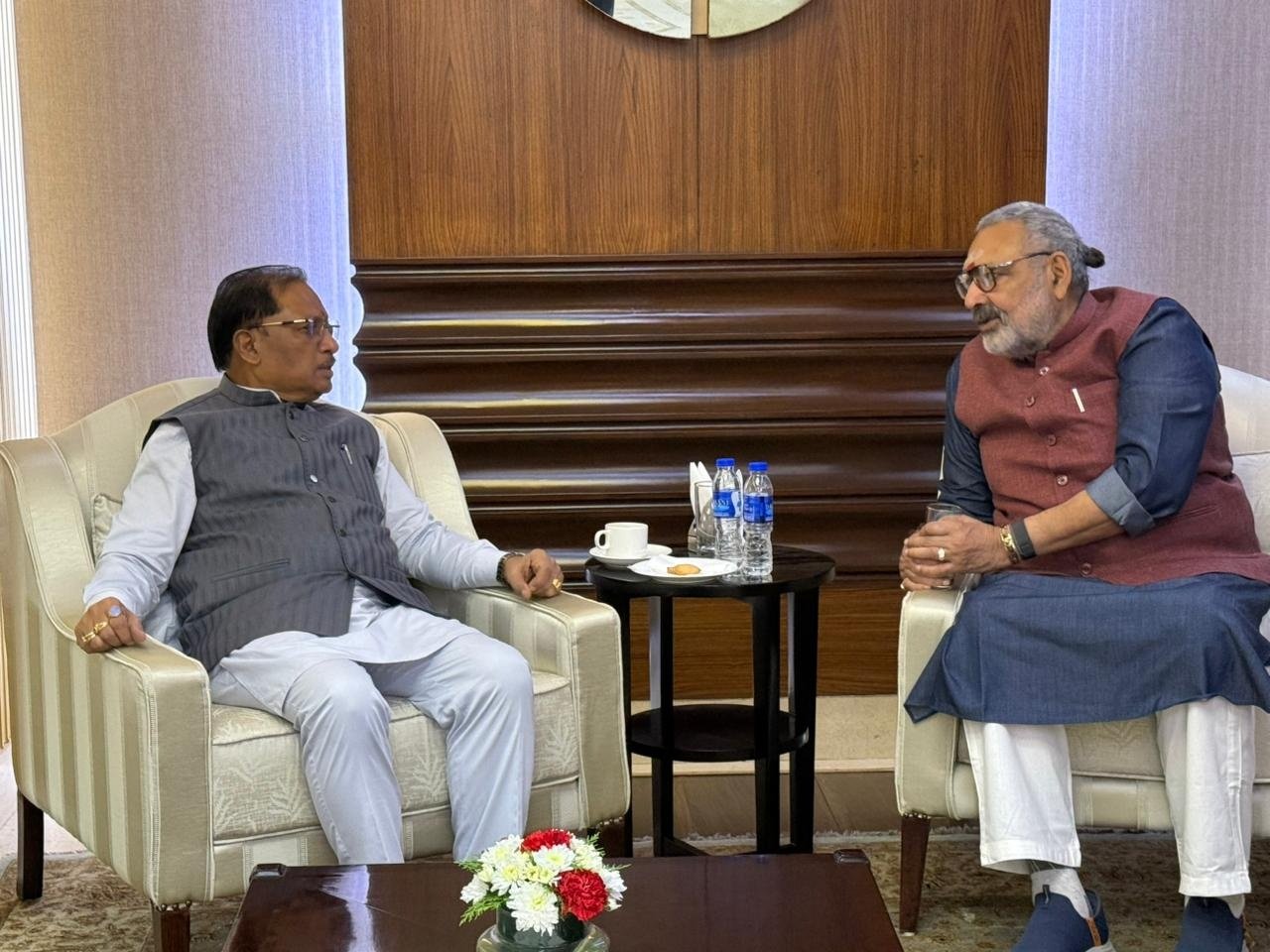
Chhattisgarh Chief Minister Vishnu Deo Sai (left) during a meeting with Union Textiles Minister Giriraj Singh in New Delhi on Friday, September 4, 2026. The discussions focused on expanding the State’s textile industry, promoting Kosa and traditional handloom products, attracting investment and creating employment opportunities-Photo Credit:channel24india.com via CG/DPR
Talks with Union Textiles Minister Giriraj Singh focus on scaling up Kosa, handloom and traditional textiles while linking local enterprises with a wider industrial and employment ecosystem
New Delhi: Chhattisgarh is looking to turn its rich textile heritage into a stronger engine of industrial growth and employment, with Chief Minister Vishnu Deo Sai seeking greater Centre-State coordination to expand investment, production and market opportunities across the sector.
Chief Minister Sai met Union Textiles Minister Giriraj Singh in New Delhi on Friday, September 4, 2026 for discussions that went beyond the preservation of the State’s traditional weaving legacy, focusing on how textiles could contribute more substantially to Chhattisgarh’s industrial economy and create livelihood opportunities for artisans and young people.
The discussions covered the expansion of textile industries in the State, promotion of investment, strengthening of local and small enterprises and ways of connecting Chhattisgarh’s traditional textile strengths with larger markets.
For Chhattisgarh, the significance of such an approach lies in the possibility of building an economic chain around a sector in which the State already possesses traditional knowledge, skilled artisans and distinctive products.
From Traditional Craft to a Larger Economic Opportunity
Sai highlighted Chhattisgarh’s rich heritage of handloom and traditional textiles, particularly Kosa, while discussing measures that could help increase both production and market reach.
Kosa is closely associated with Chhattisgarh’s textile identity and supports a chain of traditional skills and livelihoods. Expanding its market, therefore, is not merely a question of promoting a regional textile product. It also has implications for the people involved in weaving, processing, designing and marketing.
The discussions indicate an effort to view this traditional base alongside the possibilities offered by a wider textile industry.
Instead of treating handloom and industrial investment as two separate areas, the State is looking at ways in which traditional strengths, local enterprises, entrepreneurship and new investment can contribute to a broader textile ecosystem.
The central challenge is to ensure that expansion of the textile sector translates into greater economic opportunities for the people connected with it.
Employment at the Centre of Textile Expansion
Employment generation figured prominently in the discussions between Sai and Singh.
The textile sector has the potential to accommodate different levels of skill and enterprise — from traditional artisans and small producers to organised manufacturing, designing, processing, marketing and associated services.
The Chief Minister discussed possibilities for linking small and local industries with the textile sector so that industrial expansion can generate opportunities beyond large investment projects alone.
Such an approach could be particularly important for local entrepreneurs and young people looking for employment and self-employment opportunities.
A stronger textile ecosystem can potentially create economic activity across several stages — production, processing, value addition, packaging, branding, distribution and marketing.
For traditional artisans, meanwhile, wider market access can be as important as increasing production. Without sustained demand, branding and market linkages, higher production alone may not necessarily translate into better incomes.
Investment and Local Enterprise
The meeting also focused on attracting investment to Chhattisgarh’s textile sector.
Industrial investment can help create capacity and introduce new technology, but the State’s discussions with the Centre also placed emphasis on connecting smaller and locally based enterprises with the emerging opportunities.
This gives the proposed expansion a broader dimension.
A textile strategy centred only on manufacturing units would represent one model of industrialisation. A strategy that simultaneously connects artisans, traditional producers, small enterprises and larger investors could potentially spread the economic benefits more widely.
For Chhattisgarh, which possesses its own distinctive textile traditions, maintaining that connection will be important as the sector expands.
Kosa Can Become a Stronger Chhattisgarh Brand
Among Chhattisgarh’s textile assets, Kosa offers particular possibilities for stronger branding and wider visibility.
Traditional products increasingly compete not only on craftsmanship but also on presentation, design, branding and access to markets. Expanding their reach consequently requires attention to the entire journey between artisan and consumer.
This creates opportunities to combine heritage with contemporary market requirements without diluting the identity that makes the product distinctive in the first place.
The Chief Minister’s emphasis on increasing production as well as market opportunities points towards this larger objective.
For artisans, successful market expansion can mean more stable demand. For entrepreneurs, it can create opportunities in value addition and marketing. And for the State, it offers a way of turning a traditional strength into a more visible component of its economic identity.
Centre-State Coordination Crucial
Sai and Singh also discussed stronger coordination between the Centre and the State to take forward opportunities for investment and industrial expansion in Chhattisgarh’s textile sector.
Such coordination can become important when a State seeks to move beyond individual enterprises towards building a larger sectoral ecosystem.
The meeting therefore carries significance beyond a routine interaction between the Chief Minister and a Union Minister.
It reflects an attempt to position textiles at the intersection of traditional livelihoods, local enterprise, investment and employment generation.
The next stage will depend on how these discussions translate into concrete initiatives, investment proposals, market linkages and opportunities on the ground.
For Chhattisgarh, the opportunity is substantial: its textile story does not have to remain confined to preserving an admired craft tradition. With the right combination of investment, market access and support for artisans and enterprises, that heritage can become part of a larger economic growth story.
The objective is ultimately not simply to produce more textiles, but to create greater value around what Chhattisgarh already knows how to make — and ensure that this value reaches its artisans, entrepreneurs and young workforce.