Kumar Bahukhandi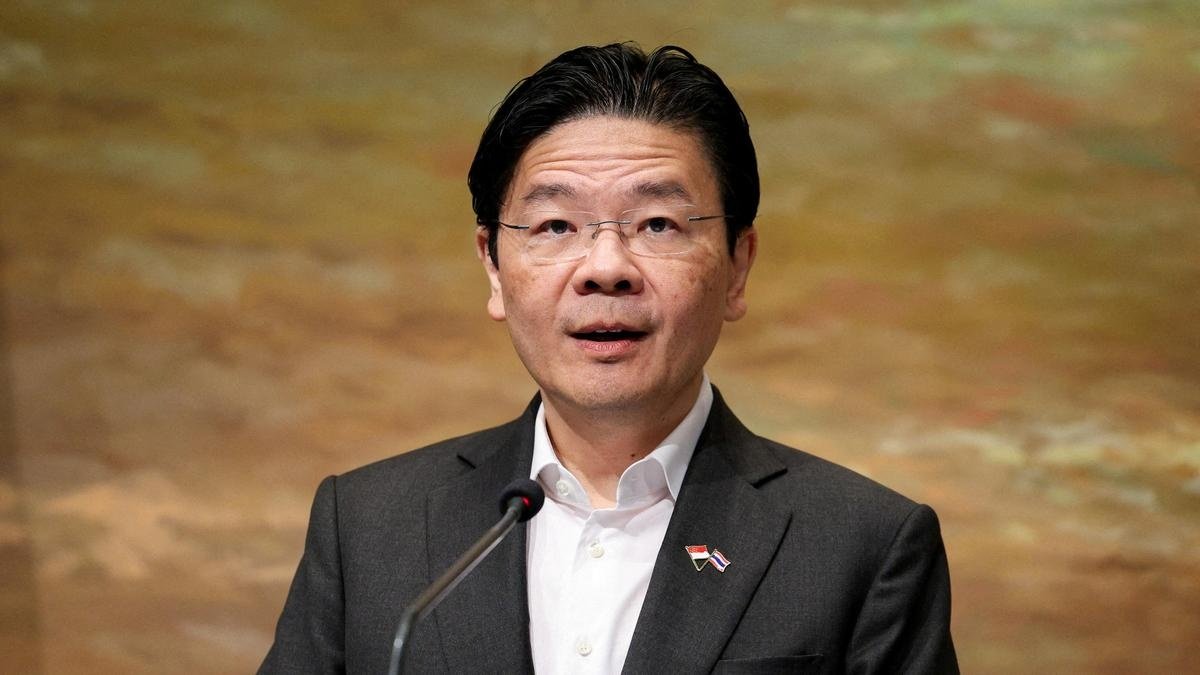
Singapore Prime Minister Lawrence Wong has warned against allowing racial prejudice to become normalised after anti-Indian abuse surfaced in online discussions surrounding the Nepal-Tibet disaster and Singapore Airlines’ investment in Air India. He said robust debate must never become a cover for hostility towards a community or foreigners. (File Photo/Reuters)
Prime Minister Lawrence Wong’s intervention over racist abuse surrounding the Nepal-Tibet disaster and Singapore Airlines’ investment in Air India raises a larger question: how does a successful multicultural society prevent legitimate debate from becoming hostility towards an entire community?
Singapore has spent decades constructing an identity around an idea that sounds simple but is extraordinarily difficult to sustain: people of different races, religions and origins can belong equally to the same nation.
That idea is now confronting one of the defining challenges of the digital age.
Prime Minister Lawrence Wong’s warning against anti-Indian prejudice did not arise from an abstract discussion about racial harmony. It followed two very different developments — the devastating Nepal-Tibet floods, in which Singaporeans were among those missing, and public debate surrounding Singapore Airlines’ investment in Air India.
Neither issue is inherently racial. Yet parts of the online conversation surrounding both reportedly descended into abuse directed at Indians. Singaporean authorities have taken the matter seriously, with police examining racist and xenophobic comments and the government seeking the removal of content that breaches platform guidelines.
That distinction — between disagreement and prejudice — is precisely where Wong’s intervention deserves attention far beyond Singapore.
“We can and should have robust debates. But we should never use seemingly legitimate arguments as a cover to fuel prejudice against any community or hostility towards foreigners,” the Prime Minister said.
It is a remarkably relevant warning in an era when almost every political, commercial or social controversy can be converted within hours into an argument about nationality, ethnicity or religion.
A Business Question Is Not a Racial Question
There is nothing improper about questioning Singapore Airlines’ investment in Air India.
Shareholders can question strategy. Analysts can scrutinise losses. Citizens can debate whether an investment makes commercial sense. Journalists should examine management decisions. Indeed, serious scrutiny is part of a healthy economic and democratic culture.
But the ethnicity of an executive has nothing to do with whether a corporate investment is sound.
Senior Minister K. Shanmugam said some online attacks had targeted the ethnicity of Temasek’s leadership while discussion of Air India had produced what he characterised as anti-Indian racist abuse. He stressed that Singapore Airlines is a listed company whose investment decisions belong to its management and board and must ultimately be judged commercially.
This is where legitimate criticism crosses a dangerous line.
If an investment is poor, demonstrate why it is poor.
If management has made a mistake, produce the numbers.
If public policy deserves criticism, challenge the policy.
But when an argument shifts from what somebody has done to what somebody ethnically is, debate has ceased to be debate.
It has become prejudice wearing the clothes of argument.
Tragedy Should Bring Out Humanity, Not Racism
The reaction to the Nepal-Tibet disaster is even more disturbing.
A natural disaster does not ask the ethnicity of its victims before destroying homes or taking lives. Families waiting for information about missing relatives do not experience grief differently because of their race.
Yet racist comments reportedly targeted some of the Singaporeans missing in the disaster because they appeared to be Indian. Shanmugam publicly condemned examples of such commentary, while Wong warned against dismissing such behaviour as merely harmless chatter on the internet.
That should trouble anyone, irrespective of nationality.
The internet has created a peculiar moral distance. People sometimes type things about strangers that they would hesitate to say while standing before their families.
A human tragedy becomes content.
Victims become photographs.
Photographs acquire comment boxes.
And behind the apparent anonymity of a screen, empathy can disappear with astonishing speed.
Wong identified the larger danger when he warned:
“If such behaviour goes unchecked, it can become normalised, deepen mistrust between communities, and pull us apart.”
The important word is normalised.
Societies rarely wake up one morning and collectively decide that prejudice is acceptable. Normalisation happens incrementally. A racial joke becomes ordinary. An insult becomes fashionable. A stereotype becomes a meme. Repetition makes language that once caused discomfort appear unremarkable.
Eventually, people stop asking whether the statement is racist and begin asking why anyone is offended by it.
That is when prejudice has travelled from the margins towards the mainstream.
The Indian Question in Singapore
The episode also deserves attention because Indians are not outsiders to Singapore’s national story.
Singapore is a deeply multicultural society in which the Indian community has long been part of public life, business, education, culture and government. Questions surrounding immigration and foreign labour can certainly be debated, just as they are in virtually every developed economy.
But an Indian citizen working temporarily in Singapore, a Singapore citizen of Indian ancestry and an Indian company doing business with Singapore are three entirely different things.
Online prejudice frequently collapses those distinctions.
Ethnicity becomes nationality; nationality becomes immigration status; immigration becomes economic grievance.
That intellectual laziness is precisely what responsible public discourse must resist.
Wong’s response was therefore notable because he did not argue that disagreement should disappear. His point was almost the opposite: debate vigorously, but don’t transform disagreement into collective hostility.
Multiculturalism Is Maintained, Not Inherited
Singapore’s experience carries a lesson for India as well.
Indians understandably object when members of the Indian diaspora encounter racism overseas. But the principle becomes meaningful only when applied universally.
We cannot demand dignity for Indians abroad while treating prejudice against communities at home as harmless entertainment.
A Sikh insulted because of his turban, an Indian targeted overseas because of skin colour, a migrant mocked for an accent, or any community stereotyped because of religion or ethnicity confront variations of the same human failure: judging the individual through an inherited label rather than individual conduct.
That is why racial harmony cannot simply be written into constitutions, pledges or legislation.
It has to be practised.
And in the social-media era, increasingly it has to be practised when nobody is physically watching.
Former Prime Minister and current Senior Minister Lee Hsien Loong also intervened, describing racist comments directed at the Indian community following the floods as deeply troubling and urging Singaporeans to stand together regardless of race, language or religion.
There is significance in senior political leaders speaking publicly when such incidents occur. Silence from institutions can sometimes be interpreted by extremists as permission.
But government action alone cannot manufacture tolerance.
Police can investigate unlawful speech. Platforms can remove prohibited content. Laws can establish boundaries.
None of them can compel one human being to respect another.
That responsibility remains social and individual.
The Test Comes When We Disagree
The easiest form of tolerance is agreeing with people who resemble us and think like us.
The real test arrives when there is disagreement.
Singapore Airlines’ relationship with Air India may succeed or fail. Its investment strategy should be scrutinised on its financial and commercial merits. Singapore’s immigration policies can be questioned. Economic competition can be debated. Governments and companies should never be insulated from criticism merely because criticism could become uncomfortable.
But criticism acquires legitimacy from evidence, not ethnicity.
The moment someone’s ancestry becomes the argument, the argument has already been lost.
Wong put the choice before Singaporeans plainly:
“We can reject such views, and refuse to give them more space or legitimacy.”
That may ultimately be more important than removing a thousand offensive posts.
A multicultural country survives not because prejudice never appears, but because enough of its citizens refuse to make prejudice respectable.
Singapore’s present controversy concerns anti-Indian abuse. Tomorrow the target could be another community, another nationality or another religion.
The names change.
The mechanism does not.
And perhaps that is the larger message from Singapore: the moment a society begins deciding whose prejudice is acceptable according to who happens to be its target, it has already weakened the principle that protects everyone.