Kumar Bahukhandi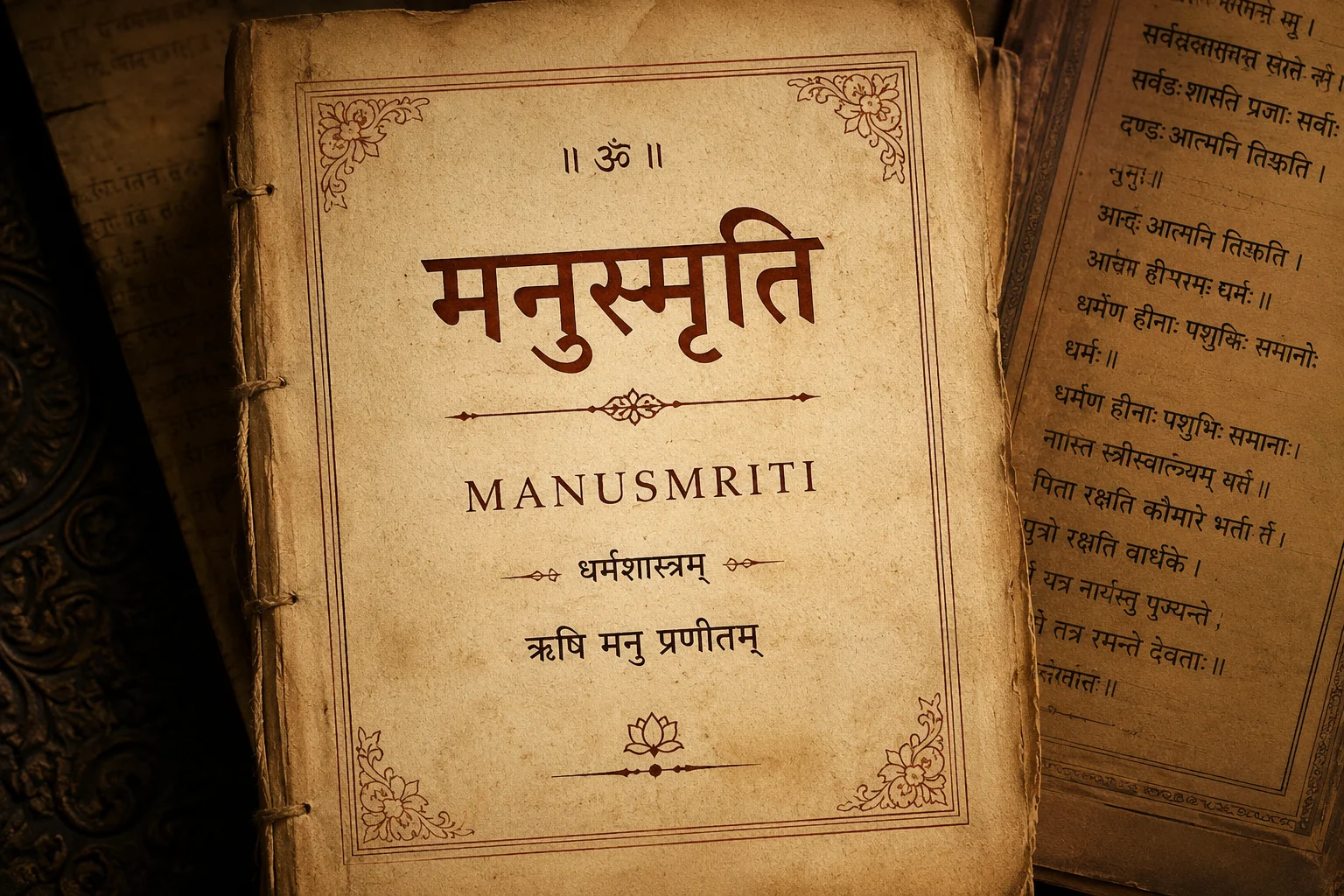
Ancient verses on women continue to divide contemporary India, but reading Manusmriti through isolated quotations risks replacing scholarship with ideology
By Kumar Bahukhandi
Few ancient Indian texts provoke arguments as intense as the Manusmriti. It is invoked by admirers as evidence of India’s civilisational wisdom and attacked by critics as a symbol of social hierarchy and gender inequality.
When the discussion turns to women, the disagreement becomes even sharper.
One side frequently invokes the celebrated declaration:
“Yatra nāryastu pūjyante ramante tatra devatāḥ” — where women are honoured, there the gods rejoice.
The other points to an equally consequential formulation:
“Na strī svātantryam arhati” — a woman is not considered fit for independence.
Both passages matter.
But neither, by itself, is the whole Manusmriti. That is precisely where much of the contemporary argument goes wrong. The original paper deliberately warns against allowing either favourable or restrictive individual verses to represent the entire text.
Protection Is Not the Same as Freedom
One of the most controversial passages is Manusmriti 9.3. It describes the father as protecting a woman in childhood, the husband in youth and sons in old age, before concluding that she is not fit for independence.
The Sanskrit word rakṣati carries the sense of guarding or protecting. It is therefore possible to understand the verse as imposing responsibility upon male family members for a woman’s welfare.
But that interpretation does not make the problem of autonomy disappear.
Protection and autonomy are not synonymous.
A social arrangement can genuinely claim to protect someone while simultaneously restricting that person’s freedom to make independent choices. Recognising the protective meaning of rakṣati therefore cannot simply erase the restriction represented by svātantrya.
This distinction matters enormously when an ancient normative text is brought into a twenty-first-century debate.
Then Comes a Very Different Verse
Manusmriti 3.56 presents what initially appears to be an entirely different conception of women:
“Yatra nāryastu pūjyante ramante tatra devatāḥ.”
Broadly translated, it declares that where women are honoured, the gods rejoice; where they are not honoured, acts become fruitless. The surrounding passages similarly associate women’s wellbeing with the wellbeing of the household.
How, then, can a text speak so strongly about honouring women while elsewhere restricting their independence?
The apparent contradiction becomes easier to understand when honour and autonomy are recognised as different concepts.
A person may occupy an honoured position within a traditional social structure without possessing the degree of individual autonomy recognised under a modern constitutional system.
That does not make the restriction acceptable today. It helps us understand the intellectual and social framework in which the different propositions could coexist.
Respect. Protection. Agency.
Perhaps the most useful way to approach the controversy is through three words:
Respect. Protection. Agency.
Respect concerns the dignity and value given to an individual.
Protection concerns responsibility for that person’s safety and welfare.
Agency concerns the person’s ability to make decisions for herself.
They are related, but they are not interchangeable. A society can offer the first two while restricting the third.
This is why asking merely whether Manusmriti “respected women” or “oppressed women” can produce an incomplete answer.
The more meaningful question is what conception of women’s social position emerges when its prescriptions concerning honour, protection, duties, dependence and agency are examined together.
Modern India Has a Different Constitutional Foundation
Whatever the historical interpretation of Manusmriti, there should be no ambiguity about the legal position of women in contemporary India.
Modern India is governed by its Constitution and laws enacted within the constitutional framework, not by Dharmaśāstra prescriptions.
Article 14 guarantees equality before law and equal protection of the laws. Article 15 prohibits discrimination by the State on specified grounds, including sex, while Article 21 protects life and personal liberty.
That changes the fundamental relationship between the individual and authority.
An adult woman’s legal identity does not come from her father, husband or son.
Put simply:
A woman belongs to herself.
That proposition is not an argument against family. Families can embody love, responsibility, interdependence and protection. Constitutional equality challenges the idea that those relationships can become a justification for denying an adult woman agency.
The Problem With Quoting Only What Suits Us
Modern political debates frequently reduce complicated historical texts to convenient quotations.
Those defending Manusmriti may cite:
“Where women are honoured, there the gods rejoice.”
Those condemning it may answer:
“A woman is not independent.”
Both quotations are relevant.
Neither quotation is the whole text.
The intellectual problem begins when a fragment is required to support a conclusion larger than the evidence permits. Responsible interpretation requires attention to textual context, Sanskrit terminology, historical circumstances and the difference between ancient normative structures and contemporary constitutional principles.
Contextualising an ancient prescription does not mean defending it.
Contextualisation is not exoneration.
But criticism should not require suppressing evidence that complicates an argument either.
What About ‘Kāryeṣu Mantrī’?
Another Sanskrit verse frequently circulated in discussions about the ideal wife begins:
“Kāryeṣu mantrī karaṇeṣu dāsī…”
One particularly interesting expression is kāryeṣu mantrī — portraying the wife as a counsellor or adviser whose opinion matters in affairs and decisions.
Yet the same verse also contains karaṇeṣu dāsī, employing the imagery of service.
Again, selective interpretation can make the verse say whatever the interpreter wants.
There is an additional problem: its precise textual provenance has not been established sufficiently to attribute it confidently to the Manusmriti. It should therefore not be presented as primary evidence of what Manusmriti itself says.
That caution contains a lesson extending far beyond this particular verse:
Verify first. Interpret afterwards.
Ancient Text, Modern Questions
India does not have to choose between treating every ancient prescription as eternally binding and rejecting an entire intellectual tradition because parts of it conflict with contemporary values.
A civilisation should be confident enough to examine its inheritance critically.
Ideas inconsistent with equality can be rejected.
Insights that retain philosophical or historical value can be studied.
Ancient texts can be respected as objects of scholarship without being placed beyond criticism.
And criticism need not become caricature.
For women in contemporary India, however, the standard must go beyond ceremonial reverence.
Respect without control.
Protection without possession.
Family without subordination.
Equality with autonomy.
Those principles capture the central distinction developed in the original study.
Manusmriti therefore deserves neither blind reverence nor reflexive rejection. It deserves something more demanding: historical understanding, textual honesty and the willingness to distinguish between what belongs to an ancient social order and what should govern citizens today.
And before defending Manusmriti or condemning it, perhaps the first obligation remains the simplest:
About the Author: Kumar Bahukhandi is an Assistant Professor in the Department of Journalism and Mass Communication at Pragati College, Raipur, Chhattisgarh, and a working journalist.