Kumar Bahukhandi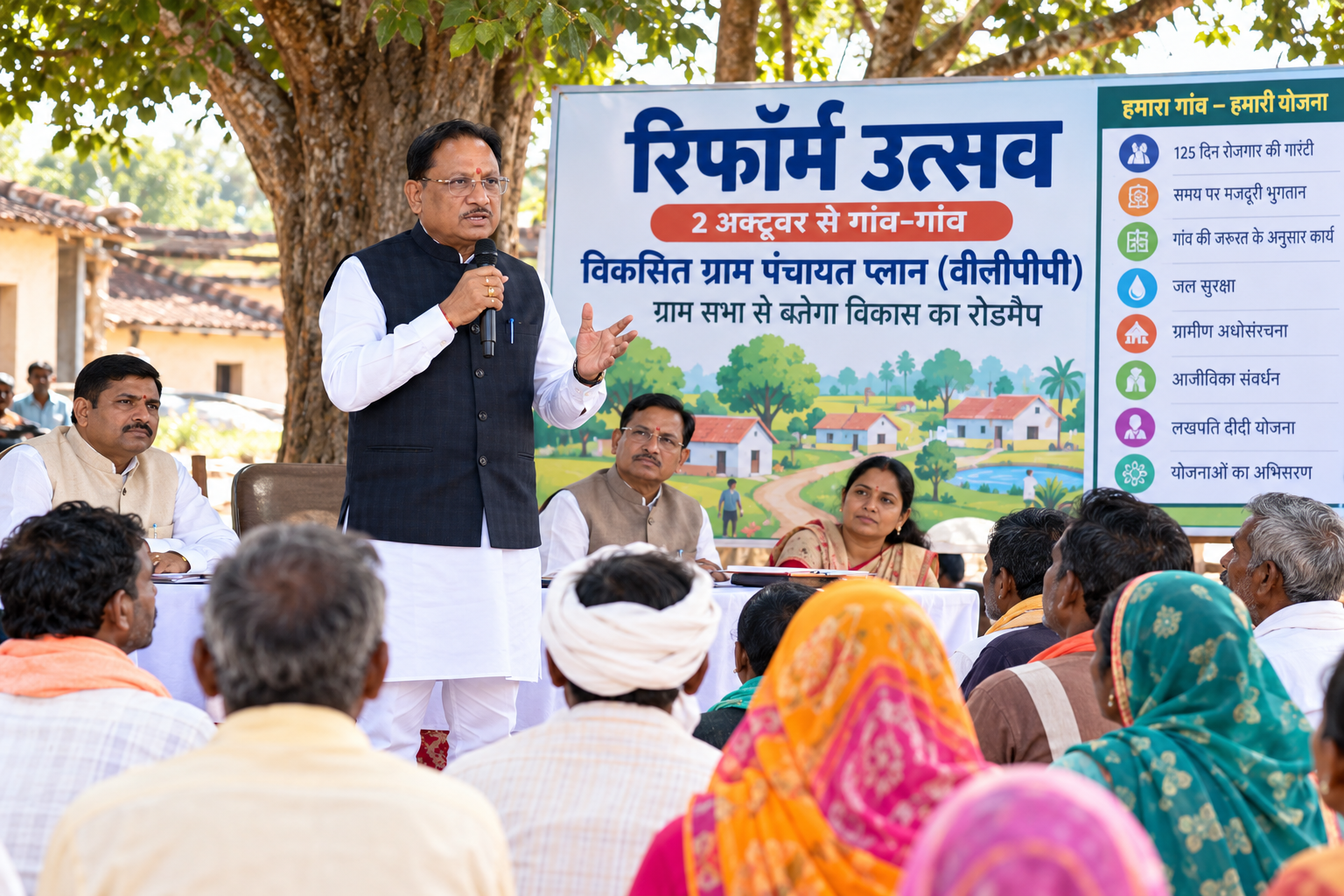
Representational image depicting a Gram Sabha-based village planning exercise. Chhattisgarh will launch ‘Reform Utsav’ on October 2 to involve rural communities in preparing Viksit Gram Panchayat Plans-Image:channel24india.com
Gram Sabhas to drive Viksit Gram Panchayat Plans, with villagers identifying priorities in employment, water security, livelihoods and rural infrastructure
Key Highlights
- ‘Reform Utsav’ to begin across Chhattisgarh on October 2
- Viksit Gram Panchayat Plan process to run alongside the People’s Plan Campaign
- Villagers themselves will identify local development gaps and priorities
- Gram Sabhas to discuss employment, timely wages, livelihoods, infrastructure and scheme convergence
- PRA exercises and ground verification scheduled during October-November
- Draft village plans to return to Gram Sabhas in December for discussion and approval
- Block and district-level consolidation targeted for completion by January 15
- QR codes to give villagers access to eight key information points
Raipur: Development planning in Chhattisgarh’s villages is set to move closer to the people who know their needs best — the villagers themselves.
Beginning October 2, Gram Sabhas across the state will become the starting point for preparing the Viksit Gram Panchayat Plan (VGPP) under a statewide ‘Reform Utsav’. Instead of development priorities being drawn up only through administrative files, villagers will be asked what their settlements lack, which assets they need and where public resources should be directed.
The exercise will be integrated with the People’s Plan Campaign (PPC), turning the Gram Sabha into more than a forum for announcing government programmes. It is intended to become the place where residents identify problems, discuss available resources and help decide the works that should enter their Gram Panchayat’s future development plan.
The approach puts a simple proposition at the centre of rural planning: a village development plan should begin with the village.
October 2 Gram Sabha will open the planning exercise
The first major step will come with the Gram Sabha on October 2.
Residents will be introduced to the VGPP planning process and provided information about their Panchayat’s baseline data, base maps and the range of permissible works available for selection.
The exercise will also look for a less visible gap — assets that physically exist in a village but have not found their way into digital records. Identifying these assets is expected to give planners a more realistic picture of what a village already possesses before new works are proposed.
This distinction matters. Development planning can lose its purpose when a database and the situation on the ground tell different stories.
The new exercise therefore seeks to begin with both — data on the screen and reality in the village.
Villagers to identify what their village needs first
October and November will take the process beyond the formal Gram Sabha.
At habitation and ward level, Participatory Rural Appraisal (PRA), physical verification and community consultations will be used to identify local deficiencies and development requirements.
That could mean one village placing water security at the top of its list while another sees livelihood infrastructure as the immediate need. Elsewhere, the priority could be a rural asset, connectivity or work capable of reducing vulnerability to adverse weather events.
The intention is not to impose an identical development checklist on every Panchayat.
Instead, communities will have room to identify priorities according to their own circumstances and available resources.
Employment and timely wages to form part of village dialogue
Employment will occupy an important place in the Reform Utsav discussions.
According to the programme details, Gram Sabhas will discuss provisions under VB-GRAMG, including the statutory guarantee of 125 days of employment, provision of work within 15 days and timely payment of wages.
Villagers will also be able to discuss which works among the 375 permissible categories are most relevant to local requirements.
Livelihood enhancement, rural infrastructure and convergence between different government schemes will form part of the consultations.
The discussions will additionally cover the Lakhpati Didi initiative and livelihood activities, bringing women’s economic participation into the village-planning conversation.
Panchayat representatives, women associated with self-help groups, young people and other residents are expected to be brought into the exercise so that the plan does not remain confined to Panchayat functionaries.
From discussion to document — and back to the Gram Sabha
The process has been designed in stages rather than as a one-day consultation.
Once village-level consultations, PRA exercises and verification are completed during October and November, a draft VGPP will be prepared in December.
Importantly, that draft will not automatically become the final plan.
It will return to the Gram Sabha.
Residents will have an opportunity to examine the proposals, offer suggestions and discuss the priorities before the Gram Sabha gives its approval.
The approved plans will subsequently move upwards for consolidation at the development block and district levels.
The state has set January 15 as the target for completing this consolidation process.
That sequence — identify, verify, draft, discuss, approve and consolidate — is intended to give community participation a place throughout the planning cycle rather than restricting it to the opening meeting.
Water security and livelihoods to get sharper attention
The VGPP framework will allow Panchayats to look beyond immediate construction demands and consider the longer-term resilience of villages.
Water security, rural infrastructure and livelihood-generating assets have been identified among the focus areas.
Works capable of reducing the impact of adverse weather events can also be prioritised according to local conditions.
This gives the planning process a wider purpose: village assets are expected not merely to fill an infrastructure gap but also to support incomes and strengthen communities against future pressures.
QR codes bring information closer to villagers
The Reform Utsav will also use a digital layer to support the ground-level exercise.
Panchayat secretaries have been provided eight principal discussion points relating to VB-GRAMG, while QR codes displayed in Gram Panchayats will allow residents to access the relevant information themselves.
The technology is intended to supplement, rather than replace, discussion in the Gram Sabha.
Its usefulness will ultimately depend on whether residents receive understandable information and are able to participate meaningfully in deciding what enters the village plan.
The Gram Sabha moves from audience to planning table
The significance of the Reform Utsav lies less in holding another round of village meetings and more in what those meetings are expected to produce.
If implemented as designed, villagers will not simply hear which works have been sanctioned for them. They will have a role in identifying the problem before the work itself is selected.
For Chhattisgarh’s rural planning process, October 2 therefore marks the beginning of a journey from the Gram Sabha to the development plan — with the village itself expected to draw the first lines of the roadmap.
Suggested Image
For this story, an image of Chief Minister Vishnu Dev Sai interacting with villagers at a Gram Sabha or rural development programme would be more appropriate than a formal portrait. It should visually connect Sai with villagers, Panchayat representatives and grassroots planning.
Important: the recreated image above is an AI-generated representational visual, not an actual photograph of Chief Minister Vishnu Dev Sai at a Reform Utsav. I would not publish it as a news photograph of Sai. If used at all, caption it clearly as a representational/AI-generated image.
Caption for a real Sai photograph
Chief Minister Vishnu Dev Sai during a rural interaction in Chhattisgarh. From October 2, Gram Sabhas across the state will begin preparing Viksit Gram Panchayat Plans, giving villagers a direct role in identifying local development priorities. Photo: primelookindia.com via CMO