Kumar Bahukhandi
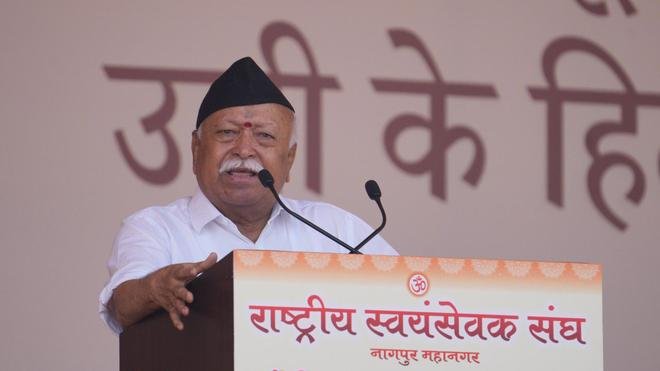
Rashtriya Swayamsevak Sangh (RSS) chief Mohan Bhagwat addresses the organisation’s 101st foundation day celebrations in Nagpur, Maharashtra, on Tuesday, October 20, 2026, coinciding with Vijayadashami, highlighting the Sangh’s nationwide outreach during its centenary year and expressing concern over global political instability, cultural disruption, narcotics and OTT content. Photo: Courtesy PTI
In his annual Vijayadashami address, RSS chief Mohan Bhagwat highlights outreach to over 10 crore Hindu households, cautions against instability driven by power struggles and calls for action against narcotics and regulation of OTT content.
Key Highlights
- RSS observes its 101st foundation day on Tuesday, October 20, 2026, coinciding with Vijayadashami celebrations.
- Mohan Bhagwat says the organisation reached 4,61,127 villages and more than 10 crore Hindu households during its centenary outreach campaign.
- RSS chief warns of a growing wave of unrest originating in the West and threatening cultural and social stability.
- Bhagwat refers to developments in France, Nepal and Bangladesh while discussing protests and political instability.
- He questions whether political agitations and changes of government can provide lasting solutions to social problems.
- Calls for stronger measures against drugs and narcotics and greater regulation of OTT content.
- Says India can offer solutions to the world’s environmental, economic and geopolitical challenges.
Nagpur: Rashtriya Swayamsevak Sangh (RSS) chief Mohan Bhagwat on Tuesday, October 20, 2026, marked the organisation’s 101st foundation day with a wide-ranging Vijayadashami address, highlighting its extensive public outreach during its centenary year while expressing concern over growing political instability, cultural disruption, economic insecurity and social challenges confronting India and the wider world. Speaking at the RSS headquarters in Nagpur, Bhagwat maintained that political agitation and changes in government alone could not resolve deep-rooted societal problems, emphasising the need for cultural awareness, social responsibility and collective national efforts.
RSS Highlights Extensive Outreach During Centenary Year
Addressing RSS volunteers and invited guests during the annual Vijayadashami programme, Bhagwat outlined the organisation’s activities undertaken as part of its centenary celebrations.
He said the Sangh had considerably expanded its engagement with communities across the country, reaching villages and households through its nationwide outreach programme.
“Under its outreach plan in the centenary year, RSS reached out to people in 4,61,127 villages in India,” Bhagwat said.
According to the RSS chief, the organisation also established contact with more than 10 crore Hindu households over the preceding year.
The figures, he suggested, reflected the scale of the organisation’s efforts to strengthen its connection with society and communicate its ideas beyond its established network of volunteers.
Warning Against a ‘Storm Coming in from the West’
In one of the more striking portions of his address, Bhagwat expressed concern about continuing demonstrations and political disturbances in several countries, particularly in Europe.
Referring to these developments, he described the unrest as a troubling phenomenon that could undermine established social and cultural institutions.
“Storm coming in from West which hates culture, system, security and good fortune,” Bhagwat said.
He also referred to political and social developments in France and neighbouring South Asian countries.
“We are hearing such news from France. We know what happened in Nepal, Bangladesh too,” he added.
His remarks reflected the RSS leadership’s concern about the potential consequences of prolonged social unrest, particularly when political confrontation begins to affect public confidence in institutions and established systems.
Political Agitations Rarely Offer Lasting Solutions, Says Bhagwat
Turning to political developments closer to home, Bhagwat questioned the belief that replacing a government necessarily resolves the underlying difficulties confronting society.
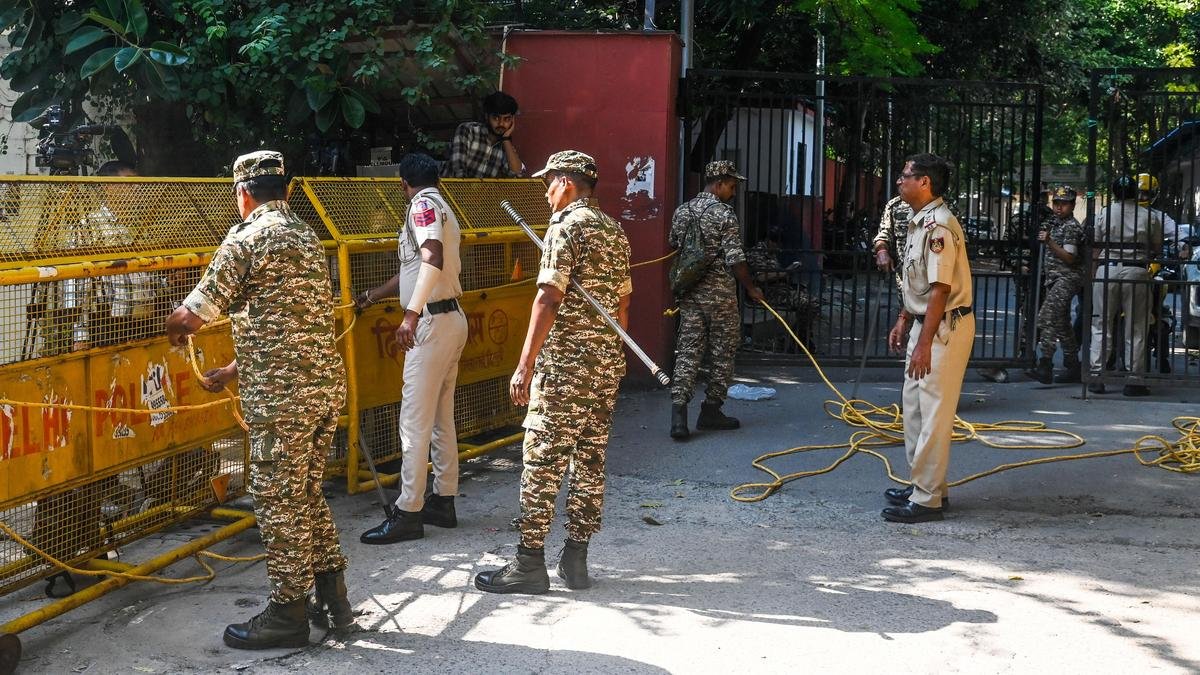
His observations came against the backdrop of recent demonstrations in New Delhi demanding the resignation of Chief Election Commissioner Gyanesh Kumar over allegations relating to electoral roll revision.
Although Bhagwat did not explicitly identify those protests in the quoted remarks, his comments addressed the broader question of political agitation and its effectiveness.
“They say situation will change with regime change but this has never happened in the past,” he said.
He further observed:
“Such things are happening in India too, at present, but it’s very rare that a problem is solved with agitation.”
The remarks placed emphasis on the distinction between political change and lasting social reform, suggesting that many challenges require sustained public participation and institutional efforts rather than confrontation alone.
World Confronting Environmental, Economic and Geopolitical Crises
Bhagwat also devoted attention to international developments, warning that the world was experiencing multiple interconnected crises.
He referred to environmental degradation, economic insecurity and geopolitical tensions, arguing that competition for power was aggravating instability across countries.
“The world is not just facing environment crisis but also geo-political crisis. Economic insecurity is prevailing all across. Everything is getting destroyed due to power struggle across the globe. The world knows that India has an answer to all this,” Bhagwat said.
His observations presented India as a country capable of contributing to international discussions on stability, cooperation and sustainable development.
The RSS chief’s remarks also reflected his view that contemporary global challenges could not be addressed through political or economic considerations alone, but required a broader understanding of social values and collective responsibilities.
Calls for Stronger Action Against Drugs and Narcotics
On domestic issues, Bhagwat raised concern about the growing threat posed by drugs and narcotics, calling for effective measures to curb their spread.
He advocated a ban on drugs and narcotics and indicated that the RSS would undertake initiatives addressing the problem in the coming days.
The issue carries particular significance because substance abuse affects not only individuals but also families, educational institutions and the wider social environment.
His remarks suggested that the organisation intended to incorporate awareness about drug abuse into its broader social engagement activities.
RSS Chief Seeks Regulation of OTT Content
Bhagwat also called for regulation of content distributed through over-the-top (OTT) streaming platforms.
The demand comes amid continuing public debate in India over digital entertainment, age-appropriate content, parental supervision and the responsibilities of online streaming services.
While OTT platforms have transformed access to films, documentaries and entertainment programmes, questions surrounding content standards and the protection of younger audiences remain subjects of policy discussion.
Bhagwat’s intervention brought the issue into the RSS’s broader discourse on cultural values and social responsibility.
Vijayadashami Address Reflects RSS Priorities Beyond Its Centenary
Founded in Nagpur in 1925, the RSS traditionally commemorates its establishment on Vijayadashami, making the annual address by its chief an important occasion for outlining the organisation’s ideological and social priorities.
The 2026 observance assumes particular significance as the organisation moves beyond its centenary milestone and enters its 101st year.
Bhagwat’s address combined a review of the RSS’s organisational expansion with commentary on international instability, political agitation, cultural preservation and domestic social concerns.
His emphasis on community outreach, opposition to narcotics and the regulation of digital content indicated that these issues would remain important areas of attention for the organisation in the period ahead.