Kumar Bahukhandi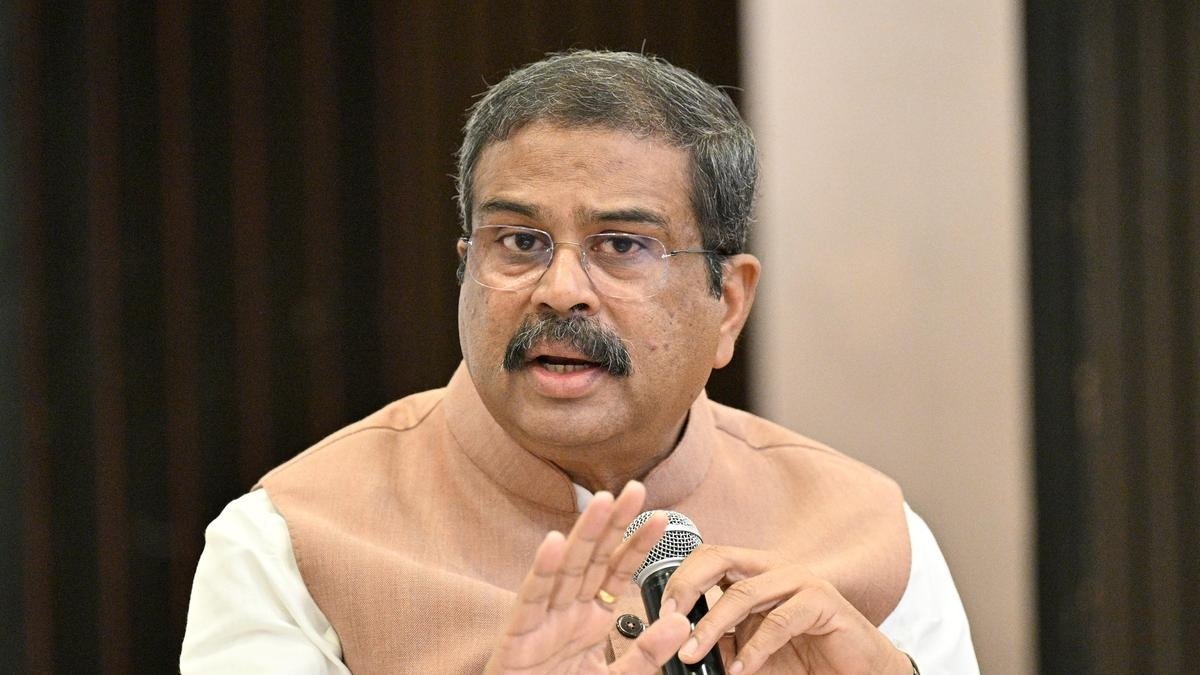
Former Union Education Minister Dharmendra Pradhan, whose post-resignation remarks in Sambalpur on Saturday, August 8, 2026, offered his account of the government’s engagement with protesting students and renewed attention on the reforms, controversies and unfinished agenda of his five-year tenure. — File Photo
His post-resignation account of seeking the Prime Minister’s approval to accept protesters’ demands offers a new perspective on the agitation that overshadowed the closing chapter of his five-year tenure
Dharmendra Pradhan’s version of what happened during the turbulent final days of his tenure as Union Education Minister came after he had resigned from office.
Speaking in Sambalpur, Odisha, on Saturday, August 8, Pradhan disclosed that amid the recent student agitation, he had personally approached Prime Minister Narendra Modi and sought his approval to accept the protesters’ demands.
The disclosure does not alter the chronology of the controversy. Rather, coming from a former minister after leaving office, it provides an opportunity to look back at an episode that ultimately became inseparable from his departure — and to examine a five-year education tenure that was considerably larger than the crisis surrounding its end.
Pradhan said dealing with the protesting youth had never been a matter of personal prestige for him.
“I believe Gen Zs are our own,” he said, adding that he had met the Prime Minister and sought permission to accept the protesters’ demands. According to Pradhan, Modi agreed and subsequently interacted with the youth.
His other observation was equally significant: “Nothing is above the nation’s interest.”
These words acquire a different meaning when spoken by someone who is no longer occupying the ministerial chair.
The Question Is Not Only Why He Left
Pradhan’s resignation followed massive student protests over alleged irregularities surrounding NEET. His exit therefore inevitably became associated with the crisis.
But My assessment is to ask a broader question: How should his tenure be remembered?
Was it principally the tenure of an Education Minister who left amid one of India’s most contentious examination controversies? Or should it also be judged by the structural changes initiated during five years of implementing the National Education Policy 2020?
The answer probably lies somewhere between the two.
Accountability for examination integrity cannot be separated from the responsibilities of the Education Ministry. At the same time, one controversy — however serious — does not by itself constitute the entire record of a minister who presided over substantial changes in school and higher education.
NEP Implementation Became the Defining Project
When Pradhan took charge of the Education Ministry, NEP 2020 had already been approved by the Union Cabinet. His principal challenge was therefore not drafting the policy but attempting to translate an ambitious document into functioning educational structures.
His tenure saw the advancement of the National Curriculum Framework, multidisciplinary education, flexible degree structures, the National Credit Framework, PM SHRI schools and changes in teacher training.
The underlying philosophy was significant: students should have greater flexibility, education should become more closely connected with skills, and traditional barriers between academic disciplines should gradually weaken.
That transformation, however, remains incomplete.
Institutions across India are still adapting to concepts such as multidisciplinary degrees and transferable academic credits. A reform announced in Delhi does not automatically become a functioning reality in thousands of colleges and universities across a country as diverse as India.
Reform Also Brought Resistance
Pradhan’s tenure was not free of ideological and federal disagreements.
The 2025 draft UGC regulations concerning appointments of teachers, vice-chancellors and other university personnel drew criticism, particularly over the proposed role of Governors in vice-chancellor appointments.
Language became another contentious area.
The push for the three-language formula and greater emphasis on Indian languages encountered resistance, particularly from Tamil Nadu. What the Centre viewed as an important component of NEP implementation was seen by critics as an attempt to impose greater uniformity on an inherently diverse education system.
This tension — national standards versus regional autonomy — remains unresolved and will outlast Pradhan’s tenure.
Then Came the Student Crisis
The NEET controversy changed the political atmosphere surrounding the Education Ministry.
What began as questions over an examination developed into a wider student agitation involving trust, accountability and the credibility of India’s competitive examination system.
For young Indians, such examinations are not abstract administrative exercises. Years of preparation, family savings and career ambitions can depend upon a single test.
That is why allegations of irregularities produce anger extending far beyond the examination hall.
Pradhan’s post-resignation statement that Gen Z should be regarded as “our own” is therefore worth examining beyond its immediate political context.
A government may disagree with protesters. It may believe some demands are unreasonable. It may even suspect political forces of attempting to influence an agitation.
But young citizens raising questions about their future cannot automatically be treated as adversaries.
His Successor Inherits an Unfinished Agenda
Pralhad Joshi has inherited much more than a ministry.
He inherits unfinished implementation of NEP 2020, debates over the National Curriculum Framework, higher-education restructuring, language policy, teacher recruitment and training, credit mobility and the larger challenge of restoring confidence in competitive examinations.
That last task may prove particularly important.
Education reform ultimately depends upon trust. Students must believe examinations are fair. Parents must believe merit will be respected. Universities must have confidence that reforms are workable. States must feel that India’s federal diversity is being accommodated rather than overridden.
Without that confidence, even well-designed reforms can struggle.
A Tenure Should Be Judged in Full
Dharmendra Pradhan left the Education Ministry under a cloud. That fact cannot be erased from his record.
Neither should five years of policy changes be erased because of the manner in which those years ended.
His tenure combined ambition with controversy, structural reform with implementation difficulties, and an aggressive push for change with resistance from sections of academia and some State governments.
The final judgement on several of those reforms cannot even be delivered today because many remain works in progress.
Perhaps that is what makes Pradhan’s post-resignation remarks particularly interesting.
When he says that holding the office of Education Minister was secondary to the larger national interest, the statement inevitably invites scrutiny of both what his ministry achieved and where it fell short.
And when he says “Gen Zs are our own,” there is a lesson that extends well beyond his resignation.
India’s young people do not merely constitute a demographic statistic or a future workforce. They are stakeholders in decisions being taken today.
For whoever occupies the Education Ministry, therefore, the challenge is not simply to reform education.
It is to reform it while retaining the confidence of the generation for whom those reforms are being made.