Kumar Bahukhandi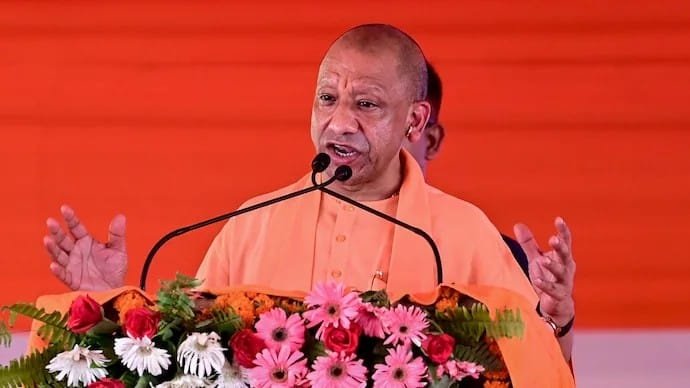
Uttar Pradesh Chief Minister Yogi Adityanath addresses a gathering recently . His assertion that people living in India cannot be permitted to insult the nation has renewed the debate over the line between democratic dissent and deliberate disrespect for national symbols. (File Photo)
Yogi Adityanath’s assertion that those living in India cannot be allowed to insult the nation deserves attention at a time when the boundary between dissent, criticism and deliberate abuse is increasingly being blurred
Uttar Pradesh Chief Minister Yogi Adityanath’s assertion that people living in India cannot be allowed to insult the nation should not be dismissed merely as another political statement. It raises a fundamental question about the way freedom of expression is being understood in contemporary India.
There can be — and must be — complete freedom to disagree with a government. But can freedom of speech mean freedom to abuse? Can disagreement with a political party become justification for insulting the country, its constitutional institutions or national symbols?
It cannot.
India’s democracy was not built on the principle that citizens must agree with those in power. Governments are elected by the people and can be questioned by the people. Prime Ministers, Chief Ministers, Ministers and political parties are all open to scrutiny and criticism.
But India is bigger than any government or political party.
That is why Yogi’s argument deserves to be viewed beyond partisan politics.
Yogi’s Warning Has a Larger Message
The Uttar Pradesh Chief Minister has repeatedly argued that national interest and national honour cannot be compromised. In earlier remarks, he has spoken against people who, while living in India, act in ways he considers detrimental to the country’s existence and unity.
His position is uncompromising: political disagreement cannot provide a shield for conduct that deliberately denigrates the country.
There is merit in that distinction.
The right to question the government is democratic. The right to criticise a policy is democratic. Peaceful protest is democratic. Writing against a government is democratic. Voting a government out of office is perhaps democracy’s most powerful expression.
Abuse, however, does not automatically become democratic merely because somebody places the label of “freedom of speech” upon it.
Freedom Comes With Responsibility
The Indian Constitution guarantees freedom of speech and expression under Article 19(1)(a), but that freedom is not absolute. Article 19(2) itself permits reasonable restrictions on specified constitutional grounds.
The Constitution goes further.
Article 51A places Fundamental Duties upon citizens, including respect for the Constitution, its ideals and institutions, the National Flag and the National Anthem, as well as the responsibility to uphold India’s sovereignty, unity and integrity.
Rights and duties therefore cannot permanently be separated from one another.
We frequently speak about what democracy gives us. Perhaps we should speak equally seriously about what citizenship expects from us.
Criticising Modi, Yogi or Any Government Is Not Insulting India
There is an equally important safeguard that must accompany this argument.
No government should be permitted to define every criticism of itself as an insult to the nation.
Narendra Modi is not India. Yogi Adityanath is not India. The BJP is not India. Nor is the Congress or any other political organisation.
Political leaders occupy constitutional offices for a limited period; the Republic belongs permanently to its people.
A journalist exposing wrongdoing, an Opposition politician questioning government decisions, students protesting over examinations, citizens challenging legislation or activists demanding accountability cannot be branded anti-national simply because their arguments are inconvenient to those governing the country.
That distinction is essential if Yogi’s proposition is to carry democratic legitimacy.
But Dissent and Abuse Are Not Synonyms
The opposite distortion is equally dangerous.
There is an emerging tendency to invoke “freedom of expression” as though those three words automatically legitimise whatever follows.
They do not.
Freedom of speech does not require society to celebrate vulgarity. Dissent does not require degradation. Political disagreement does not require hatred of the country.
One can oppose a government without abusing India.
One can criticise a Prime Minister without insulting the Tricolour.
One can challenge Parliament, approach the courts, organise demonstrations and write fiercely against government policy while remaining completely committed to the Republic.
Indeed, that is precisely what constitutional democracy makes possible.
Social Media Has Made the Question More Urgent
The distinction has become particularly important in the social-media age.
A provocative slogan uttered before a few people can today reach millions within hours. Deliberately offensive content is frequently rewarded with views, followers and political attention. Sometimes outrage itself becomes a business model.
This makes responsible expression more important, not less.
Young Indians should certainly be encouraged to question authority. A generation afraid to question its rulers cannot protect democracy.
But the same generation must understand that intellectual freedom does not require contempt for one’s country.
Patriotism Cannot Be Forced, But Respect Can Be Expected
There is another side to this debate which governments should remember.
Patriotism cannot ultimately be manufactured through punishment. Genuine attachment to the nation comes from belonging, education, history, shared experience and faith in constitutional institutions.
The State cannot order somebody to love India.
But a democratic society can certainly expect its citizens to respect the constitutional framework that protects their own freedoms.
The strongest response to offensive speech is therefore not always another restriction. It is often better citizenship, stronger civic education and a clearer understanding of the distinction between the nation, the government and the political party governing at a particular moment.
Nation Above Political Differences
This is where Yogi Adityanath’s statement acquires significance.
If his argument means that Indians should place national integrity above partisan hostility, it deserves serious consideration.
If it means that deliberate insult to constitutionally protected national symbols cannot be justified merely by shouting “freedom of speech,” the principle is difficult to dispute.
But if “national insult” ever becomes a convenient expression for silencing legitimate criticism, democracy itself would suffer.
India does not need citizens who remain silent.
It needs citizens who can disagree fiercely without losing respect for the country to which they belong.
Freedom of speech is one of India’s great democratic strengths. It gives us the right to question, criticise, protest and disagree. But no constitutional freedom should be deliberately distorted into a presumed freedom to abuse.
The government is open to criticism. Political leaders are open to criticism. Policies are open to criticism. India itself belongs to all of us — and respecting the nation should never depend upon which party happens to be in power.