Kumar Bahukhandi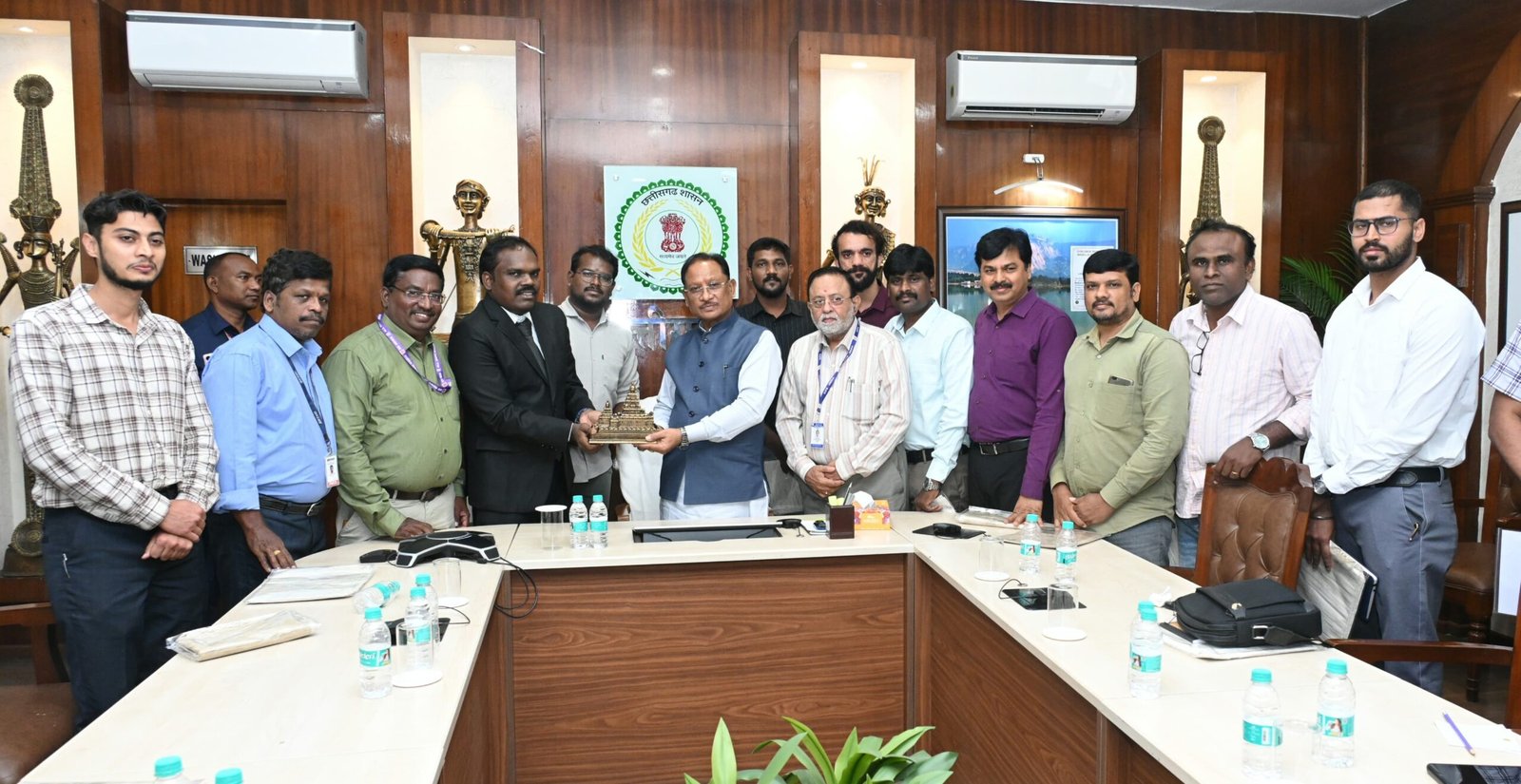
Chhattisgarh Chief Minister Vishnu Deo Sai receives a replica of Tamil Nadu’s famous Mahabalipuram temple from a visiting delegation of Chennai journalists at the Chief Minister’s Residence Office in Raipur. The delegation, led by PIB Chennai Director P Arun Kumar, interacted with Sai on Bastar’s changing security and development landscape, investment, employment, education and healthcare on Friday, August 21, 2026-Photo Credit:channel24india.com via CMO
Sai tells visiting Chennai journalists that the government’s objective goes beyond ending Naxalism — it is to build a lasting foundation for development, jobs and prosperity in Bastar
Key Highlights
- “Our goal is not merely to end Naxalism, but to build a strong foundation for development and prosperity in Bastar” — Sai
- CM credits coordinated Centre-State action, security forces and growing public confidence for gains against Naxalism
- “Areas once difficult for the government to reach are now witnessing rapid development”
- Sai sees tourism and local enterprise as major opportunities for Bastar’s youth
- New Industrial Development Policy 2024-30 seeks investment in AI, data centres, electronics, semiconductors, pharma and renewable energy
- Raipur and Nava Raipur emerging as important education and technology centres
- Chennai journalists present Sai with a replica of Tamil Nadu’s famous Mahabalipuram temple
Raipur: Chhattisgarh Chief Minister Vishnu Deo Sai said on Friday, August 21, 2026, that Bastar was entering a new phase of peace, confidence and development following decisive gains against Naxalism, with the government now concentrating on taking roads, education, healthcare, connectivity, employment and livelihood opportunities deeper into areas that remained deprived for decades.
Interacting with a group of journalists from Chennai at the Chief Minister’s Residence Office, Sai said the transformation of Bastar had become one of the most significant elements of Chhattisgarh’s changing development story.
The visiting media delegation was led by P Arun Kumar, Director, Press Information Bureau, Chennai.
“Our priority is to bring lasting change to the lives of the people of Bastar by connecting its natural wealth, culture and tourism potential with development,” Sai said.
The Chief Minister discussed with the journalists the changing development landscape of Chhattisgarh, progress in Bastar following successes against Naxalism, the state’s new industrial policy, investment and employment opportunities and the expansion of education and healthcare.
‘Our Goal is Not Merely to End Naxalism’
Sai said nearly four decades of Naxalism had seriously impeded Bastar’s development and made the delivery of basic infrastructure such as roads, electricity, education, healthcare and communication particularly challenging in difficult terrain.
He credited coordinated efforts by the Centre and the state under the leadership of Prime Minister Narendra Modi and guidance of Union Home Minister Amit Shah, along with the courage of security forces and increasing confidence among local communities, for the changing situation.
“With the courage of our security forces and the growing confidence of local people, Bastar is rapidly moving towards peace and development,” the Chief Minister said.
Sai stressed that the state’s strategy did not end with security operations.
“Our goal is not merely to end Naxalism. We want to build such a strong foundation of development and prosperity in Bastar that the future of coming generations becomes better,” he said.
According to the Chief Minister, development programmes are now reaching areas where the government’s presence was once difficult because of Naxal influence.
He highlighted the Niyad Nellanar initiative, through which government welfare schemes and essential services are being extended to villages around security camps. Expansion of roads and mobile connectivity, he said, was being accompanied by improvements in education, healthcare, drinking water, electricity, ration distribution, banking and livelihood facilities.
Sai also presented tourism as an important part of Bastar’s post-conflict economic opportunity.
“Bastar has immense tourism potential. With peace taking root, new opportunities are opening for tourism and local entrepreneurship,” Sai said.
He said Bastar’s waterfalls, forests, tribal culture, art and traditions could gain greater national and international recognition, while tourism could create employment and self-employment opportunities for local youth.
Turning to Chhattisgarh’s wider economy, Sai said the Industrial Development Policy 2024-30 had placed employment generation, value addition to local resources and emerging industries among its priorities.
The Chief Minister said Chhattisgarh was no longer looking only at its traditional industrial base. Opportunities were developing in artificial intelligence, data centres, electronics manufacturing, semiconductors, pharmaceuticals, textiles and renewable energy.
“Our special emphasis is on attracting investment that creates large-scale, quality employment opportunities for the youth of Chhattisgarh,” Sai said.
He pointed to the state’s availability of power, infrastructure, central geographical location and improving connectivity as factors strengthening Chhattisgarh’s investment proposition.
Sai also highlighted education as an important part of the state’s long-term transformation, saying Raipur and Nava Raipur were developing into important education hubs, enabling students to access quality higher and technical education within Chhattisgarh.
Healthcare, particularly in remote and tribal regions, was another priority discussed with the visiting journalists. Sai said the government was working to expand health infrastructure, medical education and modern treatment facilities with the objective of ensuring that development reached people living at the farthest end of the state.
At the conclusion of the interaction, Sai honoured the visiting journalists from Chennai with Chhattisgarh’s traditional Kosa fabric shawls. The delegation presented the Chief Minister with a replica of Tamil Nadu’s famous Mahabalipuram temple as a memento.
Chief Minister’s Adviser R Krishna Das, Public Relations Commissioner Rajat Bansal, CM’s Press Officer Alok Singh and other officials were present.