Kumar Bahukhandi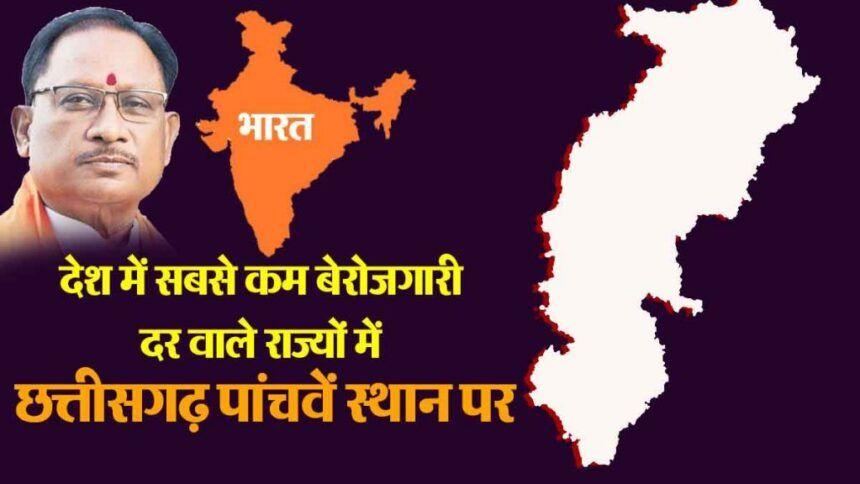
Raipur : The state of Chhattisgarh has achieved a significant achievement across the country in terms of employment generation. According to the recently released Periodic Labour Force Survey (PLFS) report, Chhattisgarh has ranked fifth among the states with the lowest unemployment rate in the country. Due to the ongoing employment generation and development efforts in the state, Chhattisgarh has now surpassed even big states like Uttar Pradesh, which shows the great success of the state in terms of unemployment rate. It is worth noting that the sample survey and data collection for PLFS is done by the National Sample Survey Organization (NSSO). Which comes under the Ministry of Statistics and Program Implementation of the Government of India.
Significant progress of Chhattisgarh in employment generation
Under the leadership of Chief Minister Vishnu Deo Sai, the Chhattisgarh government has taken several concrete steps to reduce unemployment and provide employment opportunities to the youth. The government has recently approved the recruitment of 1,068 posts in the Police, Health, PHE (Public Health Engineering) and Panchayat departments. These recruitments will provide opportunities for government jobs to the youth in the state, which will also help in effectively implementing various schemes of the state at the ground level. Chief Minister Sai has emphasized that this initiative will give new flight to the dreams of the youth along with accelerating the development of the state.
The Chhattisgarh government has focused on creating employment opportunities especially in rural and tribal areas. The government has implemented many schemes to encourage self-employment and skill development, so that the youth of the village get an opportunity to work in their own area and they do not have to migrate to the metros.
Status of other states in PLFS report
The report of Periodic Labour Force Survey (PLFS)* has also revealed the unemployment figures in various states across the country. According to this report, the unemployment rate was highest in Kerala, where the unemployment rate was recorded at 29.9% among youth in the age group of 15-29 years. The unemployment rate among women in Kerala was 47.1% and among men was 19.3%. In addition, Lakshadweep recorded the highest unemployment rate of 36.2%, followed by Andaman and Nicobar Islands at 33.6%. In contrast, Chhattisgarh has ranked fifth among the states with the lowest unemployment rate in the country, which is a symbol of the success of the state government’s employment generation policies.
Emphasis on education and skill development
The Chhattisgarh government has considered education and skill development as important pillars of employment generation. Chief Minister Vishnu Deo Sai has directed the officials to make special efforts to provide technical and vocational skills to the youth, so that they can be prepared to work in new industries. Many skill development centers have been opened in the state, where the youth are being taught modern techniques and skills, so that they can take advantage of new employment opportunities.
Development of Chhattisgarh and Prime Minister Modi’s vision
The state of Chhattisgarh, which is already famous for its natural resources and cultural heritage, is now joining the country’s leading states in the field of employment generation and development. The steps taken by the state government are also realizing the vision of Prime Minister Narendra Modi of ‘Atmanirbhar Bharat’. Through employment generation at the local level, the government has taken steps towards taking the economic and social development of the state to new heights.
Just as Prime Minister Modi has set the goal of providing development and employment opportunities in every corner of the country, the Chhattisgarh government is moving rapidly in the same direction. Chief Minister Vishnu Deo Sai has pledged to expand employment generation schemes in every village of the state in this direction, so that every youth of the state can become self-reliant and the state can develop rapidly.